Summarise this article using AI





Webflow is not HIPAA compliant. It doesn't sign business associate agreements on any plan, Enterprise included, and its Terms of Service tell you in plain words not to collect protected health information on the platform. You can still run a healthcare website on Webflow, and plenty of clinics and health-tech companies do, as long as patient data never touches it.
We design and build health-platform sites on Webflow as a Certified Webflow Partner, so the boundary drawn below is the one we draw in scoping calls, not a summary of other people's blog posts.
What you'll get that the current page-one answers don't: a page-by-page map of where PHI gets created on a healthcare site, the three-layer architecture that keeps Webflow on the right side of it, a priced list of form and scheduling tools that do sign BAAs, the analytics rules after the 2024 court ruling most guides still haven't caught up with, and the accessibility deadline with an actual date on it.
Is Webflow HIPAA compliant? No, and Webflow says so in writing
No. Webflow does not offer HIPAA compliant services, does not sign a business associate agreement, and its Terms of Service (section 3.6, "HIPAA Non-Compliance") require you not to provide, or let your visitors provide, protected health information through the platform. That has been the position since the current terms took effect in November 2023, and nothing in the 2026 plan changes touched it.
Three Webflow-authored sources say the same thing, which matters because most of the pages ranking for this question cite each other rather than Webflow:
- The Terms of Service ask you, in a plain-English aside, not to collect PHI "as Webflow does not offer HIPAA compliant services at the present time".
- The security page FAQ states that Webflow "is not HIPAA compliant by default and is not designed to store or process protected health information".
- The HIPAAtizer app listing on Webflow's own marketplace says the platform "cannot process any protected health information on your behalf" and places all HIPAA liability between you and the form vendor.
Enterprise doesn't buy you out of this. The Enterprise tier adds SSO, SCIM, custom roles and a 99.99% uptime SLA, but no BAA; dpa-atlas's vendor record for Webflow, updated May 2026, reaches the same conclusion for every plan.
A point of precision before going further. No platform is "HIPAA compliant" on its own. Compliance is a property of how a covered entity deploys its tools, and the signed BAA is what makes a vendor part of that deployment. Jotform, AWS and Google Workspace all sign BAAs under the right plans. Webflow doesn't. So the useful question isn't "is Webflow compliant" but "can my Webflow site be built so that HIPAA never applies to it". The answer to that one is yes, and the rest of this guide is how.
- No BAA on any plan
- Terms of Service 3.6 bans PHI
- Public pages only
Who HIPAA actually binds on a website (and when it's the FTC instead)
HIPAA applies to covered entities (providers that bill electronically, health plans, clearinghouses) and to their business associates, meaning any vendor that creates, receives, stores or transmits PHI on their behalf. PHI is individually identifiable health information: a name or email address plus anything about a person's condition, care or payment. A contact form that asks for "reason for visit" next to an email field creates PHI the moment a patient submits it.
HHS is explicit that a cloud vendor storing or processing electronic PHI is a business associate and needs a BAA, even when the vendor only holds encrypted data it can't read (HHS FAQ 2075). That rule is what makes Webflow's position decisive. If PHI lands in a Webflow form submission, Webflow has become an unsigned business associate, and the covered entity, not Webflow, is the party OCR investigates.
Then there's the group most "is Webflow HIPAA compliant" posts skip entirely: health-tech companies that aren't covered entities at all. A symptom-tracking app. A direct-to-consumer telehealth brand that never bills insurance. A wellness marketplace. HIPAA often doesn't reach them, and the FTC's Health Breach Notification Rule does. The rule was amended in 2024 (effective July 29, 2024) to cover health apps and similar platforms, and it treats an unauthorised disclosure, including one made through an advertising pixel, as a breach that must be reported (FTC).
The FTC had already shown its hand before the amendment. GoodRx paid $1.5 million in February 2023 for sharing health information with Facebook and Google through tracking pixels, and BetterHelp paid $7.8 million a month later for sending intake-questionnaire answers to Facebook, Snapchat, Criteo and Pinterest.
So the boundary advice in this guide applies whether or not you're technically a covered entity. The regulator changes. The mistake doesn't.
The PHI boundary map: what can live on Webflow and what can't
Anything a visitor can read without identifying themselves is fine on Webflow. Anything a visitor types, uploads or is identified by, combined with any hint about their health, is not. That single test sorts almost every page on a healthcare site, and the table shows how it plays out feature by feature.
We do this mapping in the first week of every healthcare project because clients are usually surprised by where PHI hides. It's rarely the obvious intake form. It's the "which service are you interested in" dropdown on the general contact form, the condition-specific landing page feeding a newsletter list, the careers form that asks about accommodation needs.
| Page or feature | Creates PHI? | OK on Webflow? | Where it lives instead |
|---|---|---|---|
| Service and condition pages, provider bios, locations, hours, pricing, patient education | No | Yes | Webflow CMS |
| Careers, press, about, investor pages | No (keep health and accommodation questions off the careers form) | Yes | Webflow CMS |
| Newsletter sign-up, email only, no condition-based segmentation | Generally no | Yes, with a compliant email tool behind it | An email vendor that signs a BAA if lists are ever segmented by condition (Paubox Marketing) |
| General contact form with name, email and a free-text message | Yes, the moment the message mentions symptoms or a visit | Not for patient contact | A form vendor with a BAA, or restrict the form to vendor and press enquiries with a visible notice |
| "Request an appointment", "reason for visit", insurance fields | Yes | Never | Scheduling or intake vendor with a BAA (NexHealth, IntakeQ, Healthie, Jane) |
| Symptom checker, quiz, eligibility screener | Yes | Never | A vendor app under a BAA, or a custom app on HIPAA hosting |
| File upload (referrals, insurance cards, records) | Yes | Never | Form vendor with a BAA and encrypted storage |
| Live chat or chatbot on patient-facing pages | Yes, as soon as a patient types | Never with a generic chat widget | Klara, Paubox, or another chat vendor that signs a BAA |
| Patient portal, telehealth, payments that show statements | Yes | Never | EHR portal (Epic MyChart, athenahealth), telehealth vendor (Doxy.me, Zoom for Healthcare) |
| Condition-specific landing pages with retargeting pixels | Possibly (see the analytics section) | Pages yes, pixels no | Aggregate, cookieless analytics only |
Two habits leak PHI into Webflow even when the form itself is compliant. Webflow's native forms send every submission as ordinary email to whoever is on the notification list and keep a copy of every field in the site's form submissions panel. Both leaks close when the form posts directly to the vendor and never to Webflow's form handler. Staging sites are the version of this we check first: a cloned project with a working form on a webflow.io subdomain is the same exposure on a different domain, and unnus makes a similar point in its analysis of hidden PHI paths through cloned pages and notification emails.
- Service pagesAnyone can read it without saying who they are.
- Provider biosCredentials and conditions treated are not patient data.
- Locations and hoursStructured data, no visitor input.
- Newsletter signupFine while lists are never segmented by condition.
- Contact formOne message about symptoms or a visit makes it PHI.
- Book an appointmentName plus a reason for visit is patient data.
- Upload insurance cardFiles with records or insurance are PHI.
- Live chatA patient describing a symptom is PHI.
- Symptom checkerAnswers about health, stored or not, are PHI.
- Patient portalAnything behind a patient login. Never Webflow.
The three-layer architecture that passes an audit
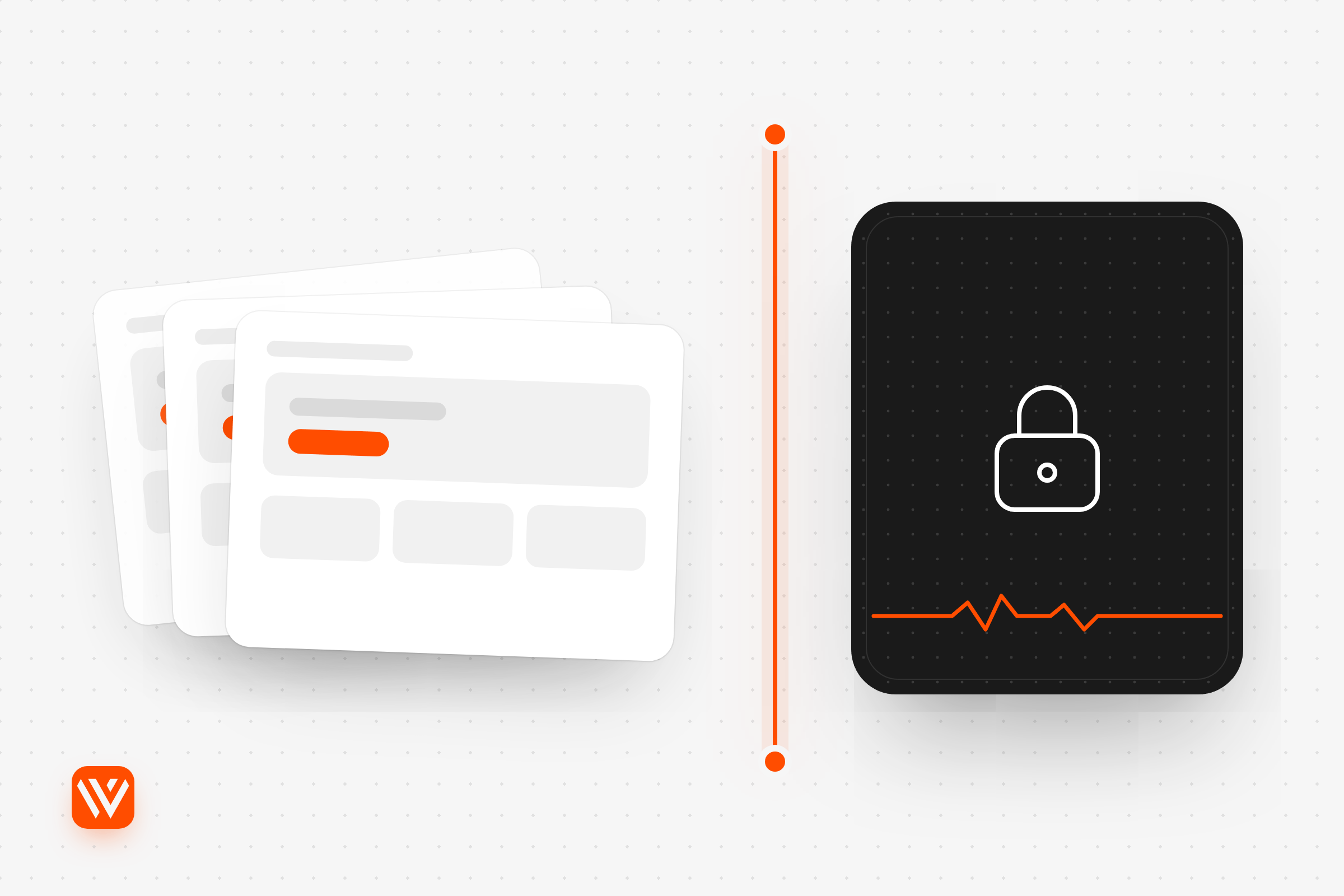
Build the site as three layers with one-way traffic. A Webflow layer holds every public page and collects nothing about patients. A BAA layer of vendors that sign agreements handles every form, booking, upload and conversation. A clinical layer (EHR, portal, telehealth) receives what the BAA layer collects. Patient data enters at layer two and never flows back to layer one.
In practice: a visitor lands on a Webflow service page, clicks "Book an appointment", and the form or scheduler that opens is a widget or iframe served by the vendor. The submission posts from the visitor's browser to the vendor's servers. Webflow's form handler never sees it. No Zapier run copies it into a CMS collection, and no Slack notification pastes it into a channel.
Four rules keep the layers honest:
- The form action is the vendor's endpoint, always. Embedding a vendor's HTML form that still posts to Webflow defeats the point.
- Nothing syncs back. Automations from the BAA layer into Webflow (a "new patients this month" number in the CMS, a thank-you page that repeats what was typed) are where we see teams undo their own compliance. If you need automation across health apps, Keragon exists for exactly this and signs BAAs.
- No PHI in Webflow's side channels: form notification emails, form submission storage, Designer comments, CMS drafts, staging sites, backups. Turn Webflow's native form off on patient-facing pages rather than hoping nobody uses it.
- The Webflow layer is treated as public. Every page, every CMS item, every asset URL. If something would be a problem when the URL leaks, it isn't a Webflow asset.
This is the split we draw for health-platform clients, and the conversation with their compliance lead gets short once the diagram is on the table. Webflow is the brochure, the vendors are the front desk, the EHR is the clinic. Nobody expects the brochure to sign a BAA.
HIPAA compliant forms, scheduling and chat that embed in Webflow (with 2026 prices)
The cheapest compliant form stack on a Webflow site is HIPAAtizer at $29 a month billed yearly ($34 monthly), with a BAA, audit logs and e-signatures included and a native Webflow app (HIPAAtizer pricing). Jotform's Gold plan at $99 a month yearly or $129 monthly (Jotform HIPAA) and Formstack Forms from $83 a month plus a HIPAA add-on (Formstack pricing) are the usual alternatives when a practice already lives in those tools. Scheduling and intake come from vendors built for clinics, and they embed as widgets.
| Tool | Job on the site | Signs a BAA | Price (Aug 2026) | How it goes into Webflow |
|---|---|---|---|---|
| HIPAAtizer | Forms, intake packets, e-signatures, payments | Yes, included | $29/mo yearly or $34 monthly (Gold); $39/$45 Gold Plus | Webflow marketplace app or embed code |
| Jotform Gold | Forms, uploads, e-signatures | Yes, on Gold and Enterprise only | $99/mo yearly or $129 monthly | Embed or iframe |
| Formstack Forms | Forms, workflows, documents | Yes, as a paid add-on (included on Enterprise) | From $83/mo yearly plus the HIPAA add-on | Embed |
| Paubox | HIPAA email, encrypted form-to-email, marketing email | Yes | Quote-based | Form embed; email stays inside Paubox |
| NexHealth, IntakeQ, Healthie, Jane | Online booking, intake, reminders, telehealth | Yes | Quote or per-provider pricing | Booking widget, or a hosted page linked from the CTA |
| Klara | Patient messaging and web chat | Yes | Quote-based | Chat widget |
| Keragon | Automation between health apps (the Zapier you're allowed to use) | Yes | Quote-based | No front end; connects the vendor layer to the EHR |
Prices are from each vendor's pricing page on 23 August 2026; the quote-based tools don't publish list prices, so ask for the BAA in writing before the demo, not after.
Two warnings from projects. HubSpot's standard plans aren't covered by a BAA (its sensitive-data handling is a higher-tier feature), so a Webflow and HubSpot setup is right for a B2B health-tech company selling to hospitals and wrong for a clinic collecting patient enquiries. And Zapier and Make sit outside any BAA; if PHI passes through them you've added an unsigned business associate. Our Webflow integrations page lists what we wire and what we decline to.
Can you use Google Analytics and Meta Pixel on a healthcare website? The rules after AHA v. Becerra
Yes, with limits, and the limits moved in 2024. A federal court vacated the part of HHS's tracking guidance that treated an IP address plus a visit to a public page about a health condition as PHI, so analytics on unauthenticated informational pages is no longer the automatic violation it was presented as. Trackers on pages where a patient logs in, books or types about their health are still a problem, and the FTC polices the same behaviour for companies HIPAA doesn't cover.
The short history, because most guides stop at step two:
- December 2022: HHS's Office for Civil Rights publishes a bulletin saying tracking technologies on covered entities' sites can disclose PHI, including on unauthenticated pages.
- March 18, 2024: OCR revises the bulletin but keeps the core claim.
- June 20, 2024: in American Hospital Association v. Becerra, the Northern District of Texas vacates the "proscribed combination" rule, the part that made an IP address plus a condition-page visit into PHI (Holland & Knight's analysis).
- August 29, 2024: HHS drops its appeal (AHA). The rest of the guidance still stands, including everything about authenticated pages and pages where users enter health information.
What that leaves you with on a Webflow health site:
| Tracker | Public service and condition pages | Pages with booking, intake or chat | Authenticated or post-submission pages |
|---|---|---|---|
| Webflow Analyze (cookieless, no session replay, data stays in Webflow) | Yes | Yes; it doesn't read form fields | Not applicable, those pages aren't on Webflow |
| Google Analytics 4 | Yes, behind consent, with IP handling documented | Avoid; at minimum no form-field or URL-parameter capture | No |
| Google Ads tag and Meta Pixel (conversion, retargeting) | Risky; never on pages that imply a condition | No | No |
| Hotjar, Microsoft Clarity and other session replay | No, on any page a patient might type on | No | No |
| Consent management (OneTrust, TrustArc, Cookiebot) | Yes, and it's how you document the rest | Yes | n/a |
Webflow Analyze gets a clean column because of Webflow's own description of it: cookieless, no session replay, data not shared with third-party ecosystems, with OneTrust and TrustArc integrations for consent (Webflow Analyze). That's worth knowing because at least one compliance vendor's Webflow page claims the platform's built-in analytics collect session recordings, which isn't what Webflow ships.
The pixel advice isn't caution for its own sake. GoodRx and BetterHelp were pixel cases. Both sent health-adjacent data to ad platforms from pages that looked like ordinary marketing, and the FTC treated it as a breach. A retargeting audience named "visited the fertility page" is the same fact pattern.
Our default on healthcare builds: Webflow Analyze or a server-side, aggregated setup for behaviour; GA4 only behind a consent platform and only on the public layer; no Meta Pixel on condition pages; no session replay anywhere; and a written inventory of every script per page template. That inventory is what an OCR risk analysis asks for, and risk-analysis failures featured in 76% of the investigations OCR settled in 2025 (HIPAA Journal).
- Webflow Analyze, cookieless
- GA4 behind consent
- Aggregated, server-side
- Meta Pixel on condition pages
- Session replay where patients type
- Any tag on booking or login pages
Accessibility is now a dated obligation: WCAG 2.1 AA by May 2027
Healthcare providers that receive HHS funding and have 15 or more employees must bring their websites and mobile apps to WCAG 2.1 Level AA by May 11, 2027. Smaller recipients have until May 10, 2028. The deadlines come from HHS's Section 504 rule of May 2024 and a May 2026 interim final rule that pushed them back by a year (Federal Register, May 11, 2026).
That makes accessibility the one healthcare web requirement with a date on it. And it's the one none of the pages ranking for Webflow-and-HIPAA mention.
The scale of the problem: WebAIM's 2026 survey of the top million home pages found detectable WCAG failures on 95.9% of them, averaging 56.1 errors per page, with health and fitness sites averaging 54.4 (WebAIM Million 2026). Low-contrast text (83.9% of pages), missing alt text (53.1%) and unlabelled form fields (51%) lead the list, and all three are design decisions rather than code problems. On the other side of the screen, the CDC puts US adults with a disability at 28.7%, more than one in four (CDC, July 2024).
| Who | Standard | Deadline |
|---|---|---|
| HHS-funded providers with 15 or more employees | WCAG 2.1 AA for websites and mobile apps | May 11, 2027 |
| HHS-funded providers with fewer than 15 employees | WCAG 2.1 AA for websites and mobile apps | May 10, 2028 |
Private providers outside HHS funding still face ADA lawsuits, which don't wait for a rule.
Webflow is a good place to meet the standard and an easy place to miss it. The platform ships semantic HTML, an audit panel in the Designer that flags missing alt text and heading-order problems, and alt fields on every image and CMS image field. None of that helps if the brand palette is light grey on white or the booking widget from the vendor layer is a keyboard trap. We test the embedded vendor widgets as part of the site, because the patient doesn't know where Webflow ends. Our Webflow WCAG 2.2 checklist walks through the build-side items; 2.2 AA goes beyond the 2.1 AA the rule asks for, so you clear the legal line with room.
Designing the pages patients actually trust
Design a healthcare site for the patient who arrives from an AI answer or a Google result already holding an opinion, and who will leave over a 3.9-star rating. rater8's June 2026 Patient Choice Report found that among people who searched for a doctor in the past year, AI tools such as ChatGPT and Claude influenced 36%, slightly ahead of Google search at 34% and physician referrals at 32%; 75% won't book a provider rated below 4.0 stars, and 66% say a provider's replies to reviews affect their trust (rater8, 2026).
Two design consequences follow, and neither is about colour palettes.
First, your site has to be the source of truth that AI answers and map listings are read against. rater8 found 66% of patients who used AI hit incorrect provider information, and 60% trusted the summary without checking. If your provider pages don't state the same name, credentials, specialties, insurance accepted, address and hours that appear on your Google Business Profile and your EHR's directory, the engines average the inconsistencies and patients act on the average. In Webflow that means one CMS collection for providers with a structured field for every attribute, Physician and MedicalClinic schema generated from those fields, and one locations collection feeding every map, footer and hours block. We wrote up how Webflow handles AI-search visibility separately; the short version is that the CMS makes this consistency cheap if you design the collections first.
Second, the provider page is the conversion page, not the homepage. The anatomy we build to for healthcare clients:
- Photo, name, credentials and a one-line "treats" statement above the fold, written as a condition list rather than a specialty taxonomy.
- Insurance accepted, rendered from a CMS multi-reference so it's identical on every page that mentions it.
- Reviews pulled from a platform that handles them compliantly, shown with the provider's responses. Responding is now a trust signal with a number attached to it.
- One booking call to action that opens the BAA-layer scheduler, repeated at the end of the page. Never a Webflow form.
- Location, hours, parking and telehealth availability as structured data, not a paragraph.
- Plain-language patient copy; clinical depth lives on the condition pages and is linked, not inlined.
Speed is part of trust too, and it's where Webflow earns its place. Our rebuild of Futurense took PageSpeed from 39 to 92 and GoFIGR's from 52 to 88, and the discipline behind those numbers (no third-party script bloat, which on a health site doubles as a compliance control) applies unchanged to a clinic. Run your current site through our free AI Design Scorer to see where it stands before you plan a redesign.
- 1Photo and credentials
- 2Conditions treated, plainly
- 3Insurance accepted
- 4Reviews with replies, 4.0+
- 5Booking via a BAA vendor
- 6Location and hours as data
Security and governance on Webflow: what's true in 2026 and what's stale
Webflow's hosting is well-secured for what it's allowed to hold: SOC 2 Type II, ISO 27001, 27017, 27018 and 42001 certifications, TLS 1.2 or higher on every site, encryption at rest, HSTS on by default, two-factor authentication, and AWS infrastructure behind a CDN with DDoS protection (Webflow security, Webflow Trust Center). None of that is HIPAA compliance, and a SOC 2 report is not a BAA. But it does mean several claims still circulating about Webflow are out of date.
| Claim you'll read | Status in 2026 | Where to check |
|---|---|---|
| "Webflow doesn't encrypt data at rest" | Stale. Webflow states data is encrypted at rest and in transit with TLS 1.2 or higher | webflow.com/security |
| "Webflow has no audit logs" | Partly stale. The Team plan (May 2026) includes a site activity log and API; Enterprise adds an audit log API for SIEM export | webflow.com/pricing, Webflow help centre |
| "Webflow has no role-based access" | Stale for Enterprise (custom roles, SSO, SCIM); still limited on self-serve plans | webflow.com/enterprise |
| "Webflow Enterprise is HIPAA compliant" | False. No BAA on any plan | webflow.com/legal/terms, dpa-atlas |
| "Webflow's analytics record user sessions" | False for Webflow Analyze, which is cookieless with no session replay | webflow.com/analyze |
Governance is the part that matters for a hospital's web team. Who can publish a page that states a visiting policy or a dosage? On a Team plan ($2,500 a month, billed annually) you get publishing workflows, single-page publishing and the activity log; Enterprise adds SSO, SCIM provisioning, custom roles, custom security headers and the 99.99% SLA (Webflow pricing, Webflow Enterprise). For a multi-site health system we'd put that in the budget. For a three-clinic group it's more control than the risk justifies, and the money is better spent on the vendor layer.
One forward-looking item. HHS's proposed overhaul of the HIPAA Security Rule (published January 2025) would make MFA, encryption, asset inventories and vulnerability testing mandatory rather than "addressable". Final action has slipped to July 2027 on the Fall 2026 regulatory agenda (Clark Hill), but your BAA-layer vendors will be asked for those controls by then, and your vendor inventory is the first document an auditor wants. HIPAA Journal's tally of 2025's reported breaches attributes 35.8% of them to business associates rather than to providers themselves (HIPAA Journal), so choosing those vendors is most of the security work on a healthcare website.
When Webflow is the wrong tool for a healthcare project
Webflow is the wrong tool for anything a patient logs into. Portals, telehealth, intake applications, symptom checkers with stored results, payment pages that display statements: these need a platform that signs a BAA and an application stack built for PHI, and no amount of embedding makes Webflow that platform.
| Project | Webflow fit | Build it on |
|---|---|---|
| Marketing site, locations, provider directory, education content | Strong | Webflow |
| Appointment requests, intake, uploads | Only as an embedded vendor widget | HIPAAtizer, Jotform Gold, NexHealth, IntakeQ, Healthie |
| Patient portal, records, secure messaging | None | EHR portal (Epic MyChart, athenahealth) or a custom app on AWS, Azure or Aptible under a BAA |
| Telehealth | None | Doxy.me, Zoom for Healthcare, Healthie |
| Health-tech product app (the product, not its marketing) | None | Your application stack, with Webflow for the marketing site only |
Two approaches you'll find recommended that we push back on. "Export the Webflow code and host it on HIPAA-compliant AWS" sounds tidy and loses the CMS, the forms, the Editor and every reason you chose Webflow; a static export is fine for a five-page brochure and unworkable for a 200-page hospital site. And "Webflow Enterprise plus strict internal policies" is a policy pretending to be a control. The Terms of Service still apply, and the BAA still doesn't exist.
The pattern that works is boring: Webflow for the public site, a subdomain (app.clinic.com or portal.clinic.com) for everything behind a login, and a design system shared between the two so the patient experiences one brand. We build the marketing half of that pairing for health platforms, and it's the split we recommend in the first call rather than after the compliance review.
The Webyansh pre-launch checklist for a healthcare Webflow site
Run this before the first publish and again before every major release. It's the list we use, and it's short because each item is a real control rather than a reminder.
- Every form on the site either posts to a BAA-signing vendor or collects nothing about health, and says so next to the field.
- Webflow's native form handler is unused on every patient-facing page, and form notification emails are off.
- No PHI in CMS items, drafts, comments, assets, backups or staging sites; staging has no working forms.
- A script inventory per page template: every tag, pixel and widget listed with its purpose and its BAA status.
- No Meta Pixel, Google Ads tag or session replay on condition, service or booking pages; the consent platform loads before any analytics fires.
- Provider and location data come from one CMS collection each and match the Google Business Profile and the EHR directory exactly.
- Physician, MedicalClinic and FAQPage schema generated from CMS fields and validated.
- WCAG 2.1 AA audit passed on every template and on the embedded vendor widgets; contrast, alt text and form labels checked by a person, not only a scanner.
- Privacy policy and notice of privacy practices linked in the footer, with the analytics and form vendors named in the privacy policy.
- Two-factor authentication on every Webflow seat, publishing rights limited to named people, activity log reviewed monthly.
- Vendor BAAs filed with renewal dates for every tool in layer two.
- MFA and encryption confirmed with each vendor ahead of the Security Rule's July 2027 target.
If a proposal you're evaluating doesn't mention items 1 to 5, the agency hasn't built for healthcare before. Our healthcare industry page shows how we scope these builds, and we'll review an existing site against this list before you commit to a rebuild.
Is Webflow HIPAA compliant?
No. Webflow doesn’t sign business associate agreements on any plan, including Enterprise, and its Terms of Service (section 3.6) require you not to collect protected health information through the platform. You can still build a healthcare marketing site on Webflow if every form, booking and chat that touches patient data runs through a vendor that signs a BAA.
Does Webflow sign a BAA?
No. As of August 2026 Webflow doesn’t offer a business associate agreement on self-serve, Team or Enterprise plans, and its security page says the platform isn’t designed to store or process PHI. Vendors that do sign BAAs, such as HIPAAtizer, Jotform on its Gold plan and NexHealth, can be embedded in a Webflow site instead.
Can I use Webflow forms for patient intake?
No. Webflow’s native forms store submissions in your site settings and send them to your team as ordinary email, and no BAA covers any of it. Use a form vendor that signs a BAA, such as HIPAAtizer from $29 a month or Jotform Gold from $99 a month, embedded so that submissions post directly to the vendor.
Which website builder is HIPAA compliant?
None of the mainstream builders sign a BAA by default. Webflow, Squarespace and WordPress.com don’t, and Wix only under a specific PHI-protection setup. HIPAA compliance comes from the architecture rather than the builder: keep the public site on Webflow and route every patient form, booking and message through a vendor that signs a BAA.
Can I use Google Analytics on a healthcare website?
Yes, with limits. Since the June 2024 AHA v. Becerra ruling, analytics on public, unauthenticated pages isn’t automatically a HIPAA violation, but trackers on booking, intake or logged-in pages still are. Run GA4 behind a consent platform on informational pages only, keep advertising pixels away from anything condition-specific, and consider Webflow Analyze, which is cookieless with no session replay.