Summarise this article using AI


AI search visibility for B2B SaaS is concentrated and follows authority. In our October 2026 sample of 146 B2B software companies, 17.8% had no AI citations at all, the bottom half shared 0.6% of all citations, and Domain Rating predicted citations far better than team size. Almost nobody blocks AI crawlers. Shortlists are built from "best X" pages.
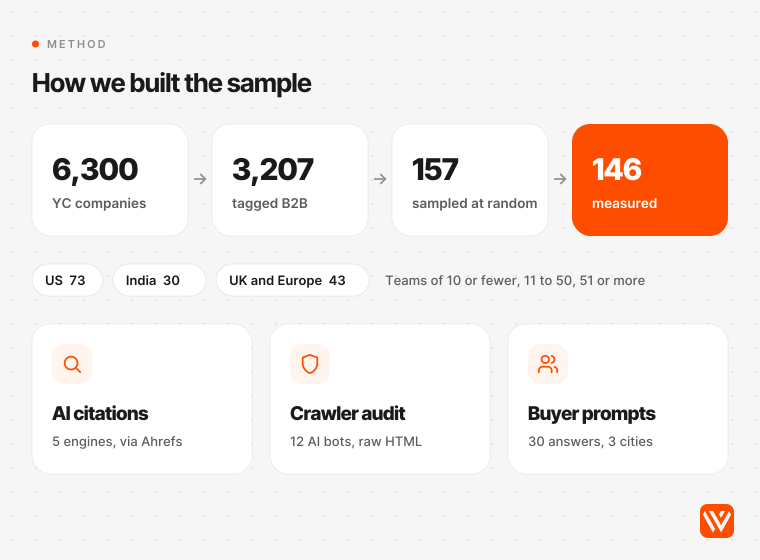
We build Webflow sites and run AI-search work for B2B SaaS companies, so we wanted numbers we could defend rather than numbers we could repeat. On 15 October 2026 we drew a random sample of B2B companies from Y Combinator's public directory, pulled their AI citations on five engines from Ahrefs, audited how their sites treat AI crawlers, and asked Claude 30 buyer questions from San Francisco, London and Bengaluru. Below: the method, eight findings, how the US, UK and India compare, and what to do at each stage.
Key takeaways
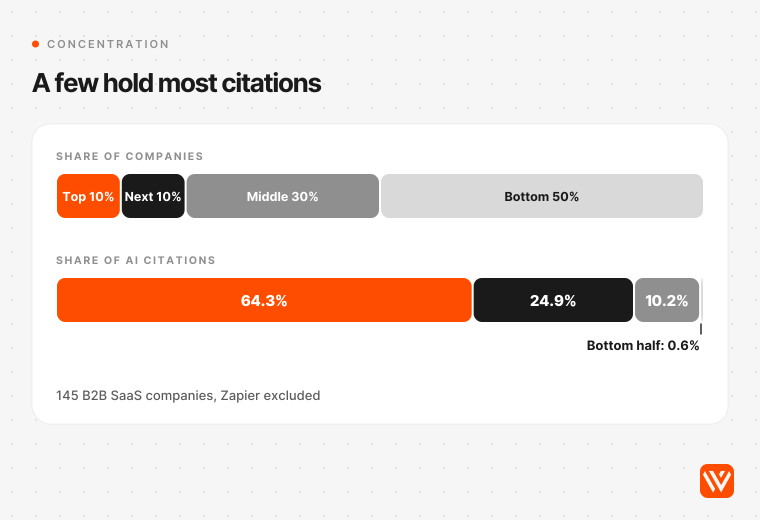
- Visibility is a long tail with a fat head. Leaving out Zapier, which alone held 68.9% of the sample's citations, the top 10% of companies still held 64.3% of AI citations. The bottom half held 0.59%.
- Authority beats size. Domain Rating had a 0.77 rank correlation with AI citations. Every company at DR 60 or above was cited somewhere; 85% of companies under DR 20 were cited nowhere.
- Crawler blocking is a non-issue. One site in 146 (0.7%) blocked an AI search bot in robots.txt. The bigger technical gap was JavaScript: 9.6% of homepages showed under 100 words without it, and those sites had a median of 0.5 citations.
- Shortlists come from listicles. When we asked Claude which CRM, help desk or SOC 2 tool a 50-person B2B software company should buy, 94.4% of the 288 pages it cited were "best X" or comparison pages, and 64.2% sat on software vendors' own sites. G2 got 2.1%. Reddit got none.
- Market matters less than authority. Indian companies in our sample had a lower median, but among companies at DR 40 or above they had the highest median of the three regions. Claude gave the same first pick in all three locations for 6 of 10 categories.
How we measured AI search visibility
We measured AI search visibility three ways on the same random sample: how often AI engines cite each company's website, whether its site lets AI crawlers read it, and which pages an AI assistant cites when a buyer asks for a shortlist. Everything was collected on 15 October 2026 with scripts we can rerun.
The sample. Y Combinator publishes a directory of every company it has funded. We took the 3,207 companies tagged B2B, kept those marked Active or Public with a working website, and grouped them by headquarters (United States, India, United Kingdom and Europe) and team size (10 or fewer, 11 to 50, 51 or more). Then we drew a fixed-seed random sample from each group: 75 US companies, 37 Indian (every large Indian company in the pool) and 45 UK or European. Eleven sites failed to load or refused a plain request, which left 146.
| Group | Companies | Median Domain Rating | Note |
|---|---|---|---|
| United States | 73 | 54 | Largest pool: 1,714 eligible companies |
| United Kingdom and Europe | 43 | 55 | 241 eligible |
| India | 30 | 29 | Only 55 eligible, so every Indian size band is close to a census |
| Team of 10 or fewer | 49 | 27 | 26 of 49 from 2025 and 2026 batches |
| Team of 11 to 50 | 53 | 54 | |
| Team of 51 or more | 44 | 65.5 | Includes Zapier, Mixpanel, Checkr, Flexport |
AI citations. For each domain we pulled Ahrefs' AI citation counts (its site-explorer AI responses report) for ChatGPT, Google AI Overviews, Google AI Mode, Perplexity and Gemini, plus Ahrefs' all-platform total, and its Domain Rating (DR). A citation is a link to the company's site inside an AI answer in Ahrefs' tracked prompt sets. Those prompt sets differ in size per engine (272.5 million monthly prompts for AI Overviews against about 28.9 million for Perplexity, per Ahrefs), so we compare the share of companies each engine cites, not raw totals.
Crawler and page audit. A script fetched each robots.txt and checked the rules for 12 AI user agents, looked for /llms.txt, then requested the homepage as Chrome, GPTBot, ClaudeBot and PerplexityBot. It counted the words visible in the raw HTML (what a crawler that doesn't run JavaScript sees) and read the homepage's JSON-LD schema. It never ran JavaScript and never tried to get past a bot challenge.
Buyer prompts. We asked Claude (Sonnet 5.5, with web search) one question per category in 10 software categories, for example "We are a 50-person B2B software company. Which CRM should we use? Give me a shortlist of the best options with one line on why each." Each question ran three times, with the user location set to San Francisco, London and Bengaluru. We recorded the vendors named and every page cited.
Our own Search Console. We also read 91-day query exports from Webyansh's Google Search Console for two back-to-back windows, because something odd was showing up there (more in finding 7).
The limits are real, and we list them at the end. The short version: Ahrefs' data is a panel of prompts, not every conversation; YC companies lean towards venture-backed, developer-friendly businesses; and AI answers vary from run to run.
What is AI search visibility?
AI search visibility is how often AI answer engines (ChatGPT, Google AI Overviews and AI Mode, Perplexity, Gemini, Claude, Copilot) name your brand or cite your pages when people ask questions you could answer. It has three layers, and they don't move together:
- Mention: the answer names your company.
- Citation: the answer links to a page on your site as a source.
- Recommendation: the answer tells the reader to pick you.
This study measures citations, because they can be counted at scale and tied to a domain. Mentions and recommendations come up in finding 6, where we read the answers themselves. The distinction matters more than it sounds. In an August 2026 Reddit thread in r/aeo, a B2B SaaS marketer described tracked citations rising all year while ChatGPT referrals fell about 75%. One agency owner who replied put it plainly: being cited and being the named pick "are separate outcomes."
Finding 1: How visible are B2B SaaS companies in AI search?
Most B2B software companies in our sample are cited by AI engines, but very few are cited often. The median company had 42.5 citations across every platform Ahrefs tracks. 26 of 146 (17.8%) had none, and 56 (38.4%) had fewer than 10.
The total was 278,414 citations. Zapier alone had 191,936 of them (68.9%), which says more about Zapier (DR 91) than about B2B SaaS. So we also looked without it. Among the other 145 companies, the top 10% held 64.3% of citations, the top 20% held 89.2%, and the bottom half held 0.59%.
| Team size | Companies | No AI citations | Median citations | 100+ citations |
|---|---|---|---|---|
| 10 or fewer | 49 | 40.8% | 1 | 12.2% |
| 11 to 50 | 53 | 7.5% | 81 | 49.1% |
| 51 or more | 44 | 4.5% | 297.5 | 61.4% |
| All | 146 | 17.8% | 42.5 | 40.4% |
What this means for a seed-stage team: you start at roughly zero, and the curve is steep. A company with 10 people had a 41% chance of being cited nowhere. A company with 51 or more had a 4.5% chance. That gap is not about prompts or schema. It's about how much of the web already talks about you.
Finding 2: Does authority or company size predict AI visibility?
Domain Rating predicted AI citations better than anything else we measured. The Spearman rank correlation between DR and total citations was 0.773. Team size came in at 0.609, and the number of words in the homepage's raw HTML at 0.514.
| Domain Rating | Companies | No AI citations | Median citations | Cited by ChatGPT | Cited by Perplexity |
|---|---|---|---|---|---|
| 0 to 19 | 20 | 85.0% | 0 | 5.0% | 0% |
| 20 to 39 | 40 | 20.0% | 3 | 27.5% | 42.5% |
| 40 to 59 | 36 | 2.8% | 62 | 75.0% | 86.1% |
| 60 or more | 50 | 0% | 480 | 84.0% | 92.0% |
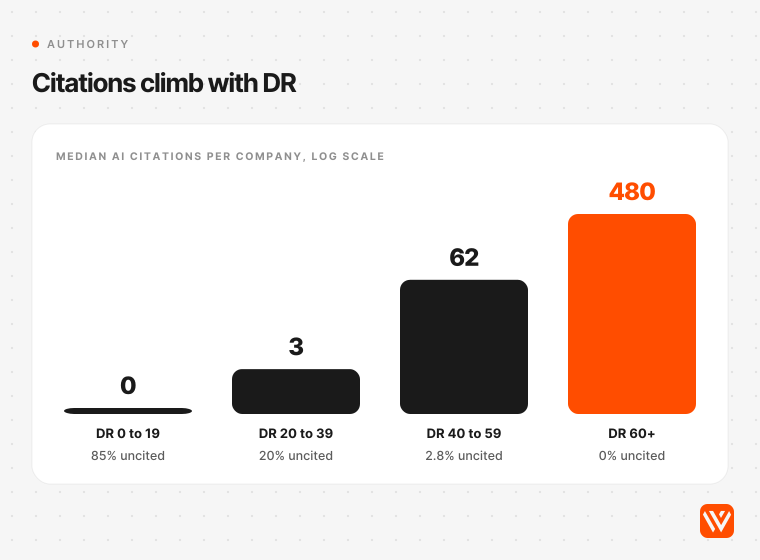
Read DR here as a proxy, not a lever. DR counts linking domains, and linking domains travel with everything else that makes a brand citable: press, reviews, comparison pages, integrations, community threads. Ahrefs found the same shape on a much bigger set. Across 75,000 brands, branded web mentions correlated with AI Overview visibility at 0.664, against 0.326 for DR (Ahrefs, May 2025). Our 0.773 is higher because our sample spans tiny startups to public companies, which stretches every brand signal at once.
The practical reading: there's a threshold around DR 40. Below it, most companies are invisible to ChatGPT (27.5% cited at DR 20 to 39). Above it, three in four are cited. Moving a site from DR 25 to DR 45 takes a long run of earned coverage, not a sprint, which is why we'd plan AI visibility as a brand and PR programme with a technical floor under it, not the other way round.
Finding 3: Which AI engines cite B2B SaaS companies most?
Perplexity cited the widest range of B2B SaaS companies in our sample: 64.4% had at least one Perplexity citation. ChatGPT and Google AI Mode each cited 55.5%, Gemini 53.4% and Google AI Overviews 52.1%.
| Engine | Companies with at least one citation | Citations in sample |
|---|---|---|
| Perplexity | 64.4% | 31,502 |
| ChatGPT | 55.5% | 5,300 |
| Google AI Mode | 55.5% | 14,734 |
| Gemini | 53.4% | 13,932 |
| Google AI Overviews | 52.1% | 12,946 |
The engines mostly agree on who exists. 64 companies (43.8%) were cited on all five, and 42 (28.8%) on none of the five. Only 16 (11.0%) were cited by exactly one engine, and eight of those were Perplexity-only. Twelve companies were cited by ChatGPT but not AI Overviews; seven the other way round.
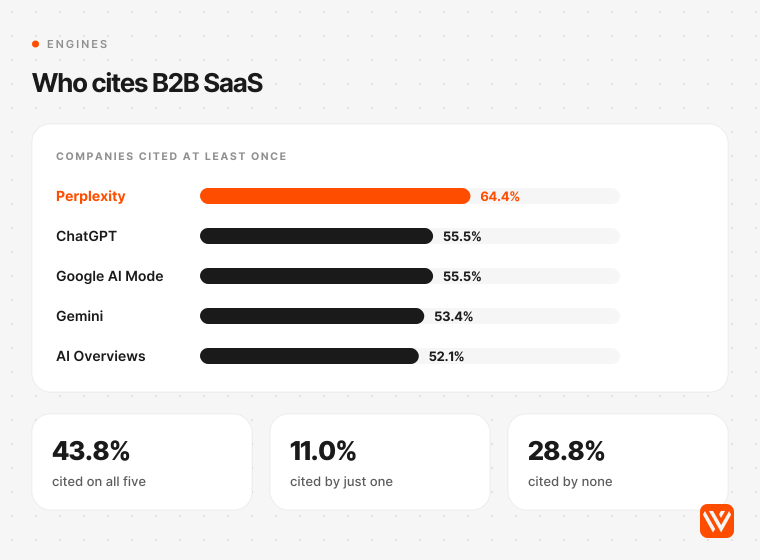
Two cautions. First, don't read the citation totals as market share: Ahrefs runs far more prompts through Google's AI features than through ChatGPT. Second, engine share of use is moving fast. Similarweb estimates ChatGPT's share of generative AI web traffic fell from about 76% in June 2025 to about 53% in May 2026, while Gemini rose from under 9% to 27 to 28% and Claude from about 2% to about 9%. Google says AI Mode passed 1 billion monthly active users (Alphabet Q2 2026 remarks, July 2026). A strategy built for one engine is a bet on that engine.
Perplexity's breadth fits how it works: it searches the web for its answers and lists several sources, so smaller companies with one decent page get picked up. ChatGPT cited fewer of the small companies: 22.4% of 10-person teams, against 30.6% on Perplexity.
Finding 4: Is AI search visibility different in the US, UK and India?
On raw numbers, yes. The median Indian company in our sample had 8.5 citations, against 34 for US companies and 81 for UK and European ones, and 30% of Indian companies had none (US 15.1%, UK and Europe 14.0%).
But the Indian group also had a median DR of 29, against 54 and 55. Hold authority roughly constant and the gap flips:
| Region | Median citations, DR under 40 | Median citations, DR 40 or more |
|---|---|---|
| United States | 1 (25 companies) | 137 (48) |
| United Kingdom and Europe | 3 (16) | 210 (27) |
| India | 1 (19) | 654 (11) |
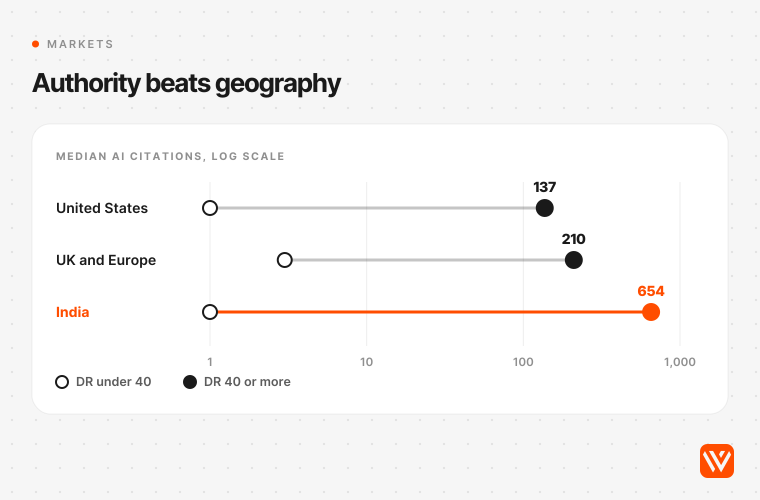
The India figure rests on 11 companies, three of which (SalaryBox, WareIQ and Decentro) have more than 2,000 citations each, so treat it as a direction, not a law. The direction is clear, though. An Indian SaaS company is not invisible to AI engines because it's Indian. It's invisible because, in this sample, it's younger and less linked.
What did change by location? Very little. When we asked Claude the same 10 buyer questions from San Francisco, London and Bengaluru, the first vendor it named was identical in all three places for 6 of 10 categories (CRM, project management, help desk, accounting, sales engagement, SOC 2 compliance). The top four overlapped by 3.5 of 4 on average between the US and India runs. Vendors founded in India (Zoho, Freshworks with Freshdesk and Freshsales, and Sprinto in SOC 2) showed up in the lists from all three locations, San Francisco and London included. The shortlists were close to identical, and the payroll list from Bengaluru was still led by US payroll tools (Gusto, Rippling).
That matters for Indian companies selling into the US and UK: the AI shortlist a US buyer sees is the same global list. There's no local lane to win first. It also matters for Indian buyers, because AI search use in India is large. Google calls India one of its "biggest markets" for AI Overviews (June 2025), and India is ChatGPT's second-largest market at 100 million weekly users, per Sam Altman as reported by TechCrunch (February 2026). In the UK, Ofcom counted 1.8 billion ChatGPT visits from January to August 2025, up from 368 million a year earlier, with AI Overviews on about 30% of searches.
Finding 5: Are B2B SaaS sites blocking AI crawlers?
Almost none are. 91.1% of the sites had a robots.txt, and a quarter (25.3%) named at least one AI crawler in it, but only 5.5% blocked any of the 11 AI agents we checked at the root. Just one site (0.7%) blocked a crawler that powers AI search answers.
| AI crawler (what it does) | Named in robots.txt | Blocked at root |
|---|---|---|
| GPTBot (OpenAI model training) | 22.6% | 1.4% |
| OAI-SearchBot (ChatGPT search results) | 19.2% | 0.7% |
| ClaudeBot (Anthropic model training) | 21.9% | 1.4% |
| PerplexityBot (Perplexity search results) | 22.6% | 0.7% |
| Google-Extended (Gemini training and grounding) | 19.9% | 1.4% |
| CCBot (Common Crawl) | 17.1% | 3.4% |
| Bytespider (ByteDance) | 11.6% | 4.8% |
At the server level, six sites (4.1%) returned a 403, a 429 or an error to at least one AI user agent while serving Chrome normally. One of them, SalaryBox, refused all three bots in our test and still had 3,066 AI citations, a reminder that engines also read search indexes and earlier crawls. Bot blocks can also depend on IP and rate, so a block we saw from one address may not be what OpenAI's crawler sees.

The useful distinction is between training bots and search bots. OpenAI's documentation says OAI-SearchBot "is used to surface websites in search results in ChatGPT's search features", while disallowing GPTBot only means "a site's content should not be used in training." Anthropic separates ClaudeBot (training) from Claude-SearchBot, and says blocking the search bot "may reduce your site's visibility and accuracy in user search results". Google says Google-Extended "does not impact a site's inclusion in Google Search". So a B2B SaaS company can block training and stay visible in AI search. Few in our sample bothered to make that choice either way, which is fine.
One thing worth checking even if your robots.txt is clean: your CDN. Cloudflare started blocking AI crawlers by default for new domains on 1 July 2025. If a site moved to Cloudflare after that date, someone should look at the bot settings.
Does JavaScript rendering hide B2B SaaS sites from AI?
It did in our sample. 14 homepages (9.6%) showed fewer than 100 words in their raw HTML, which means a crawler that doesn't run JavaScript sees an almost empty page. Those 14 sites had a median of 0.5 AI citations, against 52 for the rest. The gap held inside DR bands: 1 against 46.5 between DR 30 and 49, and 43 against 210 at DR 50 and above.
The mechanism is documented. Vercel and MERJ studied crawler traffic across Vercel's network and found that "none of the major AI crawlers currently render JavaScript" (December 2024): GPTBot and Claude's crawler fetch script files but don't execute them. A founder posting in r/B2BSaaS this month found their own homepage returned zero words to ChatGPT's crawler and fixed it by pre-rendering public pages at build time. One reply said assistants took three to six weeks to reflect the change.
The platform didn't decide this. Next.js was the most common stack in the sample (54 sites, 37%), followed by Webflow (29), Framer (14), Astro (12) and WordPress (11). Among sites at DR 40 or above, medians ranged from 138 (Astro) to 308 (Framer), with Webflow at 183, WordPress at 188 and Next.js at 250. With samples this small, none of those differences mean much. The thin homepages turned up on custom builds (9 of the 14), Next.js (3), Webflow (1) and Framer (1). Every one of those stacks can ship full HTML; what mattered was whether this particular page did. We cover the Webflow side in our JavaScript SEO guide for Webflow.
Does llms.txt improve AI search visibility?
There's no good evidence it does, but the B2B SaaS companies that have one are more visible. 46.6% of the sites in our sample served an llms.txt file, against 10.13% of the roughly 300,000 domains SE Ranking checked. Companies with one had a median of 128.5 citations; those without had 6.
That looks like a strong effect until you split it. Within DR 50 and above, the medians were 230 against 106.5. Within the 51-plus team size band, 1,401 against 104. The file shows up where developer documentation shows up, and docs platforms such as Mintlify now host an llms.txt automatically. So llms.txt in our data marks companies that publish a lot of structured, technical content. That content is what gets cited.
The controlled evidence points the same way. SE Ranking's model across 300,000 domains found no link between llms.txt and AI citations, and removing the variable made the model more accurate. Ahrefs' Louise Linehan concluded that for ChatGPT, Perplexity or AI Overviews, "an llms.txt file is largely decoration" (June 2026). Google's own guide says such files "will neither harm nor help your site's visibility or rankings in Google Search". The case for it comes from its author, Jeremy Howard of Answer.AI, who argued in 2024 that "site authors know best" which content an LLM should use, and from AI coding tools that do read it. Our view: add one if your docs platform makes it free. Don't expect it to move a citation count.
Structured data showed a similar pattern. 58.2% of homepages carried Organization, WebSite, SoftwareApplication or Product schema, and they had higher medians (109 against 5), but within DR 50 and above the difference nearly vanished (199 against 183). Google says there is "no special schema.org structured data that you need to add" for AI Overviews or AI Mode. Schema helps engines identify you; it doesn't make anyone talk about you. Our schema guide for Webflow covers the markup worth having anyway.
Finding 6: What do AI engines cite when buyers ask for a B2B software shortlist?
They cite listicles, and mostly listicles written by software vendors. Across 30 buyer answers from Claude, there were 288 citations on 78 domains, an average of 9.6 per answer. 272 of them (94.4%) pointed at "best X", "top X", "X vs Y", "alternatives" or comparison pages.
| Who published the cited page | Citations | Share |
|---|---|---|
| A software vendor (its own blog or comparison page) | 185 | 64.2% |
| An agency, consultant or personal blog | 54 | 18.8% |
| A publisher (TechRepublic, Newsweek, TechnologyAdvice and others) | 31 | 10.8% |
| A software directory or comparison site | 12 | 4.2% |
| G2 | 6 | 2.1% |
| Reddit, YouTube or LinkedIn | 0 | 0% |
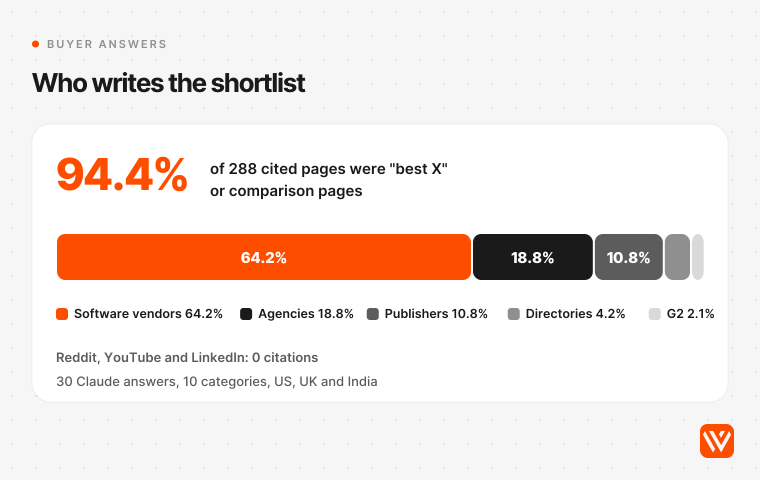
Typical examples: monday.com's "CRM for SaaS Companies: 15 Best Platforms in 2026", Last9's "Best Observability Tools in 2026: 8 Platforms Compared", HiBob's "20+ Best HRIS software [2026]" and DualEntry's "Best SaaS Accounting Software 2026". The single most-cited domain was SaaS Hero, a B2B SaaS marketing agency, with 20 citations across marketing automation and product analytics answers.
Two things follow. First, a vendor that publishes an honest comparison page for its category gets read by the engine that writes the shortlist, often in all three markets at once. Second, the shortlist itself still went to the incumbents. HubSpot appeared in 10 of the 30 top-five lists; 53 vendors filled all the top-five slots. Being cited and being chosen are, again, different things.
This is one engine and one run per question, and other engines source differently. Profound's analysis of about 680 million citations found Wikipedia (7.8%), Reddit (1.8%), Forbes and G2 (1.1% each) leading ChatGPT's citations and Reddit leading Perplexity's at 6.6% (2024 to 2025 data). Similarweb's US data for early 2026 put Wikipedia at 13.15% and Reddit at 11.97% of ChatGPT citations. For a pointed "which tool should we buy" question, though, our run says the comparison page is the unit that matters.
We also asked Claude the headline question of this article, "What is the state of AI search visibility for B2B SaaS companies in 2026?", from all three locations. It answered from agency and vendor compilations (data-mania.com was cited 10 times in the US answer alone) and repeated figures it couldn't reconcile, such as Reddit's share of ChatGPT citations, while warning that the numbers were "directional". The current answer to this topic is built on unsourced statistics. That's the gap this study is meant to fill.
Finding 7: Why do AI visibility numbers move from week to week?
Because AI answers are probabilistic, and some of what looks like demand isn't human. Rand Fishkin's research with Gumshoe ran 12 prompts 60 to 100 times each across ChatGPT, Claude and Google's AI features, and found the same brand list came back less than 1% of the time. His summary: "any tool that gives a 'ranking position in AI' is full of baloney" (Search Engine Journal, January 2026).
Practitioners split on what to do about it. Eli Schwartz, author of Product-Led SEO, warns that teams are "measuring prompts instead of measuring customers". "You don't know if any of those prompts are real," he adds. Graphite's Ethan Smith takes the other side: "You can measure AI with probability distributions". An agency owner in r/DigitalMarketing described the middle path many teams land on: their weekly screenshot reports felt "hard to defend because the results can change between checks", and the replies recommended a fixed prompt set reported as a monthly trend.
Our own Search Console shows the other half of the problem. In the 91 days to 13 October 2026, 576 of the 3,451 queries webyansh.com appeared for (16.7%) were 10 words or longer, up from 10.3% in the 91 days before. Those queries took 6.9% of impressions and earned zero clicks in either window. Many follow a template: "evaluate the digital marketing & crm consulting company webyansh on cost and timeline", or a persona prompt that opens "i'm a search manager at a large enterprise tasked with driving organic visibility" and then asks for platform recommendations.
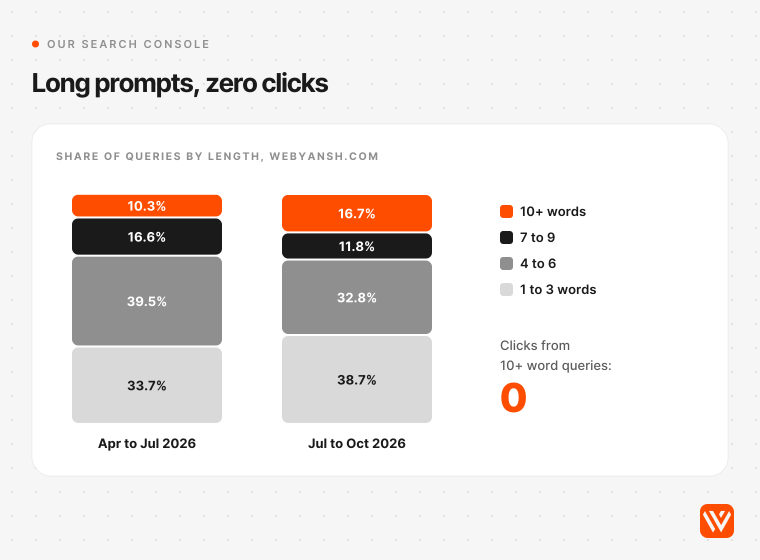
Our reading, and it is an inference: these look like scripted prompts from AI-visibility tools and AI search systems querying Google to ground their answers. They inflate impressions, they never click, and they make average position look better than it is. If your Search Console shows the same pattern, filter queries over 10 words out before you report organic performance.
Does AI search visibility turn into pipeline?
It shapes the shortlist more than it sends traffic. In G2's March 2026 survey of 1,076 software buyers, 51% said they now start research in an AI chatbot more often than in Google, up from 29% a year earlier. 85% said they think more highly of a vendor a chatbot names, and 69% chose a different vendor than planned because of one. G2 sells review visibility, so read it as a vendor survey, but the direction matches everything else here.
Clicks are a different story. When Google showed an AI summary, Pew Research found users clicked a result on 8% of visits against 15% without one, and clicked a link inside the summary on 1% (March 2025 data). Ahrefs measured a 58% lower click-through rate for the top result when an AI Overview appears (December 2025 data). Being cited helps at the margin: Seer Interactive found organic CTR of 0.70% for brands cited in the AI Overview against 0.52% for brands that weren't (Q3 2025).
Kevin Indig's line sums it up: "LLMs are a visibility surface. Not traffic you can bank on." For a B2B SaaS team that means measuring AI visibility the way you'd measure analyst coverage or review-site presence: does it put you on the list, and do branded search and direct demo requests rise with it? Referral sessions from chatgpt.com will undercount the effect.
How did AI search get here, and what changes next?
AI answers went from experiment to default in three years.
| Date | What happened |
|---|---|
| May 2023 | Google tests generative answers in Search Labs, US only (Google) |
| August 2023 | The test reaches India and Japan (Google) |
| May 2024 | AI Overviews roll out to everyone in the US (Google) |
| October 2024 | ChatGPT search launches; open to everyone without sign-up by February 2025 (OpenAI) |
| December 2024 | Vercel and MERJ find no major AI crawler renders JavaScript |
| May 2025 | AI Mode opens to everyone in the US (Google) |
| July 2025 | Cloudflare blocks AI crawlers by default for new domains; AI Mode reaches everyone in India (Google India) |
| February 2026 | ChatGPT reports 900 million weekly users (TechCrunch) |
| May 2026 | Google reports AI Overviews at over 2.5 billion monthly users (Google I/O 2026) |
| June 2026 | Google clarifies that llms.txt files "aren't needed for Google Search" (Search Central changelog) |
| July 2026 | Google says it has brought AI Overviews and AI Mode together into one Search experience (Alphabet Q2 2026 remarks) |
What's next is less certain, and we'd treat any forecast with care. Two shifts are already visible in the data. Engine share is spreading out (Similarweb's Gemini and Claude numbers above), which rewards brands cited on many engines over brands tuned for one. And the citation pool is drifting away from Google's top results: Ahrefs found only 37.9% of AI Overview citations ranked in the top 10 for the same query in March 2026, down from about 76% in its July 2025 study, partly because of better parsing. Ranking still helps. It's no longer enough.
What should a B2B SaaS team do about AI search visibility?
Fix the floor first, then spend on being talked about. The floor takes days. The rest takes quarters, and where you start depends on your authority today.
The floor (every company, this week):
- View your homepage source, or fetch it with a GPTBot user agent, and check your headline and product description are in the HTML. If they aren't, pre-render public pages. This was the clearest technical gap in our data.
- Read your robots.txt and your CDN's bot settings. Allow OAI-SearchBot, Claude-SearchBot and PerplexityBot. Block training bots only if that's a deliberate company decision.
- Add Organization and SoftwareApplication schema, a meta description and one H1 per page. Cheap, and it helps engines identify you.
- Filter Search Console queries of 10 or more words into a separate view before you report organic numbers.
Then, by stage:
| Where you are | What our data says | Where to spend |
|---|---|---|
| DR under 20, or under 10 people | 85% of sub-DR-20 companies were cited nowhere | Get listed: the 5 to 10 "best X" and "X alternatives" pages Claude cites for your category, plus your G2 and Capterra profiles. One honest comparison page on your own site |
| DR 20 to 39 | Median 3 citations; 27.5% cited by ChatGPT | Publish category and comparison pages buyers search for, earn mentions from partners and integrations, start a fixed prompt set and track it monthly |
| DR 40 and above | Median 62 to 480 citations; most engines cite you | Win the recommendation, not the citation: own your category's comparison pages, keep pricing and feature facts current, and watch which competitor gets picked when you're only cited |
Skip this if you sell mostly through outbound or partner channels into a handful of named accounts. AI shortlists matter most when buyers find you; if they never search for your category, a citation count is a vanity number.
In our own client work, Propel, a B2B SaaS company, now has 132 pages cited by AI engines. If you want to know where your site stands, run it through our free AI Design Scorer, or talk to our answer engine optimisation team about an audit. For the measurement side, our guide on how to track whether AI is recommending your brand covers prompt sets and tools, and is Webflow good for SEO, GEO and AEO covers the platform side.
Limits of this study
- Correlation, not causation. DR, team size, llms.txt and schema all move together. We controlled for DR with bands, not a model.
- Ahrefs' data is a panel. It counts citations in the prompts Ahrefs tracks, which differ in size by engine. Real usage could differ.
- The sample is YC companies. They lean towards venture-backed, English-language, developer-adjacent businesses, and a few are B2B services or marketplaces rather than pure SaaS. India has 30 companies, 11 of them at DR 40 or above.
- One engine and one run for the buyer prompts. Claude's shortlists will vary from run to run, as Fishkin's work shows, and ChatGPT and Perplexity source differently. We couldn't query ChatGPT, Perplexity or Gemini answers directly for this run.
- One vantage point for the crawler audit. We tested from a single IP in India on 15 October 2026. Real crawlers come from published IP ranges and may be treated differently.
The scripts, the sample list and the per-company results are on file, and we plan to rerun the study in April 2027 with repeated runs per prompt and more engines.
What is AI search visibility?
AI search visibility is how often AI answer engines such as ChatGPT, Google AI Overviews, Perplexity and Gemini mention your brand or cite your pages when people ask about your category. It has three layers: being mentioned, being cited with a link, and being recommended. They don’t always move together.
How many B2B SaaS companies are visible in AI search?
In our October 2026 sample of 146 B2B software companies from Y Combinator’s directory, 82.2% had at least one AI citation, but the median was 42.5 citations and 38.4% had fewer than 10. Visibility was concentrated: excluding Zapier, the top 10% of companies held 64.3% of all citations.
Does llms.txt improve AI search visibility?
There’s no good evidence it does. Companies in our sample with an llms.txt file had more citations, but the gap shrank sharply once we compared companies of similar authority, and SE Ranking’s study of about 300,000 domains found no link. Google says its Search ignores the file.
Should B2B SaaS companies block GPTBot?
Blocking GPTBot stops OpenAI from using your content for model training; it doesn’t remove you from ChatGPT search, which uses OAI-SearchBot. Only 1.4% of the companies we audited blocked GPTBot and 0.7% blocked an AI search bot. Decide on training as a company policy, but keep the search bots allowed.
How do you measure AI search visibility for a SaaS brand?
Use a fixed set of buyer prompts per engine, run them repeatedly and report the share of answers that mention or cite you as a monthly trend, not a rank. Pair it with citation counts from a tool such as Ahrefs or Peec AI, and check branded search and direct demo requests, because AI answers rarely send clicks.