Summarise this article using AI





The biggest B2B SaaS marketing trend for 2027 is that buyers now build their shortlist in an AI assistant, and AI agents are about to join the buying group: Forrester forecasts agentic buying will play a role in 75% of B2B purchases in 2027. Proof beats content volume, websites answer the first sales call, pricing grows a meter and marketing gets measured on pipeline.
We didn't want to write that from other people's prediction lists. On 15 November 2026 we read 2,523 B2B SaaS homepages, 1,080 of their pricing pages and 513 open marketing job ads, and pulled a year of our own Search Console data. Below: the ten B2B SaaS marketing trends for 2027 that data and 104 primary sources point to, the dates to put in your 2027 calendar, what doesn't change, and a plan by company stage.
Key takeaways
- Half of B2B software buyers (51%) now start research in an AI chatbot more often than in Google, up from 29% a year earlier, per G2's survey of 1,076 buyers (April 2026).
- "AI" sits in the headline of 55.5% of the 2,523 B2B SaaS homepages we read, and 62.5% of those from companies founded since 2024. When most of a category says the same word, the word stops telling a buyer anything.
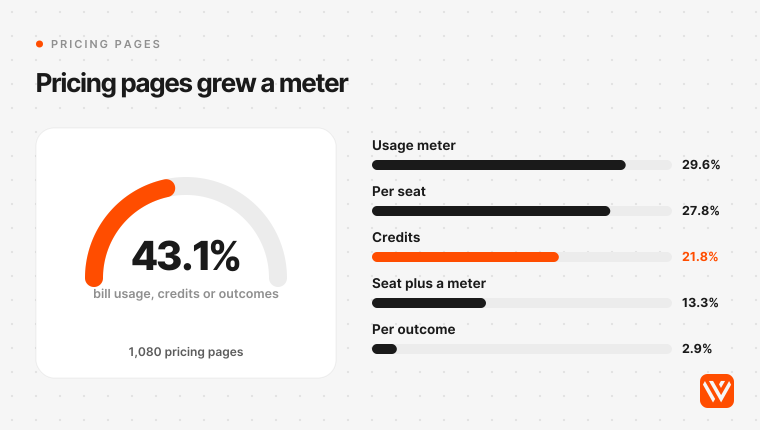
- 43.1% of 1,080 SaaS pricing pages now bill usage, credits or outcomes, not only seats. Pricing has become something marketing has to explain.
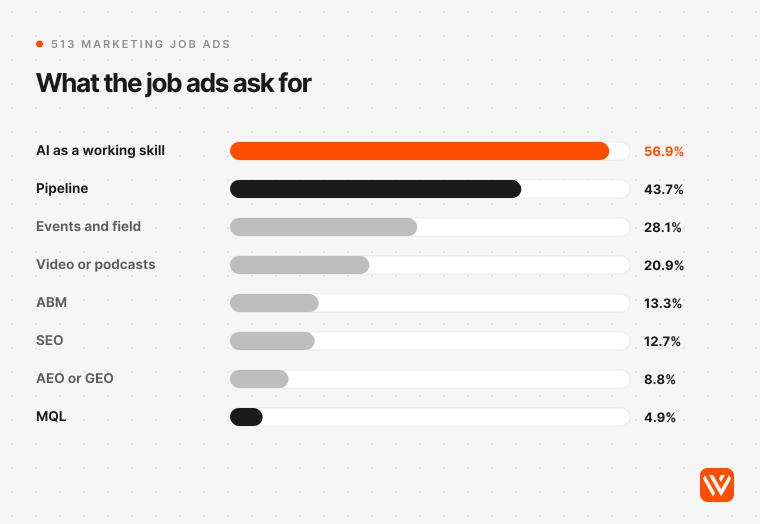
- Of 513 open marketing roles, 56.9% ask for AI as a working skill and 43.7% talk about pipeline. Only 4.9% mention MQLs.
- None of this comes with more money. Gartner's 2026 CMO Spend Survey puts marketing budgets at 7.8% of company revenue, against 7.7% in 2025.
What are the biggest B2B SaaS marketing trends for 2027?
The B2B SaaS marketing trends that matter for 2027 all come from one change: an AI answer, and increasingly an AI agent, now sits between the buyer and your company. Most of them are B2B marketing trends for 2027 in general; software companies just meet them first, because software buyers adopted AI research fastest. Here are all ten in one table, with the evidence behind each and the first move to make.
| # | Trend | Evidence | First move for a B2B SaaS team |
|---|---|---|---|
| 1 | The shortlist starts in an AI assistant | 51% of software buyers start research in an AI chatbot more often than in Google (G2, 2026) | Ask ChatGPT, Gemini and Claude for your category shortlist every month and log who appears |
| 2 | AI agents join the buying group | Forrester forecasts agentic buying will play a role in 75% of B2B purchases in 2027 | Publish the facts an agent checks: price, security, integrations, limits |
| 3 | Everyone says AI, so it stops differentiating | 55.5% of 2,523 homepages put "AI" in the headline (our scan) | Lead with the job your product does and the proof |
| 4 | The homepage does the first sales call | 47.1% of established vendors offer a free trial and a sales conversation on the homepage, against 14.7% of start-ups (our scan) | Put the self-serve door next to the demo button |
| 5 | Pricing pages grow a meter | 43.1% of 1,080 pricing pages bill usage, credits or outcomes (our scan) | Add a worked example and a spending cap to your pricing page |
| 6 | Proof beats volume in content | 78% of B2B marketers say AI's main contribution is speed; 17% say quality (CMI, 2027 research) | Publish one original data asset a quarter |
| 7 | Brand, creators and small events get budget back | Owned media and events rose as 2027 investment priorities while AI tools fell 15 points (CMI) | Fund two or three named experts and one dinner series |
| 8 | Signal-based outbound replaces volume | 27 open GTM engineer roles at 27 companies; Clay named in 46.3% of GTM engineering and ops ads (our read) | Define three buying signals before you buy another tool |
| 9 | Lean teams hired for AI fluency, on flat budgets | 56.9% of 513 marketing ads ask for AI skills (our read); budgets at 7.8% of revenue (Gartner) | Write AI workflows into each role, then hire for judgment |
| 10 | Measurement moves to pipeline and self-reported attribution | 43.7% of marketing ads mention pipeline, 4.9% MQLs (our read) | Add "How did you hear about us?" to every demo form |
The rest of this post takes them one at a time, after two things you need first: how B2B SaaS marketing got here, and what our own data showed.
How did B2B SaaS marketing get here?
B2B SaaS marketing changed in three steps between 2022 and 2026, and 2027 is the year the third one becomes normal. First, generative AI arrived: OpenAI released ChatGPT on 30 November 2022, and Google put AI Overviews into Search on 14 May 2024. Second, the old volume channels got harder. Gmail began requiring bulk senders of 5,000+ messages a day to authenticate and offer one-click unsubscribe from 1 February 2024, and Microsoft Outlook started enforcing the same rules on 5 May 2025.
Third, buyers moved. In April 2025 G2 found 29% of software buyers started research in tools like ChatGPT more often than Google; a year later it was 51%. Pricing moved with them: Zendesk priced AI agents on resolved issues from August 2024, and Salesforce moved Agentforce from $2 per conversation to "Flex Credits" in May 2025.
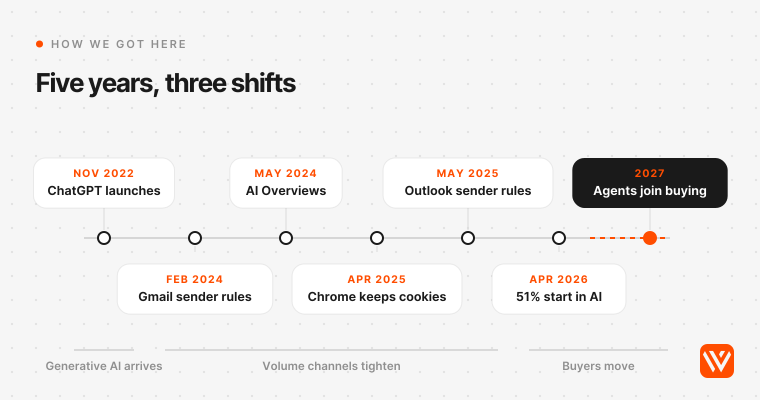
One thing didn't happen. Google confirmed on 22 April 2025 that Chrome will keep third-party cookies rather than retire them, and in October 2025 it retired most Privacy Sandbox technologies for low adoption. The "cookieless future" that dominated trend lists from 2020 to 2024 isn't a 2027 trend.
What we found on 2,523 B2B SaaS websites and 513 job ads
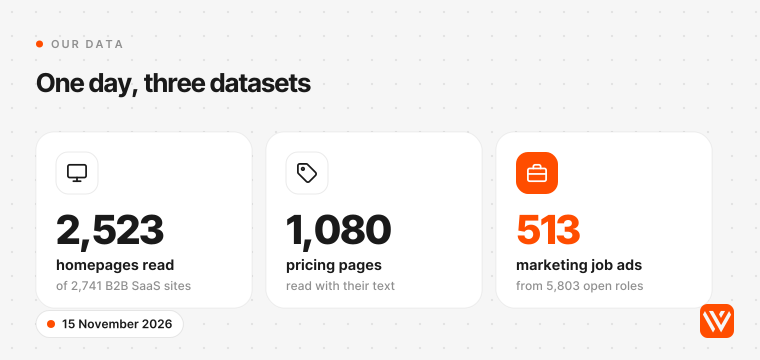
We built two datasets on 15 November 2026 to see what B2B SaaS companies are actually doing, rather than what they say they'll do.
- Websites. We fetched the homepages of 2,741 B2B software companies: every active Y Combinator company tagged B2B or SaaS in the public YC directory, plus 145 established vendors across eight software categories (CRM, analytics, helpdesk, compliance and others). 2,523 loaded cleanly. For each we recorded the headline, the buttons, the scripts on the page and whether it publishes an llms.txt file, and for 1,080 of them we read the full pricing page.
- Job ads. We read the public job boards (Ashby, Greenhouse and Lever) of the 1,160 companies in that list with ten or more staff. 371 boards matched, holding 5,803 unique open roles, 513 of them in marketing.
| What we measured | Result |
|---|---|
| Homepages with "AI" in the title, meta description or H1 | 55.5% (62.5% for companies founded 2024 to 2027, 42.0% for those founded by 2020) |
| Homepages using "agent" or "agentic" in the same places | 31.1% (38.6% for the newest companies) |
| Homepages with a demo or talk-to-sales button | 63.7% (83.8% of established vendors) |
| Homepages with both a free-trial and a sales button | 16.4% (47.1% of established vendors) |
| Pricing pages that show a price | 81.8% of 1,080 |
| Pricing pages that bill usage, credits or outcomes | 43.1% |
| Homepages answering at /llms.txt | 51.1% |
| Homepages running a visitor-identification script in the HTML | 17.3% (RB2B alone on 7.6%) |
| Marketing roles that ask for AI as a working skill | 56.9% of 513 |
| Marketing roles that mention pipeline / MQLs | 43.7% / 4.9% |
| Open GTM engineer or growth engineer roles | 27, at 27 companies |
| Marketing roles that mention AEO, GEO or AI search | 8.8% (45 roles at 39 companies) |
The limits matter, so here they are up front. We read raw HTML without running JavaScript, which means anything loaded through Google Tag Manager is invisible to us: treat the chat, demo and tracking numbers as floors. The list leans towards venture-backed start-ups. And it's one day's snapshot, so the comparison by founding year shows how younger companies market, not a measured change over time. (We tried to pull the same homepages from November 2024 through the Internet Archive; it rate-limited every request.)
The 10 B2B SaaS marketing trends for 2027
1. The shortlist starts in an AI assistant
Buyers now ask an AI assistant which tools to consider before they visit a vendor's site, so your first impression happens in an answer you didn't write. G2's March 2026 survey of 1,076 software buyers found 51% start research in an AI chatbot more often than in Google, and 69% chose a different vendor than they first planned because of a chatbot's recommendation.
The shortlist also sets early and holds. 6sense's 2026 Buyer Experience Report found the eventual winner was already on the day-one shortlist in 92% of buying cycles, and buyers made first contact with a vendor, on average, 59.2% of the way through a 10.3-month cycle.
The two studies disagree on how much AI matters, and the disagreement is useful. 6sense, surveying all B2B categories, found only 26% of buyers use large language models to discover new vendors, and that LLMs were the least-used way (15.0%) of keeping up with a category between purchases. G2 surveys software buyers, and G2 sells review-site visibility, so it has a stake in the AI-search story. Our reading: for software, AI is now a front door; for your category's general awareness, it's still one channel of many.
Buyers check the answer, too. A Gartner survey of 645 B2B buyers found 69% prefer to validate AI-generated insights with a sales rep. Alon Waks, CMO of SpotDraft, put it plainly on the Prime Venture Partners podcast: "Validation, human to human, is at its peak of all time because there's so much noise."
Our own Search Console shows the machine side of this. In 13 months we logged 565 queries that no person typed: templated prompts such as "evaluate the digital marketing & crm consulting company webyansh on b2b demand gen optimization", and persona prompts that open "i am a 25-34 or 35-44 year old seo manager". They earned 6,636 impressions and zero clicks. Software already researches vendors on someone's behalf, and the trace it leaves looks like demand you can't sell to.
What to do: run your category's buyer questions through ChatGPT, Gemini, Claude and Google's AI Mode once a month, and record who gets named and which pages get cited. Fix your own facts first: pricing, comparisons, integrations. Our SEO trends 2027 guide covers the search side in detail, including what we found when we asked ChatGPT and Claude 56 software-buying questions.
2. AI agents join the buying group
In 2027 an AI agent will sit inside many buying groups, collecting vendor facts, drafting comparisons and checking claims. Forrester's Predictions 2027 forecast that agentic buying will play a role in 75% of B2B purchases and that buyers will double their human interactions to validate what agents recommend. Gartner goes further on a longer horizon, predicting that by 2028, 90% of B2B buying will be AI agent intermediated. Both are forecasts, and both firms label them that way.
The buying groups are already big. Forrester's 2026 State of Business Buying found the typical decision involves 13 internal stakeholders and nine external influencers, and that purchases with generative AI features have buying groups twice the size (14 members against seven).
The sharper risk is what agents do to vague claims. Forrester's 2027 go-to-market predictions say "two-thirds of providers will lose deals because buyers cannot verify claims". 6sense already sees the symptom: 58% of buyers contacted sellers sooner than they otherwise would have to get answers about how AI worked in a product, because vendor websites didn't explain it. Tomasz Tunguz of Theory Ventures framed the design consequence in his predictions: "the front door needs to be designed for robots, while the side door caters to people."
What to do: list the 20 facts a procurement agent would need to shortlist you (price or starting price, contract terms, SOC 2 or ISO 27001 status, data residency, integrations, implementation time, support hours, what your AI does with customer data) and put each one on a public page in plain text. To an agent, anything behind a form is missing. Half the B2B SaaS sites we scanned (51.1%) already publish an llms.txt file. That's harmless, but Google says Search ignores llms.txt, so treat it as a convenience, not a strategy.
Skip this if: your deals are a few hundred dollars a month on a credit card. Agents matter most where procurement exists.
3. Everyone says AI, so saying AI stops working
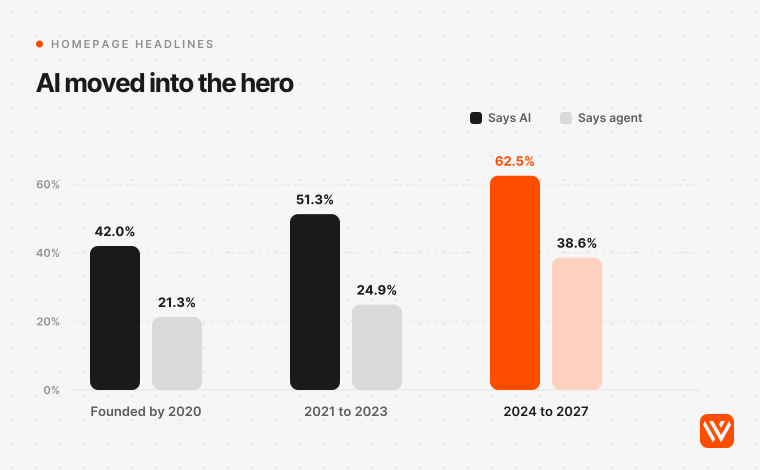
"AI" has become the default headline word on B2B SaaS homepages, which means it no longer separates anyone. In our scan, 55.5% of 2,523 homepages put "AI" in the page title, meta description or H1. Among companies founded from 2024 onward it's 62.5%, against 42.0% for companies founded by 2020. "Agent" or "agentic" appears on 38.6% of the newest homepages, against 21.3% of the oldest.
Udi Ledergor, chief evangelist and former CMO of Gong, described the result at a Tel Aviv event: "There's a sea of sameness out there," and the fix is to "start with the customer's problems and work backwards." The buying research points the same way. LinkedIn and Bain & Company research, as reported in a LinkedIn playbook with LIONS Advisory, found that among vendors that already meet requirements, positive first-hand experience (37%) and recommendations from trusted sources (25%) decide the winner, while product performance and price score 8% each. Nobody picks a vendor for saying AI.
There's also a quieter cost. If your headline reads like everyone else's, an AI assistant summarising your category will describe you like everyone else, and Forrester expects buyers to fact-check whatever claim is left.
What to do: keep the AI claim if it's true, but lead with the job your product does and the evidence that it does it (a number, a named customer, a before and after). Then test your headline the way buyers meet it now: ask ChatGPT for your category shortlist and read how it describes you next to three competitors. If the descriptions are interchangeable, so is your homepage.
Skip this if: you sell AI infrastructure to engineers. For you, the model, latency and price per token are the message.
4. The homepage does the first sales call
Buyers arrive with a shortlist already formed and most would rather not talk to sales yet, so the website has to answer what a first call used to. Gartner found 67% of B2B buyers prefer a rep-free experience (646 buyers surveyed in 2025), up from 61% a year earlier. 6sense found only 35.2% of buyers used their own contact details on a form, and 17.7% used AI tools to avoid filling one in.
Established vendors already behave accordingly. In our scan, 47.1% of 136 established software vendors offer both a free trial and a sales conversation on the homepage, against 14.7% of 2,387 start-ups, and 86.8% link a pricing page from the homepage, against 41.1% of start-ups.
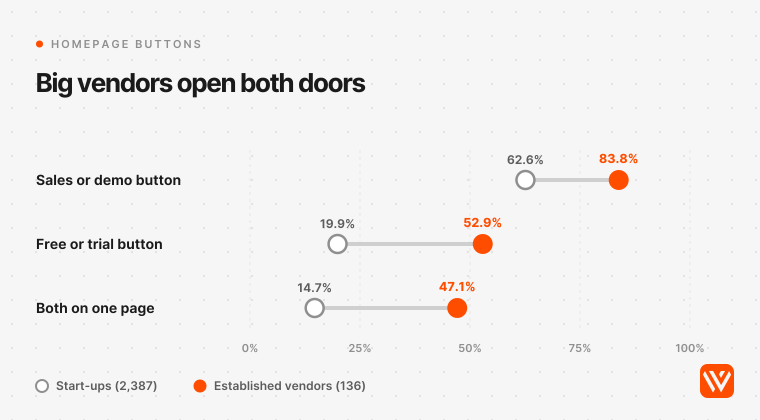
The conversion data backs the self-serve door. ICONIQ's State of Go-to-Market 2026 found free-trial and proof-of-concept paths now convert at roughly 50%, up from about 36% in 2025, against 30% to 40% for traditional demo and SQL paths. Interactive demos are scaling with it: Navattic reports 40,000 demos built on its platform in a year, up 43%. Only 1.7% of the homepages we scanned load an interactive-demo vendor in raw HTML, but most load through tag managers, so that's a floor.
Dave Gerhardt of Exit Five summed up the tension: "The buyer wants information as quickly and easily as possible, while the company wants to track, gate, measure, and assign credit to everything. Those two things are in direct conflict. And the customer always wins that fight."
The site still has to be fast and convert. When we rebuilt Futurense's site on Webflow, its performance score went from 39 to 92 and its conversion rate rose 27%; for Hopstack, organic traffic grew 266.4% and conversion rate 12%. Neither result came from adding AI to the headline.
What to do: publish what the buyer's assistant will look for (a real starting price, what's included, integrations, security, implementation time and an honest comparison page) and add a self-serve door, a trial, sandbox or interactive demo, next to the demo button rather than instead of it.
5. Pricing pages grow a meter
AI features cost the vendor money per use, so pricing is moving from seats to meters, and the pricing page has become a marketing asset you have to explain. 43.1% of the 1,080 pricing pages in our scan bill at least one thing by usage, credits or outcomes. Usage meters (per call, token, run or gigabyte, or pay as you go) appear on 29.6%, credits on 21.8% and per-seat wording on 27.8%; 13.3% mix seats with a meter. Charging per outcome is still rare, at 2.9%.
Surveys show the same shift. Kyle Poyar's 2026 State of B2B Monetization found hybrid pricing (seats plus AI consumption) is now the most common model at 37%, up from 25% a year earlier, and that AI gross margins sit near 50%. The best-known outcome prices are public: Intercom charges $0.99 per Fin AI Agent outcome, and HubSpot moved its Customer Agent from $1.00 per conversation to $0.50 per resolved conversation on 14 April 2026.
Buyers are asking for it. G2's 2026 Buyer Behavior Report found preference for outcome-based pricing more than doubled, from 11% to 23%, in a year. But meters scare people when they're unclear: Metronome's field report found customers actively avoided AI features even when free credits were included. And TrustRadius found transparent pricing has been buyers' top wish for vendors four years running.
Krish Subramanian, CEO of Chargebee in Chennai, put the business case: "AI monetization completely breaks traditional SaaS models such as freemium… Frequent, hypothesis-led pricing iterations are thus really important."
What to do: put a worked example on the pricing page ("a 40-person support team resolving 2,000 conversations a month pays about X"), give finance a cap or a forecast, and write the credit rules in plain words. A buyer's assistant will summarise your pricing page whether it's clear or not.
6. Proof beats volume in content
AI made content cheap, so volume stopped working as a strategy and evidence became the scarce thing. The Content Marketing Institute and MarketingProfs' 2027 research found 78% of B2B marketers say speed is AI's most significant contribution and only 17% say quality; 75% fear AI is eroding audience trust, yet 52% have no AI disclosure policy. 88% of B2B marketers say their organisation uses AI content tools, and the share using AI agents rose from 28% to 59% in a year.
Forrester's content analysts expect the correction to show up in priorities: "Human-generated content will become a top priority again for 50% of brands," they wrote on 30 October 2026.
The clearest signal came from the company that taught B2B SaaS to blog. HubSpot's blog once drew more than 20 million organic visits a month and lost about 80% of that while revenue kept growing, CMO Kipp Bodnar told Search Engine Journal. In a Fortune op-ed he and Kieran Flanagan wrote: "Now, we're saying the era we built is over."
What still earns attention is specific. Propel's site, which we work on, has 132 pages cited by AI engines and grew organic traffic 67% year on year. This post runs on our own scan for the same reason: a number nobody else has is a reason to be quoted.
What to do: commit to one original data asset a quarter, such as a benchmark from your product data, a survey of your customers, a scan like ours or a pricing index for your category. Then cut the content that exists only to fill a calendar slot.
7. Brand, creators and small events get budget back
When every vendor can produce the same AI-written email and blog post, the things AI can't copy (a known name, a trusted face, a room of people) get more valuable. CMI's 2027 research shows the budget moving: 42% name owned media and 35% events as top investment areas for 2027, while AI-powered marketing tools fell 15 points to 30%.
The brand case rests on timing. The LinkedIn B2B Institute's 95-5 rule says 95% of your potential buyers aren't ready to buy today, so the brand they remember when they enter the market wins. Mark Ritson put it this way in a conversation published by Dreamdata: "the brand or solution that the customer thinks of as they enter the 5% is the brand or solution they will eventually buy." Even Clay, the company most associated with automated outbound, spends on brand deliberately; co-founder Varun Anand told First Round they "always overinvested in brand way more so than any other B2B software company that I'm aware of."
Creators are becoming distribution. LinkedIn's 2026 research with YouGov found 56% of B2B buyers who use creators rely on them in the final stage of buying. TopRank's 2027 B2B influencer report found 93% of B2B marketers rate their influencer programmes effective, though only 21% have tied them to AI visibility.
Events are coming back, smaller. Kyle Poyar's 2026 State of B2B GTM, a survey of 300 software go-to-market leaders, ranked network and introductions the best channel and intimate events second: "dinners are on the menu in 2027." Forrester's 2026 events research found that most teams plan more sub-200-person events while just 18% plan more large hosted events, and only 38% of CMOs agree their events perform well.
The job ads agree: 28.1% of the 513 marketing roles we read involve events or field marketing, 20.9% video or podcasts and 13.3% creators or influencers.
What to do: pick two or three named experts (your founder, a product lead, an outside creator your buyers already follow) and fund them for a year, not a campaign. Swap one large sponsorship for a dinner series in the two cities where most of your pipeline sits.
Skip this if: you sell a developer tool bought bottom-up. Docs, a free tier and a GitHub presence will beat a dinner.
8. Signal-based outbound replaces volume
AI made cold email almost free to send, so inboxes filled up and the channel stopped working for anyone sending volume. Poyar's survey put it bluntly: "Cold outreach is officially oversaturated, and AI SDRs aren't living up to the early hype." Gartner found 73% of B2B buyers actively avoid suppliers who send irrelevant outreach. The Hacker News threads we read on AI cold email (four threads, 271 comments) say the same from the receiving end; one reader on the "Cold Email" thread wrote: "Now we get dozens a day. Straight into the garbage."
The other side has a case. SaaStr founder Jason Lemkin reports his AI agents sold 16% of paid tickets for SaaStr AI Annual 2026 (SaaStr's own figures), and he blames failures on setup: "A lot of founders bought an AI SDR, didn't train it, and got garbage results." Gartner's Dan Gottlieb, commenting on its forecast that AI agents will outnumber sellers 10 to 1 by 2028, named the condition: "If those systems are fragmented, the agents will scale the fragmentation."
What replaces volume is signals: who's on your pricing page, who just hired a new head of RevOps, whose contract with a competitor renews next quarter. That work now has a job title. We found 27 open GTM engineer or growth engineer roles at 27 companies, including Intercom, Notion, Checkr, Gorgias and Zip, and Clay is named in 46.3% of the GTM engineering and marketing operations postings. On the website side, 17.3% of the homepages we scanned run a visitor-identification script we could see in the HTML, led by RB2B on 7.6%. We've written up one version of this, dynamic landing pages built from Clay data in Webflow, if you want a worked example.
McKinsey's 2026 B2B Pulse adds a structural point: market leaders that put account-based marketing under sales ownership were more likely to reach the top revenue bands (43% against 31%).
What to do: before you hire a GTM engineer or buy another data tool, write down three signals you'd act on and the action each triggers. Keep a person writing the first line of every message to a named account. And keep authentication and one-click unsubscribe in order: Gmail and Outlook enforce both.
Skip this if: you sell to a short list of enterprises. Your best signal is a relationship.
9. Lean teams hired for AI fluency, on flat budgets
Marketing teams are expected to do more with AI on roughly the same money. Gartner's 2026 CMO Spend Survey put budgets at 7.8% of company revenue, against 7.7% in 2025; CMOs now put 15.3% of that into AI, but 70% say their processes aren't mature enough to scale it. Gartner's Ewan McIntyre warned that "optimization is not the same as strategy." For SaaS specifically, SaaS Capital's 2026 survey puts the median private B2B SaaS company's marketing spend at 8% of ARR, unchanged from the year before, with sales at 15%, while median growth slowed to 22% from 25% in 2024.
The job ads show the new baseline. 56.9% of the 513 marketing roles we read ask for AI as a working skill: AI-first workflows, named tools such as ChatGPT, Claude or Cursor, or building agents. For GTM engineering and marketing operations roles it's 85.4%. Emily Kramer of MKT1 called the "Gen Marketer" "a baseline skillset all marketers need", not a job title. Gartner expects the share of marketing work automated by AI to more than double, from 16% in 2026 to 36% by 2028, and Forrester forecasts some CMOs will cut up to 25% of roles in anticipation of productivity gains that don't arrive.
From India, Zoho's Sridhar Vembu went further, arguing in February 2026 that an industry that "spends vastly more on sales and marketing than on engineering and product development was always vulnerable" to AI.
Marketers who do get hired still cost real money. Across the 160 marketing roles that posted a US dollar salary range, the median midpoint was $174,250: $207,500 for leadership roles, $180,000 for product marketing and $155,000 for GTM engineering and marketing operations.
What to do: write the AI part into every role's scope (what gets drafted, researched or routed by AI, and who checks it), then hire for judgment and taste, which no tool supplies. Don't cut the people who know your customers in advance of savings you haven't seen.
10. Measurement moves to pipeline and self-reported attribution
The metrics built for form fills are losing their grip. In the job ads, 43.7% of marketing roles talk about pipeline and 4.9% mention MQLs. Steffen Hedebrandt, CMO of Dreamdata (which sells attribution software), named the time-window problem: "If your attribution window is 30 days and your average deal takes the better part of a year, you're only measuring a fragment of the customer journey." Databox's survey of 310 go-to-market leaders found one in four said at least a quarter of last quarter's pipeline was misattributed, and fewer than half (46%) ask leads how they heard about them.
Not everyone wants the MQL gone. Docket's Kavyapriya Sethu argued that the MQL "should not be your primary pipeline metric or your primary optimization target in 2026. It still has value as a funnel health indicator". That's our view too: keep it as a diagnostic, stop paying bonuses on it.
AI channels are small but valuable, which makes them easy to misread. Octane11's Q3 2026 data (vendor data) found AI search was 2.4% of B2B search sessions, but accounts arriving from AI engines were 2.5 times as likely to close a won deal as those from organic search. On our own site, GA4's "AI Assistant" channel logged 133 engaged sessions from June to mid-November 2026, against 1,773 from organic search. And the machine-written queries from trend 1 inflate impressions with no buyer behind them.
What to do: add a required "How did you hear about us?" field to every demo and trial form, report pipeline by source each month, and read AI visibility as a leading indicator next to it, never as revenue.
Which 2027 dates belong in a B2B SaaS marketing calendar?
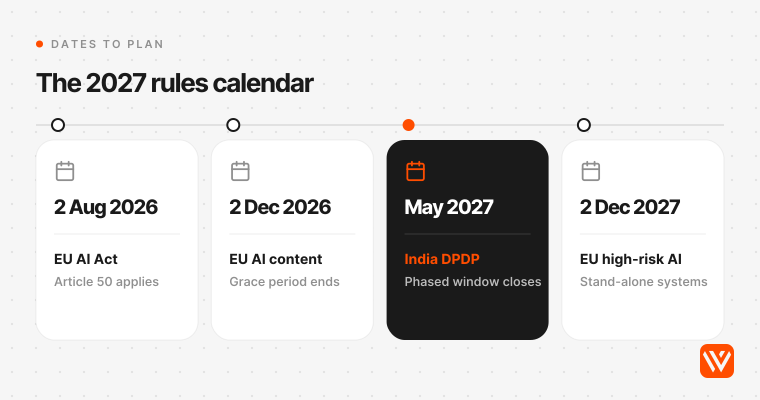
Most of the rules that shape 2027 B2B marketing are already written; the dates are what teams miss. Here are the ones to plan around, by market.
| Date | Rule | Who it affects |
|---|---|---|
| In force since 1 Feb 2024 and 5 May 2025 | Gmail and Outlook bulk-sender rules: SPF, DKIM, DMARC and one-click unsubscribe for senders of 5,000+ messages a day | Anyone sending outbound or newsletters at volume |
| In force since 5 Feb 2026 | Most of the UK's Data (Use and Access) Act 2025 data-protection changes | UK marketing data and cookies |
| In force since 1 Jan 2026 | Comprehensive privacy laws in Indiana, Kentucky and Rhode Island, alongside new California measures | US lead data |
| 2 Aug 2026 and 2 Dec 2026 | EU AI Act transparency rules (Article 50) apply; generative systems already on the market before August have until 2 December 2026 to comply | AI features and AI-generated content shown to EU users |
| May 2027 | End of the 18-month phased window of India's DPDP Rules, notified 14 November 2025: consent notices and Consent Managers; penalties up to ₹250 crore (about $26.5 million) | Personal data of people in India |
| 2 Dec 2027 | EU rules for stand-alone high-risk AI systems, delayed from August 2026 by the May 2026 Digital Omnibus deal | SaaS used in hiring, credit and similar uses |
Two US rules also deserve a line in your content policy: the FTC's final rule banning fake and AI-generated reviews and testimonials (August 2024), and the warning letters the FTC sent to ten companies under it in December 2025. If your agency or your AI tool writes testimonials, stop. (The dollar figure in the table uses ₹94.25 to the dollar, the European Central Bank reference rate of 13 November 2026.)
What doesn't change in 2027
Most of what made B2B SaaS marketing work in 2024 still works. The trends above change where buyers meet you and how you're measured, not the fundamentals.
- Positioning still decides everything else. An AI assistant can only repeat a clear position; it can't invent one. If your homepage, G2 profile and sales deck describe three different products, every engine will too. McKinsey's 2026 B2B Pulse found inconsistent information across teams is the top reason buyers switch suppliers.
- Buyers still trust people and peers. Review sites (38%) still edge AI chatbots (37%) as the top influence on software shortlists, and LinkedIn's research with Ipsos found only 45% of buyers trust sellers. Earned trust is still the scarce asset.
- Your website is still where the deal gets checked. Between purchases, buyers keep up with a category mainly through vendor websites (35.9%) and events (33.4%), ahead of podcasts, communities and LLMs.
- Search still matters. AI answers are built from pages that rank and get cited. The SEO trends 2027 post covers that side.
- Retention still pays for growth. The median private SaaS company keeps 101% of revenue from existing customers (SaaS Capital, 2025), and net retention correlates with growth more strongly than any other metric it tracks.
Some hype has already cooled, and it's worth knowing which. 6sense found the share of purchases involving AI capabilities fell from 89% to 80% in a year, and Gartner predicts over 40% of agentic AI projects will be cancelled by the end of 2027 for cost, unclear value or weak risk controls.
How should a B2B SaaS team plan marketing for 2027?
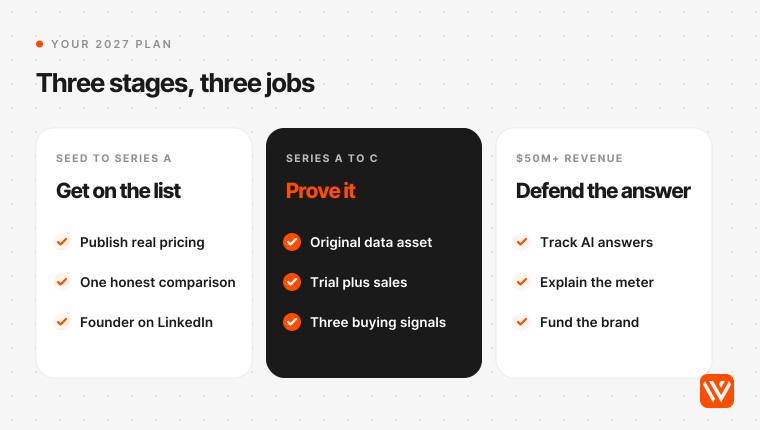
A 2027 B2B SaaS marketing plan depends on stage more than on any trend. A seed company that isn't on any AI shortlist yet has a different job from a scale-up already named in every answer.
| Stage | The job | First three moves for 2027 |
|---|---|---|
| Seed to Series A (under about $5M ARR) | Get on the list | Publish real pricing or a starting price; write one honest comparison page against the vendor buyers name next to you; put the founder on LinkedIn weekly with specific, first-hand posts |
| Series A to C (about $5M to $50M ARR) | Prove it | Ship one original data asset a quarter; offer a trial or interactive demo next to the sales door; define three buying signals and the action for each |
| $50M+ ARR | Defend the answer | Track how AI assistants describe you across three or more engines monthly; explain your meter with worked examples; fund brand and a named-expert programme for a full year |
If you're in the middle band, our B2B SaaS team works on exactly this stage, and our growth marketing service covers the site and pipeline side.
How do the US, UK, Europe and India differ?
The trends are global; the pace isn't. Here's what changes by market, from the sources above and our own scan.
| United States | UK and Europe | India | Gulf and Asia | |
|---|---|---|---|---|
| AI use | 28.3% of working-age people used generative AI at the end of 2025 | UK 38.9%, Germany 28.6% | 15.7% | UAE 64.0%, Singapore 60.9%, Japan 19.1% |
| Buying | First vendor contact at 59.2% of the way through the cycle (6sense, global) | In Europe first contact moved from 67% to 58% of the way through, and 89% of buyers use LLMs (6sense) | Enterprise buyers ask for free proofs of concept more often than US and European buyers | Pipeline is the "marching order" for Datadog's APJ marketing lead in Singapore |
| Our scan | Free-trial button on 19.4% of homepages; consent manager on 11.5% | Free-trial button on 26.1%; consent manager on 16.2% | Only 2 of 25 Indian-founded companies' pricing pages showed rupee prices | Asia-based pricing pages showed a price 50.0% of the time (22 read) |
| Rules | State privacy laws; FTC review rule | UK DUAA (Feb 2026); EU AI Act Article 50 (Aug 2026) | DPDP Rules, phased window to May 2027 | UAE and Saudi data laws (not covered here) |
| Budget mood | Flat (Gartner: 7.8% of revenue) | UK budgets saw their strongest upward revision in over two years in Q3 2026 (IPA Bellwether) | 97% of Indian B2B marketers rate video and influencer marketing among the most effective sales tools (LinkedIn) | Not measured here |
Sources for the table: AI use from the Microsoft AI Diffusion Report (January 2026); Europe buying from 6sense's European report; the India proof-of-concept point from KOGO AI's Raj K Gopalakrishnan in Outlook Business; UK budgets from the IPA Bellwether report as covered by InPublishing; India video from LinkedIn research reported by Manifest Media; Datadog's Vishal Alagh in Ortus Club.
Two notes for Indian SaaS companies selling abroad. First, your home buyers use AI far less than your US and UK buyers do (15.7% against 28.3% and 38.9%), so an AI-first plan built for the US won't transfer to Indian enterprise sales unchanged. Second, the regulation runs on two clocks: US and EU rules for the customers you sell to, and DPDP for the data you hold at home. The Indian SaaS market itself keeps growing; SaaSBoomi projects it to reach about US$100 billion by 2035, from about US$20 billion now (as reported by IBEF).
When this advice doesn't apply
- You sell only through a marketplace or resellers (AWS Marketplace, Salesforce AppExchange, a distributor in the Gulf). Put the effort into the listing and the partner's enablement, not your own homepage. Note that 6sense found 80% of buyers who used resellers still bought directly from the vendor, so check before you assume.
- Your market is a closed list of fewer than 100 accounts. Account-based sales, events and executive relationships beat every channel in this post.
- You're pre-product. You have nothing for a buyer, or an AI engine, to verify yet. Ship, then publish pricing.
- You sell into a regulated category (health data, lending, government). Keep the measurement and privacy work, and slow down on comparison claims until legal has read them.
- You have no marketer yet. Don't hire a GTM engineer first. Hire the person who can write your positioning in one paragraph.
And ignore anyone selling certainty about 2027, us included. The forecasts in this post are labelled as forecasts for a reason.
The next step
If you want to know how AI assistants describe your company before you plan 2027, our AI visibility audit runs your buyers' questions across the engines, checks your pricing, comparison and security pages, and ends with a 90-day plan. If you'd rather start with something free, run your homepage through our AI Design Scorer.
What are the biggest B2B SaaS marketing trends for 2027?
The biggest B2B SaaS marketing trends for 2027 are AI assistants forming the buyer's shortlist, AI agents joining buying groups, "AI" messaging turning generic, websites doing the first sales call, metered pricing, proof over content volume, brand and small events, signal-based outbound, AI-fluent lean teams and pipeline-based measurement.
How is AI changing B2B SaaS marketing?
AI is changing B2B SaaS marketing at both ends. Buyers use AI assistants to research and shortlist vendors before they talk to anyone: 51% of software buyers start there more often than in Google (G2, 2026). Marketing teams use AI to produce and route work: 56.9% of 513 B2B SaaS marketing job ads we read ask for AI skills.
Should B2B SaaS companies show pricing on their website?
Yes, in most cases. Of 1,080 B2B SaaS pricing pages we read in November 2026, 81.8% show a price and only 9.4% say "contact sales" with no number. AI assistants and buying agents summarise what they can find, and a missing price reads as a missing fact. Enterprise-only vendors can publish a starting price.
Is the MQL dead in 2027?
Not dead, but demoted. In our read of 513 B2B SaaS marketing job ads, 43.7% talk about pipeline and only 4.9% mention MQLs. Keep the MQL as a funnel health check, and judge marketing on qualified pipeline plus a "How did you hear about us?" field, which catches research done in AI assistants and communities.
Will AI replace B2B sales teams?
Not in 2027. Gartner forecasts AI agents will outnumber sellers 10 to 1 by 2028, yet fewer than 40% of sellers will say agents improved their productivity, and 69% of B2B buyers prefer to validate AI-generated insights with a sales rep. AI takes over research and routine outreach; people keep validation and complex deals.