Summarise this article using AI


The biggest SEO trend for 2027 is that B2B software buyers now get their shortlist from an AI answer before they visit a vendor's site. Google's AI Mode and AI Overviews, ChatGPT and Claude read many pages, cite a handful and send fewer clicks. SEO still decides which pages they read. What changes is what you publish and how you measure it.
We didn't want to write that from other people's lists. On 15 November 2026 we asked ChatGPT and Claude 56 questions a software buyer actually asks, across eight B2B categories, and recorded every source the 112 answers cited. We also pulled 12 months of our own Search Console data. Below: the ten SEO trends for 2027 that follow from that data and from 63 primary sources, what doesn't change, and a 2027 plan by company stage.
Key takeaways
- Half of B2B software buyers (51%) now start research in an AI chatbot more often than in Google, up from 29% a year earlier, per G2's survey of 1,076 buyers (April 2026).
- In our test, ChatGPT and Claude named mostly the same vendors but cited almost entirely different websites: on 37 of 56 questions they didn't share a single cited site. One engine leaned on official vendor pages, the other on third-party "best of 2026" lists.
- 89.5% of the pages Claude cited had a year in the title or URL, almost always 2026. Freshness has become literal.
- Long, prompt-like queries are growing in our own Search Console (14.4% of queries in November 2025, 24.6% in October 2026) and earned 49,478 impressions and one click in a year.
- Most of SEO's basics still hold: Google says AI features need no special schema or AI text files, and authority still predicts who gets cited. The work that changes is comparison and pricing pages, third-party coverage, crawler policy and measurement.
What are the biggest SEO trends for 2027?
The SEO trends that matter most for B2B SaaS in 2027 all come from one shift: an AI answer now sits between the buyer and your site. Here they are in one table, with the evidence behind each and the first thing to do about it.
| # | Trend | Evidence | First move for a B2B SaaS team |
|---|---|---|---|
| 1 | The shortlist starts in a chatbot | 51% of software buyers start in an AI chatbot more often than Google (G2, 2026) | Ask ChatGPT, Gemini and Claude for your category shortlist every month and record who appears |
| 2 | Google's AI Mode becomes a second front page | AI Mode passed 1 billion monthly users; its queries are three times longer (Google, 2026) | Map your category's long questions as well as head keywords |
| 3 | Clicks per search fall while impressions mislead | Pew: 8% of visits with an AI summary led to a click, against 15% without (2025) | Report qualified pipeline from organic, not sessions |
| 4 | Official pages become citation assets | 86.5% of ChatGPT's citations in our test went to vendors' own product pages | Rewrite pricing, comparison and docs pages to answer questions directly |
| 5 | Third-party lists decide the rest | 96.3% of Claude's citations in our test went to lists, comparisons and articles, not product pages | Get into the lists and reviews engines read, with facts they can quote |
| 6 | Freshness becomes literal | 89.5% of Claude's cited pages carried a year, nearly always 2026, in the title or URL | Put a real update cycle and a visible "updated" date on money pages |
| 7 | Each engine cites different sources | ChatGPT and Claude shared no cited website on 37 of 56 identical questions in our test | Track at least three engines; one engine's result isn't the market |
| 8 | Crawler access becomes a policy decision | 52% of crawler requests on Cloudflare were for AI training in June 2026 | Allow search crawlers, decide on training crawlers, check your CDN defaults |
| 9 | Ads and agents arrive inside the answer | About 26% of ChatGPT responses carry an ad (Similarweb, 2026) | Budget a small test; keep organic answers accurate |
| 10 | Measurement moves from traffic to visibility and pipeline | AI referrals were 1.08% of traffic across 13,770 domains (Conductor, 2025) | Add AI visibility, self-reported attribution and pipeline to the SEO report |
The rest of this post takes them one at a time, after two things you need first: how AI search decides what to cite, and what our test found.
How did search get here?
Search changed in three steps between 2023 and 2026, and 2027 is the year the third step becomes the default. Google tested generative answers in Search Labs in May 2023, put AI Overviews in front of every US user on 14 May 2024, and launched AI Mode as a full conversational search mode in 2025, reaching the UK on 28 July 2025 and 180 more countries in English the next month. OpenAI opened ChatGPT search on 31 October 2024, and Anthropic added web search to Claude in March 2025.
By 2026 the numbers were large enough to change how buyers behave. Google said in May 2026 that AI Overviews reach more than 2.5 billion monthly users and that AI Mode had passed one billion monthly users, with queries "more than doubling every quarter since launch". OpenAI reported 1.2 billion weekly ChatGPT users on 29 September 2026.
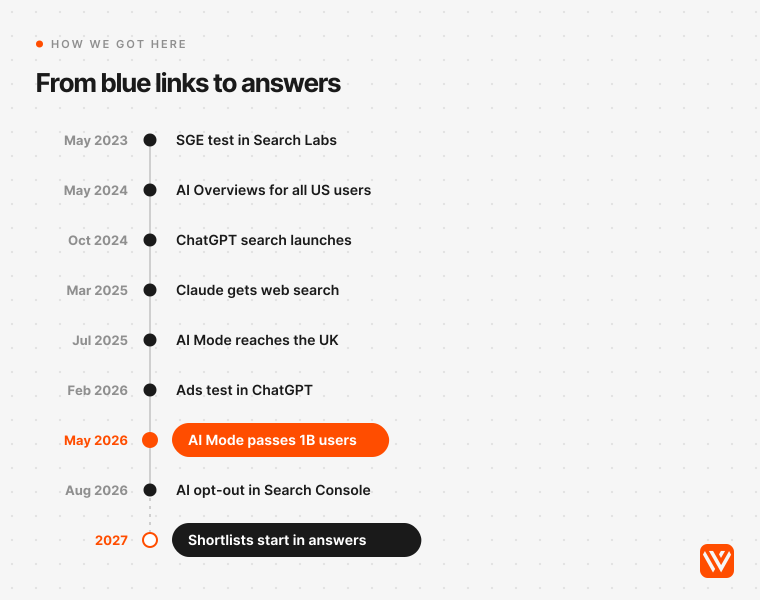
The money followed. ChatGPT began testing ads in the US on 9 February 2026 and had them live in the UK, Mexico, Brazil, Japan and South Korea by August. Google took ads in AI Mode to India and nine other countries in October 2026, with the UK planned for the fourth quarter.
How does AI search decide what to cite?
AI search answers a question by running several searches of its own, reading the pages that come back and writing an answer that links to a few of them. Google calls the first step query fan-out: AI Overviews and AI Mode "may use a 'query fan-out' technique", issuing related searches across subtopics before they answer. ChatGPT and Claude do the same through their search tools.
A citation is the link an AI answer shows next to a claim. It's the new unit of visibility: the buyer may never click it, but the vendor the answer names is now on their list.
Three terms get used for optimising for this, and they overlap almost completely:
- AEO (answer engine optimisation) is making pages that answer engines can quote.
- GEO (generative engine optimisation) is the same idea aimed at generative engines such as ChatGPT and AI Mode.
- AIO (AI optimisation) is the umbrella term some agencies, us included, use for both.
Google's position is blunt. Its May 2026 guide says optimising for generative AI search "is optimizing for the search experience, and thus still SEO", and Danny Sullivan told WordCamp US in August 2025: "Good SEO is good GEO, or AEO, AIO, LLM SEO, or LMNOPO… don't panic." Mike King of iPullRank disagrees: "'It's just SEO' is naive", he wrote in May 2026, because SEO is also "a budget line, and a reporting structure", and both were built for rankings and clicks.
Both are right about different things. The ranking signals are mostly the same. The pages, the reporting and the places you need to appear are not.
What we found when we asked ChatGPT and Claude 56 B2B software questions
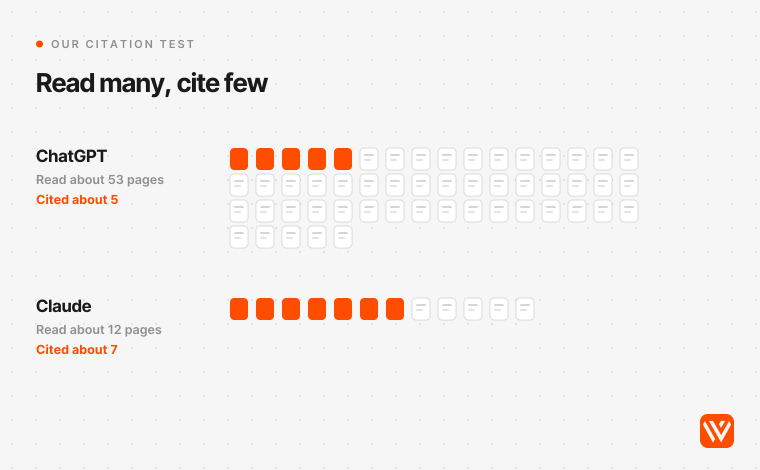
On 15 November 2026 we asked ChatGPT and Claude 56 questions a B2B software buyer actually asks, through their official APIs with web search switched on, and recorded every source the 112 answers cited. The two engines named mostly the same vendors and cited almost entirely different websites.
How we ran it. The questions covered eight software categories (CRM, project management, product analytics, help desk, employer of record and global payroll, SOC 2 compliance automation, data integration, AI meeting notes) and five intents for each: a shortlist ("What is the best CRM for a 50-person B2B SaaS company?"), a head-to-head ("HubSpot vs Salesforce"), alternatives ("What are the best alternatives to Deel?"), pricing ("How much does Vanta cost for a team of 20 people?") and how to choose. Each question ran from a San Francisco location; the eight shortlist questions also ran from London and Bengaluru. ChatGPT ran through OpenAI's Responses API with its web search tool (model gpt-6.1-sol); Claude through Anthropic's Messages API with its web search tool (claude-opus-5-5). We normalised every cited URL, 632 in all, and labelled who published it and what kind of page it was.
What the engines cited
| ChatGPT | Claude | |
|---|---|---|
| Answers with at least one citation | 56 of 56 | 54 of 56 |
| Pages read per answer (average) | 53 | 12 |
| Pages cited per answer (average) | 4.5 | 6.8 |
| Citations to a vendor's own product page (pricing, docs, product) | 86.5% | 2.9% |
| Citations to lists, comparisons and blog posts by software companies | 8.3% | 58.7% |
| Citations to media sites, agencies and independent blogs | 2.0% | 30.8% |
| Citations to review sites and communities | 0.8% | 6.8% |
| Cited pages with "2025", "2026" or "2027" in the title or URL | 6.8% | 89.5% |
| Pricing questions where the vendor's own pricing page was cited | 8 of 8 | 0 of 8 |
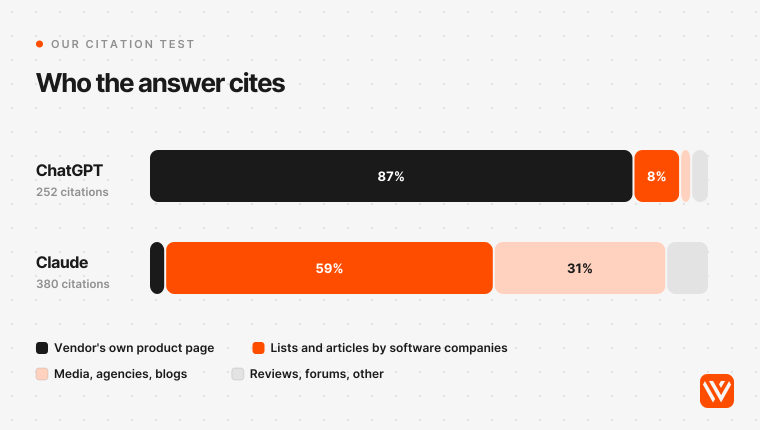
Four findings stand out.
- ChatGPT quotes vendors; Claude quotes people writing about vendors. 86.5% of ChatGPT's citations went to a vendor's own product page: 57.5% of all its citations were pricing pages and 15.1% docs and help pages. Only 2.9% of Claude's citations did. Claude drew 80.5% of its citations from best-of lists, alternatives pages and comparisons.
- For pricing, one engine skipped the vendor entirely. Asked "How much does HubSpot cost for a team of 20 people?", Claude cited six pricing explainers written by other companies (Featurebase, eesel, Hublead and three agencies and review sites) and not hubspot.com. Across the eight pricing questions, Claude cited the vendor's own pricing page 0 times; ChatGPT did in all 8.
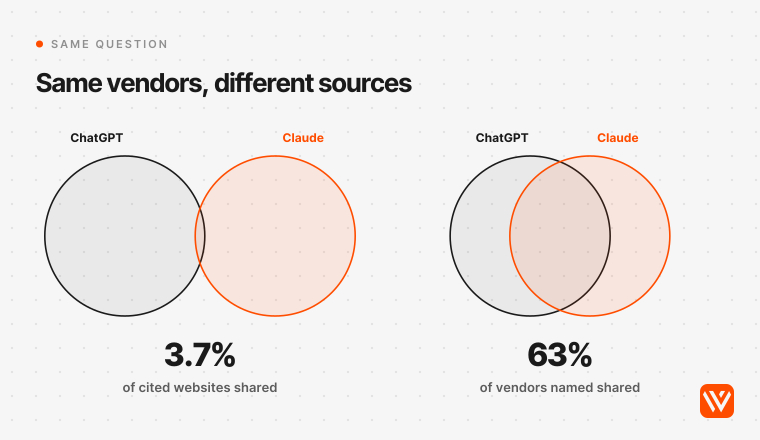
- The engines agree on who, not on where. On 37 of 56 questions, ChatGPT and Claude didn't cite a single website in common (average overlap 3.7%). Yet 63% of the vendors they named overlapped, and the first vendor each answer named matched on 15 of 24 shortlist questions.
- Reviews and forums barely appeared. G2 got 0.5% of Claude's citations and none of ChatGPT's. Reddit and YouTube got none from either engine, which matches what our October study found for Claude.
Two limits. Each question ran once, and answers change between runs. And API answers can differ from what the consumer apps show, so treat the split as a pattern, not a fixed rate. We couldn't include Gemini: its API refused Google Search grounding on our key for quota reasons, so Gemini and Google AI Mode answers in this post come from Google's own statements and third-party studies.
The 10 SEO trends that change B2B SaaS in 2027
1. The vendor shortlist starts in a chatbot
B2B software buyers now build their first shortlist inside an AI chatbot. G2's April 2026 survey of 1,076 software buyers found 51% start research in an AI chatbot more often than in Google, up from 29% in April 2025, with ChatGPT the dominant chatbot for that research at 63%. G2's July report, a separate survey of 1,038 decision-makers in North America, EMEA and Asia-Pacific, found more than 80% had sourced software recommendations from an AI chatbot in the past two years.
The shortlist then hardens early. In 6sense's survey of more than 4,000 buyers, 94% of buying groups had ranked a preferred vendor before first contact with sales, and they bought that vendor 77% of the time. G2 found that 80% of AI-assisted buyers bought from their initial shortlist in three of their last five purchases, against 65% of buyers who didn't use AI.
Read those two together and the risk is plain: if the answer leaves you out, you may not get a second chance in that deal. One caution on the source. G2 runs a review platform and benefits when buyers trust third-party opinions, so treat its numbers as direction, not precision.
What to do: ask the engines your buyers use for your category shortlist once a month (best X for Y, X alternatives, X vs Y), from the markets you sell in, and log which vendors appear and which pages are cited. That's the baseline every other trend in this list builds on.
2. Google's AI Mode becomes a second front page
AI Mode is Google's conversational search mode, and in 2027 it's where long, complex B2B questions go. Google said in October 2026 that query growth was "the highest it's been in the last five years", that AI Mode queries are on average three times longer than classic searches, and that one in five use voice, images or documents.
Not everyone sees the same growth. Similarweb wrote in July 2026 that AI Mode usage "grew fast early on and has since leveled off and started to soften", and SparkToro's panel saw only 0.34% of US Google searches go to AI Mode between January and April 2026. Barry Adams of Polemic Digital made the bolder call in 2025: "I suspect AI Overviews are probably going to disappear and be replaced by AI Mode." That's his forecast, not a Google plan.
For a B2B SaaS team the takeaway doesn't depend on who's right about the size. AI Overviews already sit on a large share of results: BrightEdge measured them on roughly 48% of tracked queries, up from about 30% a year earlier. Both surfaces fan out into sub-questions, and both cite.
What to do: list the 30 to 50 long questions a buyer asks before choosing a product like yours (integrations, security, pricing for a team size, migration from a competitor) and check that one page on your site answers each one directly. Don't build a separate page for every variation. Google's guide warns that writing for fan-out queries "primarily to manipulate rankings" violates its scaled content abuse policy.
3. Clicks per search fall, and impressions stop meaning demand
A search with an AI answer sends fewer clicks than one without. Pew Research tracked 900 US adults in March 2025 and found they clicked a result on 8% of visits that showed an AI summary, against 15% without one; only 1% clicked a link inside the summary. Ahrefs measured a 58% lower click-through rate for the top result on queries with an AI Overview across 300,000 keywords. SparkToro estimated that 68.01% of US Google searches ended without a click in early 2026.
Google disagrees with the conclusion people draw from this. Liz Reid, its head of Search, wrote in August 2025 that "total organic click volume from Google Search to websites has been relatively stable year-over-year". Both can be true: fewer clicks per search, more searches in total. And being cited still pays. Seer Interactive found that brands cited inside an AI Overview earned 120% more organic clicks than brands that weren't, though still 38% fewer than on queries with no AI Overview at all.
Our own Search Console shows the other half of the story. Between November 2025 and 12 November 2026, webyansh.com appeared for queries of eight words or more 49,478 times and got one click from them. Shorter queries converted 0.30% of impressions into clicks. Long queries also grew: 14.4% of our query rows in November 2025, 24.6% in October 2026. Queries of 12 words or more went from 6.1% to 11.8%.
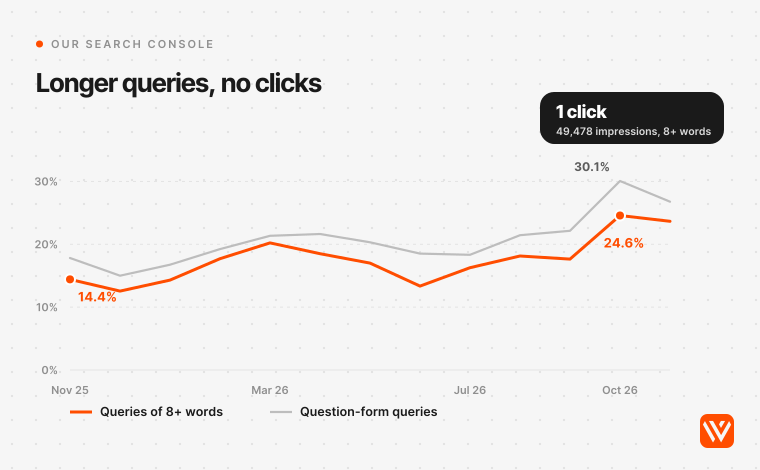
Here's what the long ones look like. All had zero clicks.
| Query (October or November 2026) | Impressions in the month | Average position |
|---|---|---|
| which templates are optimized for saas and enterprise b2b websites? | 524 | 2.8 |
| what aeo experimentation roadmap should marketers follow to improve ai visibility and conversions? | 313 | 6.2 |
| how strong is webflow's api and headless capabilities for complex enterprise stacks? | 173 | 2.4 |
| recommend a webflow agency for ongoing site maintenance and updates | 80 | 6.4 |
| top webflow us agencies that optimize enterprise websites for llms | 58 | 3.2 |
People don't usually type "recommend a webflow agency for ongoing site maintenance and updates" into Google, see us in position six and move on, 80 times. Our reading, which is an inference and not something Google confirms, is that many of these are prompts or the fan-out searches that AI assistants and AI-visibility trackers send while they assemble an answer. The page earns the impression. The assistant keeps the reader.
HubSpot has lived the extreme version. Its CMO Kipp Bodnar said in October 2026 that the blog lost about 80% of more than 20 million monthly organic visits while revenue grew nearly 20% in 2025. "We had tracked traffic as the scoreboard for 15 years, and it said we were failing," he said.
What to do: stop reporting organic sessions as the headline. Report clicks on queries that signal buying intent, demo and trial starts from organic and AI referrals, and pipeline. And read impressions on long queries as a visibility signal, not demand you're failing to capture.
4. Official pages become citation assets
Your own pricing, comparison, docs and integration pages are what one major engine quotes when a buyer asks about you. In our test, 86.5% of ChatGPT's citations went to a vendor's own product page, and for every head-to-head and pricing question it cited the vendor's own site (16 of 16). When the buyer asked for alternatives, ChatGPT cited the alternatives' own pages in all 8 answers.
This is the cheapest trend on the list to act on, and the one most B2B SaaS sites get wrong. Pricing pages that say "contact us" give the engine nothing to quote, so it quotes someone else's guess. Comparison pages written as sales copy ("why we're better") give it nothing neutral to lift.
What to do: make every money page answer its question in the first two sentences: what it costs and for whom, how it compares and where it doesn't fit, which plans include which limits. Use tables. Keep the facts current, because engines will quote them back to buyers.
5. Third-party lists decide the rest of the answer
When an engine doesn't quote your site, it quotes pages other people wrote about your category. In our test, 96.3% of Claude's citations went to lists, comparisons, pricing explainers and articles rather than a vendor's own product page, written by other software companies (58.7%), media sites, agencies and independent blogs (30.8%), and review sites and communities (6.8%). Many are companies a buyer has never heard of: a help desk vendor explaining Zendesk's pricing (LiveAgent), an analytics tool comparing Amplitude and Mixpanel (Humblytics), an AI support startup explaining HubSpot's (eesel).
That changes where SEO effort goes. Getting into the lists, reviews and comparisons that engines read is now part of SEO, not a PR side project. Our October study of 146 B2B software companies found the same concentration from the other side: Domain Rating had a 0.77 rank correlation with AI citations, 17.8% of companies had none at all, and the bottom half shared 0.59% of them.
Be careful with the shortcut. Lily Ray of Amsive found that a brand's own self-ranking listicle can earn a citation and still "backfire, serving as a vote for your competitors": in her sample, brands cited for their own "best" list were left out of the recommendation 69% of the time.
What to do: find the 20 pages the engines cite most for your category questions and work on being in them honestly: correct facts, a real customer quote, current pricing. Publish your own comparisons too, but make them fair enough that an engine could use them for a competitor's question.
6. Freshness becomes literal
Engines prefer pages that say they're current, and in our test that preference was visible in the URLs. 89.5% of the pages Claude cited had "2025", "2026" or "2027" in the title or URL, almost all of them "2026". ChatGPT's figure was 6.8%, but only because it cited product pages, which don't carry a year.
Writers have noticed. Title tags with the current year are now standard on "best X" and "X pricing" pages, which is why so many list posts read "2026" in November. The risk for 2027 is a race to stamp "2027" on unchanged pages. That's not the point. The point is that a page with stale prices or a retired plan gets quoted wrong, and the engine's answer becomes your problem in a sales call.
What to do: give pricing, comparison and integration pages an owner and a review date, show a visible "updated" date, and change the year in the title only when the content changed.
7. Each engine cites different sources
ChatGPT, Gemini, Claude, Perplexity and Google's AI features don't share a source list, so one ranking no longer means one result. In our test, ChatGPT and Claude cited no website in common on 37 of 56 identical questions, while naming 63% of the same vendors.
The market split widened too. Similarweb's panel shows ChatGPT's share of generative AI web visits falling from about 76% to about 53% between June 2025 and May 2026, while Gemini rose from under 9% to 27–28% and Claude from about 2% to about 9%. Josh Grant, Webflow's VP of Growth, described the effect in November 2025: "Every query is a fresh model run that reshuffles sources in real time based on context, trust, and recency."
What to do: track at least three engines (ChatGPT, Google AI Mode or AI Overviews, and the one your buyers use most, often Gemini or Claude in enterprise accounts) and judge trends over weeks, not single runs.
8. Crawler access becomes a policy decision
AI crawlers now come in three kinds, and B2B SaaS teams need a decision for each. Training crawlers collect pages to train models, search crawlers fetch pages so an engine can cite them, and user agents fetch a page when someone asks an assistant to read it. OpenAI documents GPTBot for training and OAI-SearchBot for ChatGPT search, and notes that for ChatGPT-User "robots.txt rules may not apply". Anthropic separates ClaudeBot, Claude-SearchBot and Claude-User. Perplexity says PerplexityBot "is not used to crawl content for AI foundation models", and Google's Google-Extended token controls Gemini training and, in Google's words, "does not impact a site's inclusion in Google Search". The same page says Google intends to support the AIPREF training-preference signal, a shared machine-readable standard, in early 2027.
Training traffic has grown fast. Cloudflare reported that 52% of crawler requests on its network were for AI training in June 2026, against 22% in spring 2025, and that new Cloudflare domains block AI training crawlers by default. In July 2025 Cloudflare measured Anthropic crawling 38,065 pages for every referral it sent back, OpenAI 1,091 and Perplexity 195. Those ratios undercount app referrals that carry no referrer, but the direction is clear.
The risk for B2B SaaS isn't blocking too little. It's blocking the wrong crawler by accident. When we scanned 207 Astro sites in November 2026, GPTBot and ClaudeBot got a 403 on 20 of 55 sites with Cloudflare's AI settings, while ChatGPT's and Claude's search crawlers got through on almost all of them. That's usually the intended outcome. Blocking a search crawler is not.
Google added its own control. Since 31 August 2026 any site can opt out of AI Overviews, AI Mode and AI Overviews in Discover from Search Console, and Google says the setting isn't used as a ranking signal outside those features. In the UK it follows the Competition and Markets Authority's June 2026 conduct requirement. For a software company that wants to be recommended, opting out is almost always the wrong call.

What to do: read your robots.txt and your CDN's bot settings this quarter. Allow OAI-SearchBot, Claude-SearchBot, PerplexityBot and Googlebot. Decide on GPTBot, ClaudeBot and Google-Extended as a business choice, write the decision down, and check that your firewall matches it.
9. Ads and agents arrive inside the answer
AI answers are becoming ad inventory in 2027. OpenAI says of ChatGPT that "Ads do not influence the answers", and keeps ads off paid tiers; Similarweb estimated in 2026 that roughly 26% of ChatGPT responses contain an ad. Google runs ads in AI Mode in the US and, since October 2026, in India, Australia, Canada, Singapore and six more countries, and says click-through rates "are already similar between sponsored and organic product list items" there.
The forecasts are big and should be read as forecasts. eMarketer expects US AI search ad spend to grow from $2.08 billion in 2026 to $25.93 billion in 2029. Gartner predicts that by 2028 90% of B2B buying will be intermediated by AI agents, with more than $15 trillion of spend. Read that next to 6sense's finding that buyers still pick a favourite before they talk to anyone, and the honest view for 2027 is narrower: agents will compile options and compare specs, and the facts on your pages are what they compare.
What to do: keep paid tests small until measurement matures, and make your product facts machine-readable: plain HTML tables for plans and limits, clear integration lists, and security and compliance pages that state what you hold.
10. Measurement moves from traffic to visibility and pipeline
AI referrals are still small in analytics, and that's exactly why they're easy to misjudge. Conductor's benchmark across 13,770 domains found AI referrals made up 1.08% of traffic, 2.80% in IT, with ChatGPT sending 87.4% of them. Clicks from Google's AI features arrive as ordinary Google organic traffic, so they're invisible in referral reports.
Per visit, the traffic converts well. Ahrefs reported that AI search was 0.5% of its visits and 12.1% of its signups in June 2025, and Webflow's VP of Growth said 10% of signups came from AI discovery. In volume, Google still dominates: Marie Haynes found across 100 sites that Google drove 96.5% of conversions, and wrote that "the AI search that is actually sending people to businesses today isn't ChatGPT. It's Google."
Our own analytics agree with both. From November 2025 to 13 November 2026, AI assistants sent about 14% as many engaged sessions to webyansh.com as organic search did, and referrals from chatgpt.com fell from 122 sessions in January 2026 to 22 in October. AI visibility moves around. A report built only on referrals will miss most of it.
Not everyone thinks visibility is the right thing to measure. Eli Schwartz warned in January 2026: "We're back to that place where now we're measuring prompts instead of measuring customers." He has a point. The fix is to measure both and connect them.
What to do: add four lines to the monthly SEO report: share of AI answers that name you for your top 20 buyer questions, cited pages, AI referral sessions and conversions, and a "how did you hear about us" field on demo forms with AI assistants as an option. Use Bing's AI Performance report and Search Console's AI feature data where you can.
What doesn't change in 2027
The fundamentals still decide who gets read in the first place. Google says there are no additional requirements to appear in AI Overviews or AI Mode and no special schema to add. Its guide says you can ignore "chunking" content and AI text files such as llms.txt, which "will neither harm nor help" visibility in Google Search.
The independent data mostly agrees:
- llms.txt: SE Ranking found the file on 10.13% of about 300,000 domains and no correlation with AI citations. John Mueller called its future "purely speculative for now" in June 2026.
- Schema: Ahrefs added structured data to 1,885 pages and compared them with 4,000 controls; the change in AI citations was indistinguishable from zero for AI Mode and ChatGPT. Google also retired FAQ rich results on 7 May 2026. Schema still helps search engines understand a page. It isn't a citation switch.
- Authority: in our 146-company study, Domain Rating predicted AI citations far better than team size; every company at DR 60 or above was cited somewhere and 85% of companies under DR 20 were cited nowhere.
- Core updates: Google ran core updates in March, May and November 2026. Rankings still move on the old schedule.
We still add an llms.txt and structured data on client sites because they cost little and help other tools. We just don't sell them as AI visibility. (Our own schema guide for Webflow explains what to keep.)
Rand Fishkin put the balance well in June 2026: your SEO "still matters as much or more than ever before, it just won't earn you traffic the way it once did".
How should a B2B SaaS team plan SEO for 2027?
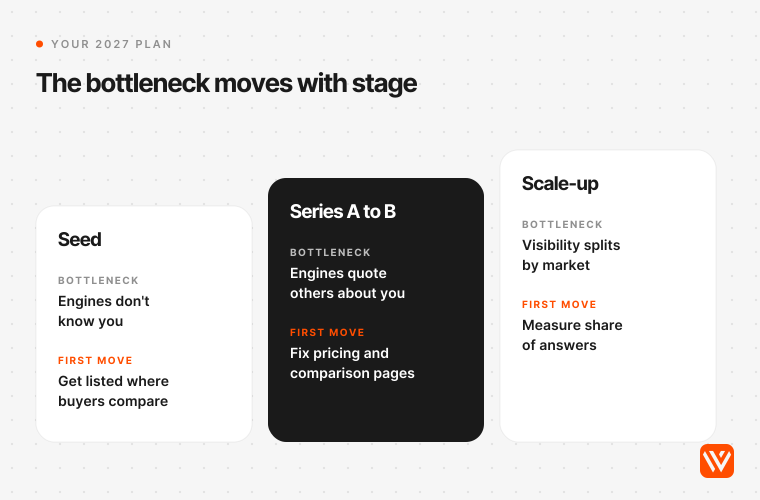
Plan 2027 by stage, because the bottleneck differs. A seed-stage company has no authority for engines to trust; a company at $20 million in revenue usually has authority and stale pages.
| Stage | Main bottleneck | What to do in 2027 | What to skip |
|---|---|---|---|
| Pre-seed to seed, under about 20 people | Engines don't know you exist (40.8% of companies with 10 or fewer people had no AI citations in our 146-company study) | Get listed where the category is compared: review sites, integration directories, two or three honest third-party comparisons. Publish a clear pricing page and three comparison pages | Large content programmes, AI visibility dashboards |
| Series A to B, roughly $5M to $50M revenue | Engines know you but quote other people's facts about you | Rewrite pricing, comparison, alternatives and integration pages answer-first. Monthly prompt tracking on three engines. Fix crawler and CDN settings | Publishing for every fan-out variation; stamping "2027" on unchanged pages |
| Scale-up and enterprise | Visibility is fragmented across markets, products and engines | Measure share of AI answers by market and product line, and tie it to pipeline. Refresh comparison content on a set cycle. Decide training-crawler policy at company level | Treating AI referrals as the KPI on their own |
A 90-day start for most Series A to B teams:
- Write down 20 to 30 buyer questions for your category, from sales calls and the "People also ask" boxes on your top keywords.
- Run them in ChatGPT, Gemini or AI Mode, and Claude from your main markets, and record the vendors named and the pages cited.
- Fix the pages of yours that should have been cited: pricing, comparisons, alternatives, integrations, security.
- Contact the five third-party pages cited most often with corrections or new facts.
- Check robots.txt and CDN bot rules against a written crawler policy.
- Add AI visibility and a self-reported attribution field to the monthly report.
- Re-run the questions at day 90 and compare.
We do this for clients as part of our AI search optimisation for Webflow sites. For Propel, one of our clients, 132 pages are now cited by AI engines and organic traffic grew 67% year on year.
How do the US, UK and India differ in 2027?
The trend is global, but the timing, the ads and the rules differ by market. If you sell in all three, plan for the slowest and the fastest at once.
| United States | United Kingdom | India | |
|---|---|---|---|
| Google AI Mode | Since 2025; three-times-longer queries reported for the US | Launched 28 July 2025 | English since August 2025, plus seven Indian languages from October 2025 |
| Ads in AI answers | ChatGPT ads since 9 February 2026; ads in AI Mode | ChatGPT ads by August 2026; AI Mode ads planned for Q4 2026 | AI Mode ads since October 2026; ChatGPT ads not listed by OpenAI as of August 2026 |
| Regulation | Court remedies against Google (September 2025), data-sharing still being built in 2026 | CMA conduct requirement: publisher opt-out from AI features, compliance due about nine months from June 2026 | No regulator action on AI Overviews found |
| Usage signals | 68.01% of Google searches ended without a click (SparkToro, early 2026) | About 30% of searches show an AI Overview; ChatGPT had 1.8 billion UK visits in eight months of 2025 (Ofcom) | Google's largest voice and visual search market; about 100 million weekly ChatGPT users (Sam Altman, February 2026) |
Sources: Google on AI Mode in the US, Google UK, Google India, OpenAI ads, Google ads in AI Mode, CMA, Ofcom, TechCrunch on India's ChatGPT users.
Location mattered less than the engine in our test. Asking the eight shortlist questions from London or Bengaluru instead of San Francisco, ChatGPT named the same first vendor in 14 of 16 runs and reused 74% of its cited domains; Claude named the same first vendor in 11 of 16 and reused 49%. Only one of 202 citations in the London and Bengaluru runs pointed to a .uk or .in site. For B2B software, the sources that shape an answer in India and the UK are mostly the same US-written pages, so local pages win on local facts (pricing in INR or GBP, data residency, payroll law), not on general category content.
Europe moves through regulators. The European Commission opened an antitrust case in December 2025 over Google's use of publishers' content in AI Overviews and AI Mode, and fined Google a total of €890 million (about $984 million at the ECB rate of 13 November 2026) under the Digital Markets Act in July 2026, €460 million of it for favouring its own services in Search. The Commission said its dialogue with Google on AI Overviews and AI Mode will continue. When AI Overviews reached France in July 2026, Ahrefs measured a median 5.7% fall in click-through rate across 963 domains, and 23.1% for the most exposed. In South Korea, Naver's own AI Briefing appeared on about 20% of queries in 2025, and Naver expects more than 40% in 2026.
Indian practitioners describe the same shift as everyone else. "The most common call we get now is a client asking, 'Rankings are fine, so why is traffic down?'" Saket Dandotia, CEO of Onetab.ai, told exchange4media in July 2026. "And the honest answer is: nothing's broken. This is just search now."
When this advice doesn't apply
Skip most of this post if:
- You sell only through partners or a marketplace (AWS Marketplace, Salesforce AppExchange) and buyers never research you directly. Work on the marketplace listing instead.
- Your buyers are a closed list of under 100 accounts. Account-based sales and events will beat search visibility, AI or not.
- You're pre-product. You have nothing for an engine to cite yet. Ship, then publish pricing and comparisons.
- You're in a regulated category where claims need legal review (health data, financial advice). Keep the crawler and measurement work, and move slower on comparison content.
And skip the parts that sell certainty. Nobody, us included, can promise that a page will be cited by a given engine on a given day.
The next step
If you want to know where your company stands before you plan 2027, our AI visibility audit runs your buyer questions across the engines, checks your pages and crawler settings, and ends with a 90-day plan. If you'd rather start with something free, try our AI Design Scorer on your homepage.
What are the top SEO trends for 2027?
The top SEO trends for 2027 are AI answers replacing the first shortlist, Google's AI Mode growing alongside AI Overviews, fewer clicks per search, vendor pages and third-party lists becoming citation sources, visible freshness, engines citing different sources, crawler policy, ads inside AI answers, and measurement shifting to visibility and pipeline.
Is SEO dead in 2027?
No, and AI isn't replacing it. SEO still decides which pages AI engines read and cite, and Google says appearing in its AI features needs nothing beyond good SEO. What's declining is traffic per search: Pew found clicks fell from 15% to 8% of visits when an AI summary appeared. SEO now earns visibility and pipeline more than visits.
What's the difference between SEO, AEO and GEO?
SEO is optimising pages to rank in search engines. AEO (answer engine optimisation) and GEO (generative engine optimisation) are optimising pages to be quoted and cited by AI answers in Google AI Mode, ChatGPT, Gemini, Claude and Perplexity. The signals overlap heavily; the pages, measurement and channels differ.
How do B2B SaaS companies get cited by ChatGPT and Google AI Mode?
B2B SaaS companies get cited by publishing pages that answer buyer questions directly (pricing, comparisons, alternatives, integrations), keeping them current, allowing AI search crawlers, and appearing in the third-party lists and reviews engines read. Authority still matters: in our 146-company study, Domain Rating predicted AI citations best.
Should B2B SaaS companies block AI crawlers?
Block training crawlers only if that's a deliberate business decision, and never block search crawlers you want citations from. Allow OAI-SearchBot, Claude-SearchBot, PerplexityBot and Googlebot. Check your CDN too: new Cloudflare domains block AI training crawlers by default, and settings can block more than intended.