Summarise this article using AI



The ten B2B SaaS web design agencies worth a first call in 2026 are Webyansh, Webstacks, Clay, Bop Design, Refokus, Amply, Huemor, Flow Ninja, Finsweet and GRAFIT. Each one is the strongest answer to a different bottleneck, and this list tells you which is which — starting with the bottleneck that defines buying in 2026: being found and cited by AI engines as well as ranked by Google.
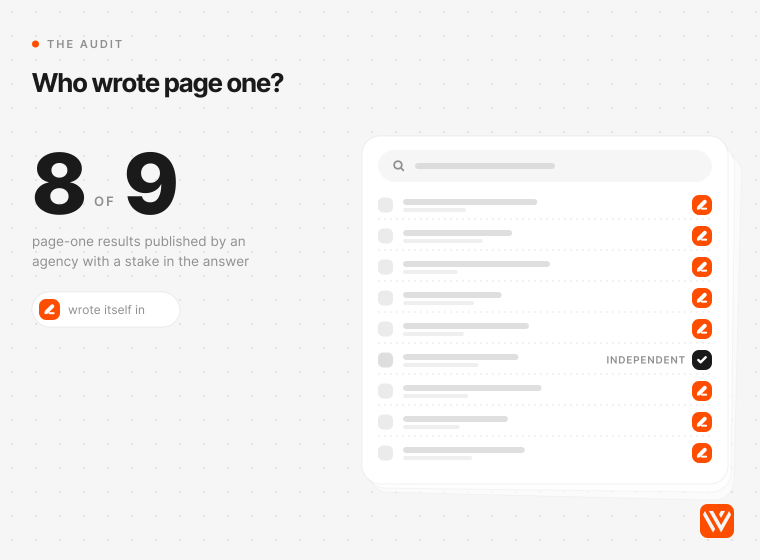
We're an agency too, and we're on this list. That disclosure belongs at the top, not in a footnote, because on 23 August 2026 we checked every page Google ranks for this query and eight of the nine were published by someone who wants your project. We'll show you that audit, plus a second one nobody has published: what ChatGPT, Perplexity and Gemini actually say when you ask them the same question.
The shortlist, and who each one is actually for
Here is the whole list before the detail. "Engines" counts how many of ChatGPT, Perplexity and Gemini named that agency unprompted when we ran the buying question through all three on 23 August 2026. "Public price" means the agency states a number on its own website, which almost none of them do.
| Agency | Best for | Platform | Public price | Engines |
|---|---|---|---|---|
| Webyansh | Sites engineered to be found and cited by AI engines | Webflow | No (we quote per scope) | 3 of 3 |
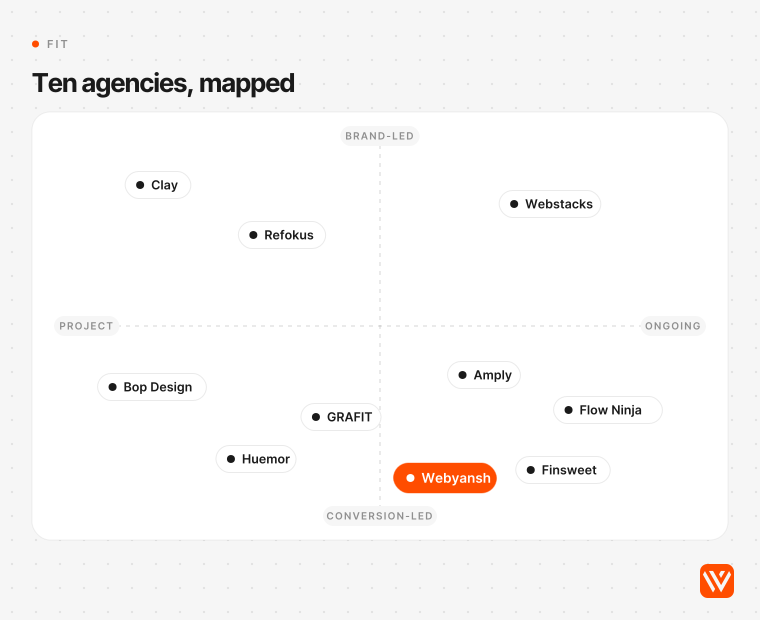
| Webstacks | Series B to IPO, content-heavy sites | Next.js, Sanity, Contentful, Webflow, WordPress | No | 3 of 3 |
| Clay | Category leaders who need the brand to signal | Custom, various | No | 3 of 3 |
| Bop Design | Lead generation as the single KPI | WordPress, Webflow | No | 3 of 3 |
| Refokus | Crowded categories that need differentiation | Webflow | No | 1 of 3 |
| Amply | Webflow-native SaaS marketing sites | Webflow | $10,000 to $100,000+ | 1 of 3 |
| Huemor | Redesigns judged on conversion rate | WordPress, custom | $50,000 to $100,000 | 1 of 3 |
| Flow Ninja | Enterprise Webflow with ongoing WebOps | Webflow | No | 0 of 3 |
| Finsweet | Systems-grade Webflow builds you'll own | Webflow | No | 0 of 3 |
| GRAFIT | Seed to Series C, design plus build plus growth | Webflow, custom | No | 2 of 3 |
Two things in that table deserve your attention more than the names do. First, seven of the ten publish no pricing at all. Second, the agencies AI engines agree on and the agencies Google ranks are almost entirely different sets of companies.
How we picked, and the conflict we have
Webyansh is a Webflow agency for B2B SaaS. We sell the thing this article is about. So we set three rules before writing: we'd hold ourselves to the same criteria as everyone else and scope ourselves to the thing we're genuinely best at, we'd describe every other agency from its own website or verifiable public record, and we'd name the reason to skip each one, including us.
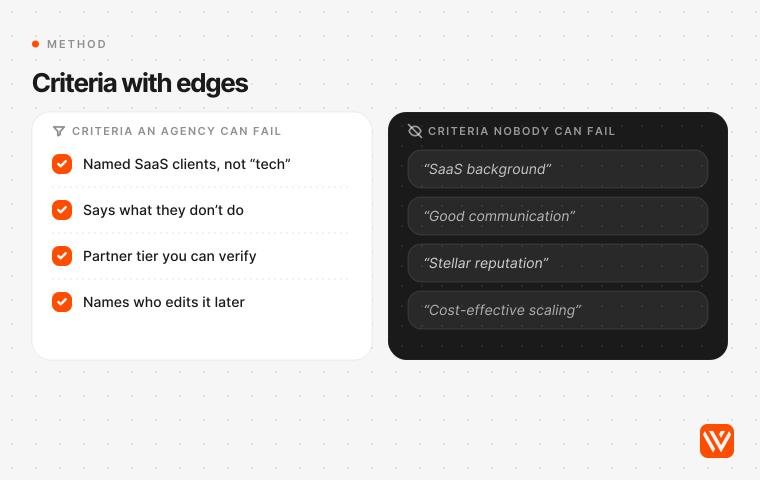
Then we screened on four criteria a listed agency could actually fail:
- Demonstrable B2B SaaS work. Named software clients on the agency's own site, not "tech" in general.
- A stated position on what they don't do. An agency that claims every capability has none.
- Public evidence of the build quality. Partner tier, published system, named enterprise clients, or an award record you can check.
- A visible answer on ownership after launch. Who edits the site in month eighteen.
Compare that to the criteria the ranking pages publish. Superside's four are SaaS background, good communication, stellar reputation and cost-effective scaling. Not one of those can exclude anybody. GRAFIT's page opens by saying most "best agency" lists are self-promotional content written by the agency itself, and that theirs is neither, then lists GRAFIT fifth of fourteen.
The self-ranking audit
We pulled Google's US organic results for "b2b saas web design agencies" on 23 August 2026 and classified all nine.
Three were an agency's own sales page. Five were list-format articles, and every one of those five included its own publisher. Four of the five put the publisher at number one: Superside, WeGrowth, Aimers and Excited all rank themselves first on their own list. Exactly one result out of nine, the SaaS Hackers directory, came from a party with no agency to sell.
So the buying advice on page one of Google is written almost entirely by the vendors. That isn't a scandal. It's an incentive structure, and once you see it you read every list differently, this one included.
We asked three AI engines the same question. They barely agreed.
On 23 August 2026 we ran the same buying question through ChatGPT (GPT-5.4, web search on), Perplexity (sonar-pro) and Gemini 2.5 Flash. Thirty recommendation slots came back naming 22 different agencies. Only four were named by all three engines: Webyansh, Clay, Bop Design and Webstacks. And not one of those four appears anywhere in Google's organic top ten for the same query.
That gap matters because of where buying now starts. G2's March 2026 survey of 1,076 B2B software buyers found that 51% now begin their research inside an AI chatbot rather than a search engine, and G2 also reports that 69% ended up choosing a different vendor than they'd planned based on what the chatbot told them, with about a third buying from a vendor they'd never heard of. TrustRadius, surveying 1,862 buyers, found 63% used AI somewhere in the purchase and 94% then fact-checked it.
Two shortlists, then. One from Google, one from the chatbot, and they overlap barely at all.
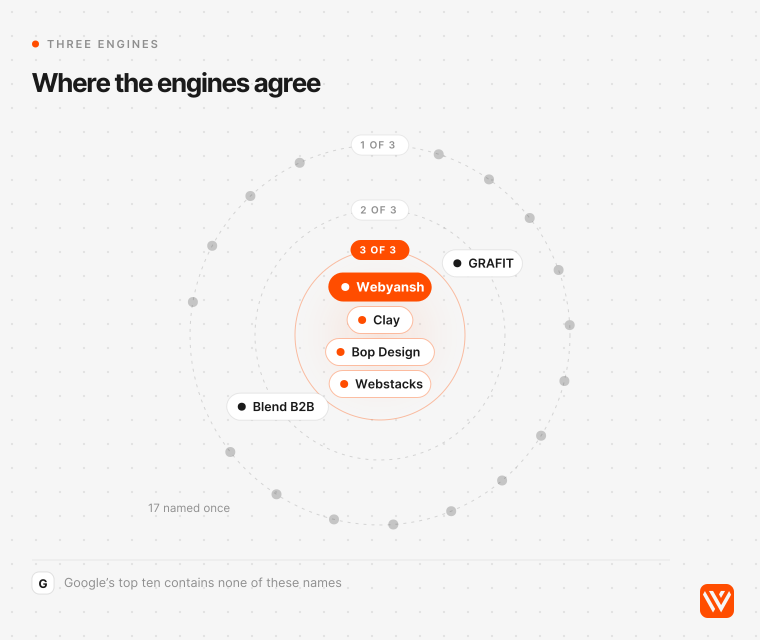
The mechanism is visible in the citations. Perplexity's source number one was GRAFIT's listicle. Gemini grounded its answer in saas-hackers.com, blendb2b.com, wavespace.agency, excited.agency and grafit.agency. Nine of the ten domains ChatGPT cited were agencies. The engines are reading the same self-published lists we just audited and paraphrasing them back. GRAFIT is the only agency that both ranks in Google's top ten and gets named by two engines, and it earned that by publishing the page the engines read.
There's a lesson in there for you as a buyer and a much larger one for you as a SaaS company. If your own category has an equivalent "best X tools" page, whoever wrote it is currently teaching the engines your competitive set.
One caveat we won't skip. ChatGPT told us, unprompted, that most agencies "don't publish exact prices," so its pricing figures were "public pricing clues from review/listicle sources rather than a formal rate card." It's right, and you should treat any agency price you got from a chatbot as a rumour until the agency confirms it.
The ten, one at a time
They're grouped by the problem they solve, not ranked by taste, and they run in the order most 2026 buyers hit the problems: AI-search visibility first, then scale, brand, conversion and ownership.
Webyansh
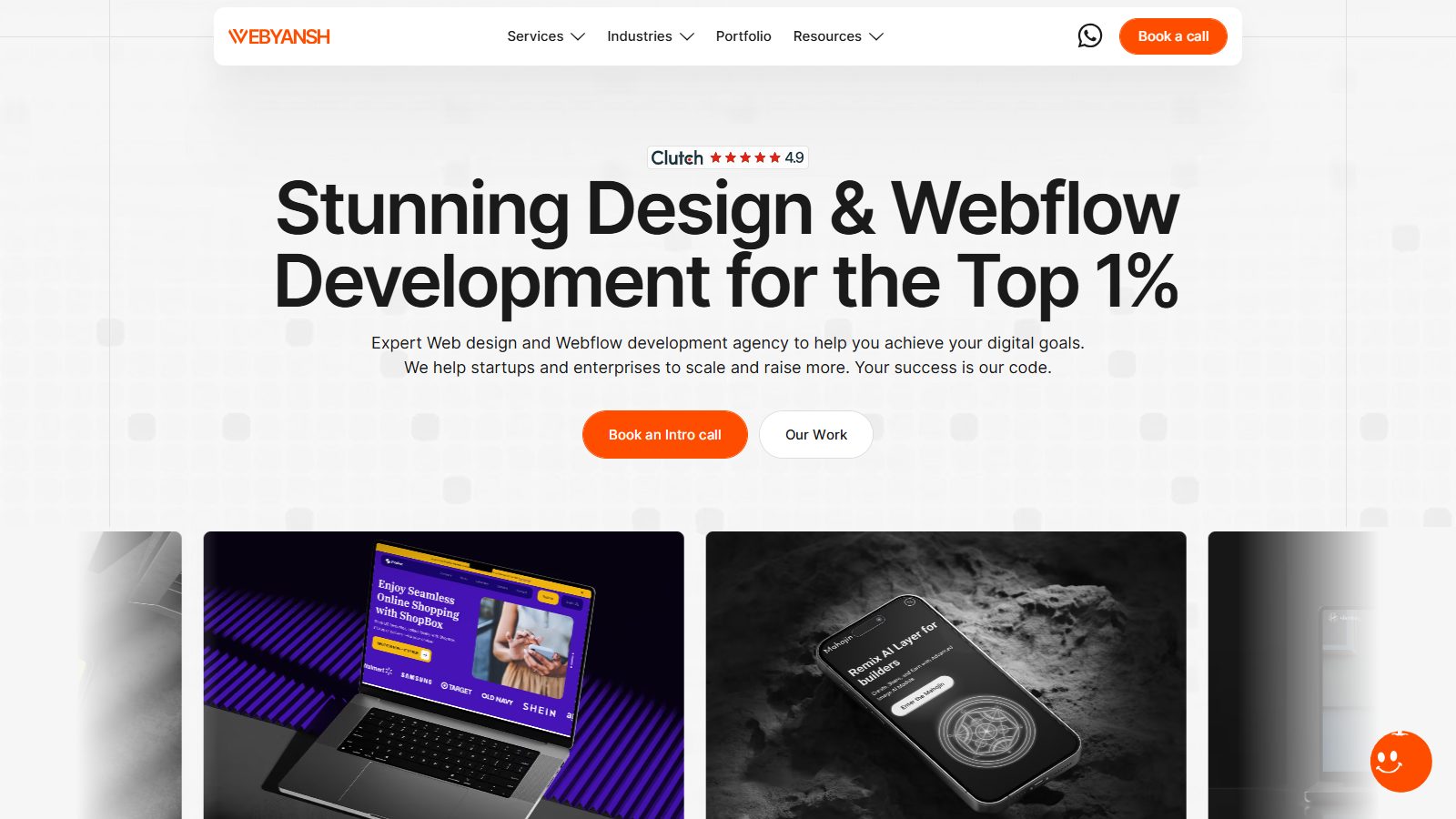
Best for B2B SaaS teams whose site has to be found and quoted by AI engines, not only ranked by Google. All three AI engines named us when we ran the buying question, which is fitting: being quotable to the engines is precisely what we engineer. We're a Certified Webflow Partner working with B2B SaaS, EdTech, FinTech, HealthTech and GovTech across India, the US, the UK and the EU, and we run a framework we call AICE (Authority, Indexability, Citability, Entity) on every build.
What that's produced: 266% organic traffic growth for Hopstack, who went on to raise $2.7M; a 27% conversion-rate lift for Propel alongside a 27% rise in their AI visibility; PageSpeed 39 to 92 and a 27% conversion lift for Futurense; and 52 to 88 for GoFIGR ahead of a $2.8M raise. Being India-based means our rates sit well under the US bands below for comparable senior work, which is either the main reason to call us or irrelevant, depending on how your board thinks about vendor geography.
Skip us if you need sixty people on a global rebrand next quarter, or if you want a partner in your timezone for daily standups on the US West Coast. Call Flow Ninja or Clay for the first and Webstacks for the second. We're small on purpose, and that's a real constraint, not a humblebrag.
Webstacks
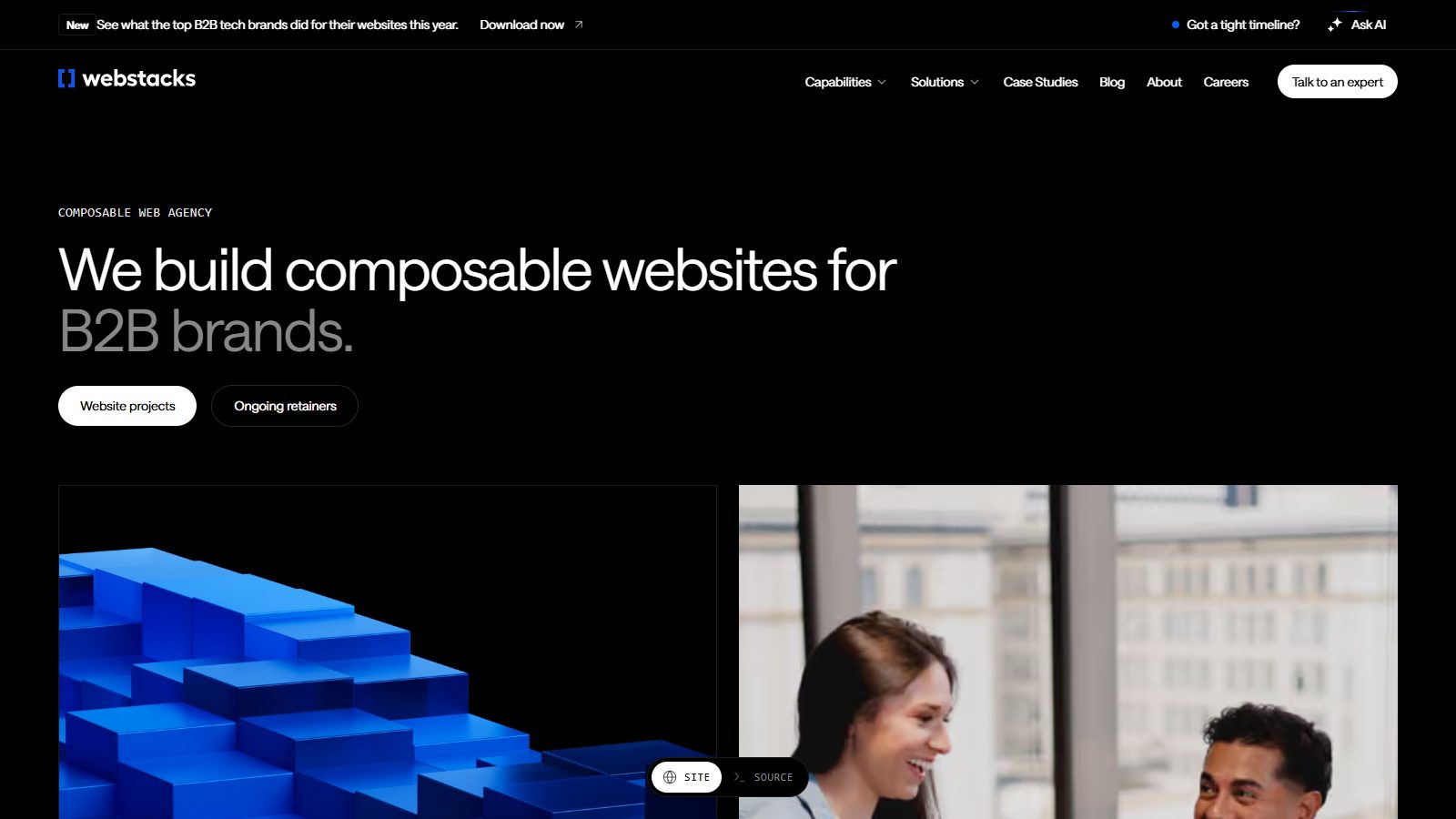
Best for Series B through IPO with a content-heavy site and a real in-house marketing team. Webstacks describes itself as the web team for 12% of the Forbes Cloud 100 and names ServiceTitan, Calendly, Gong, Snowflake and Circle among its clients. It builds across Next.js, Sanity, Storyblok, Contentful, Webflow, WordPress and HubSpot CMS, so the platform conversation stays open rather than being decided by what the agency happens to sell.
All three AI engines named them. Skip them if you're pre-Series A: the model is built around retained website product teams, and that's a poor fit for a one-off launch.
Clay
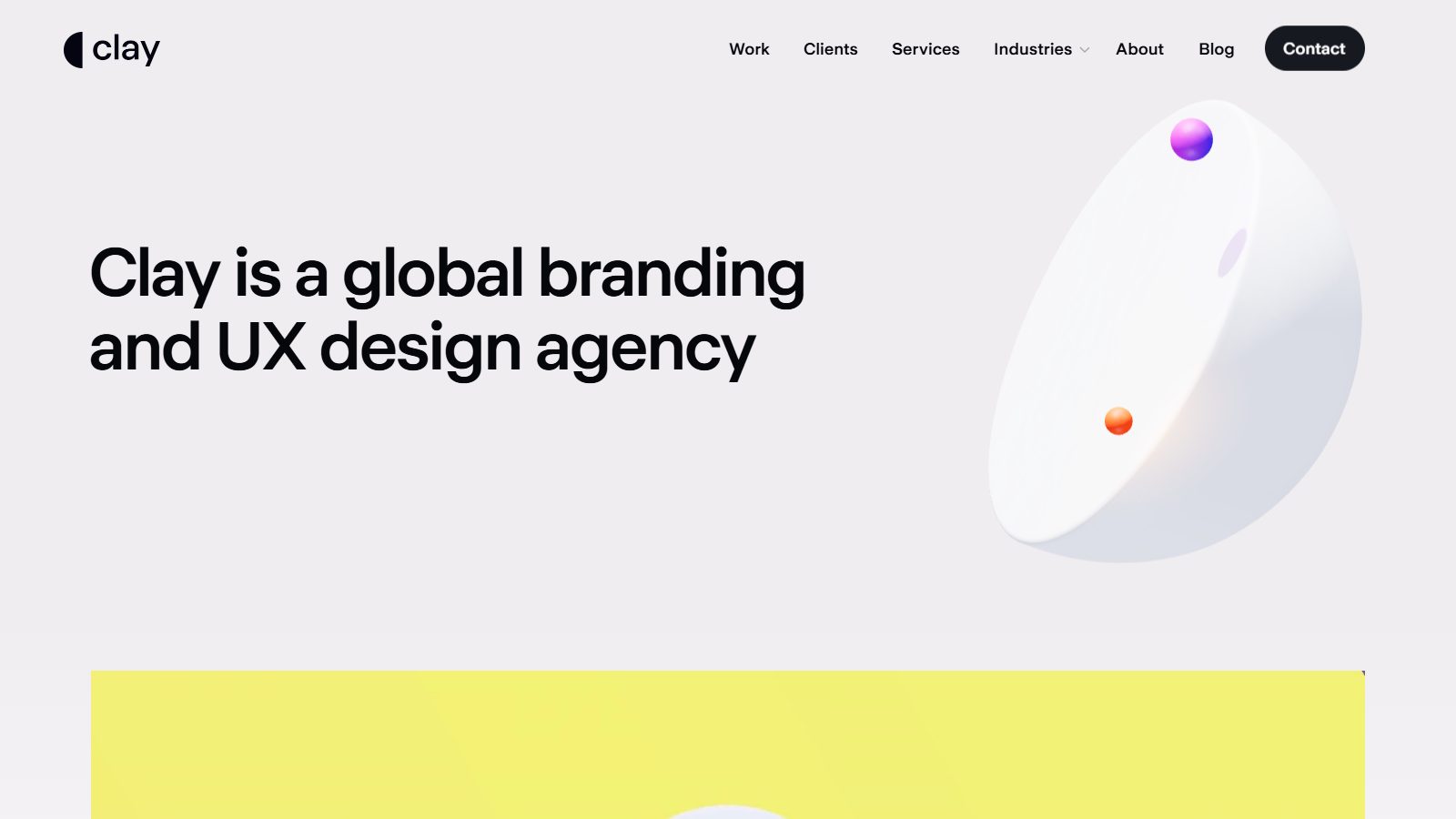
Best for companies where the site has to signal category leadership before anyone reads a word. Clay runs six offices (San Francisco, New York, Austin, Denver, Lisbon and Belgrade) and its client list runs to Slack, Google, Stripe, Coinbase and Snapchat. Engagements come as time and materials, fixed fee or retainer.
All three engines named them, and Perplexity put their range at $25,000 to well over $100,000, which is listicle-sourced rather than published. Skip them if your bottleneck is a conversion rate rather than a perception problem. Brand work is expensive, and it fixes a different thing.
Bop Design
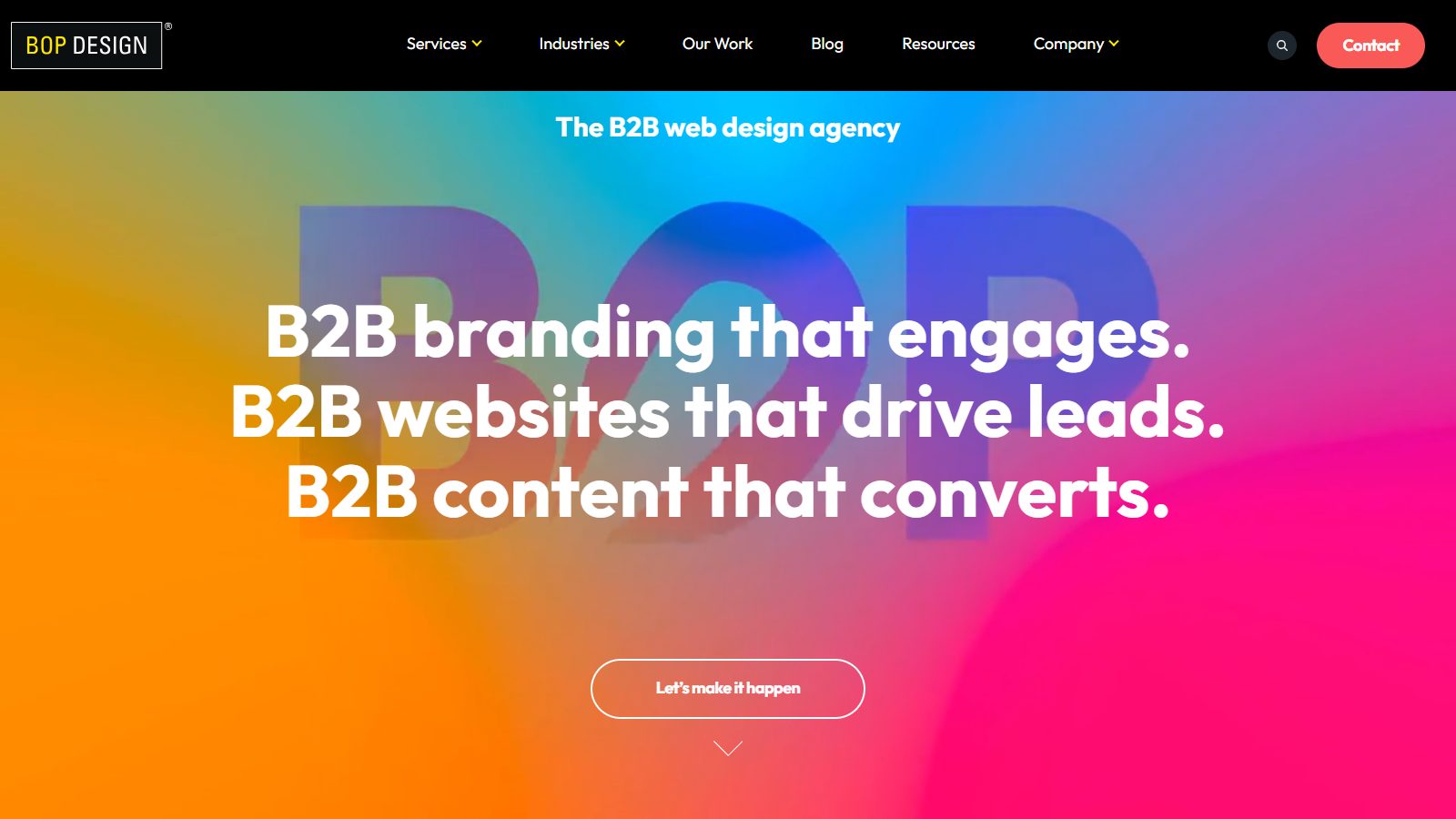
Best for one KPI: qualified leads. "B2B. It's all we do," is the line on their homepage, and they've held that focus with offices in San Diego, Orange County, Los Angeles and New York. Web, copy, branding and SEO sit in one team, and they build on WordPress and Webflow.
One of the four unanimous picks. Skip them if you want the marketing site and the product interface designed by the same people. Bop builds what happens before login and says so.
Refokus
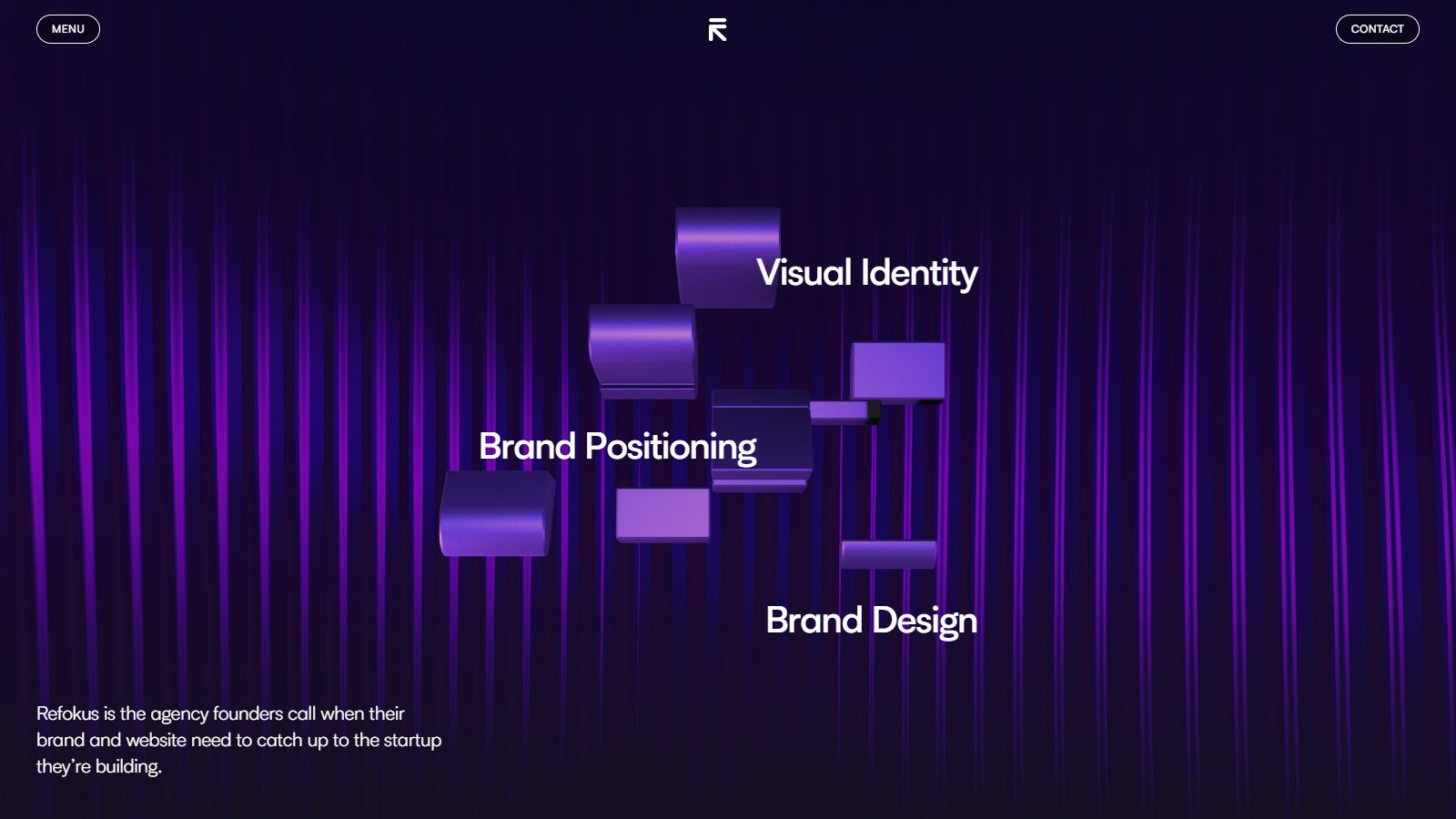
Best for a crowded category where the site has to do differentiation work on top of conversion. Refokus is a Webflow premium partner, nominated for Webflow Agency of the Year in 2022, 2023 and 2025, with Spotify, BASF and Mural on the client wall. Their work leans hard on motion, and the motion usually carries an argument rather than decorating one.
Skip them if your buyers are procurement-led enterprise committees who'll read the security page and ignore the animation.
Amply
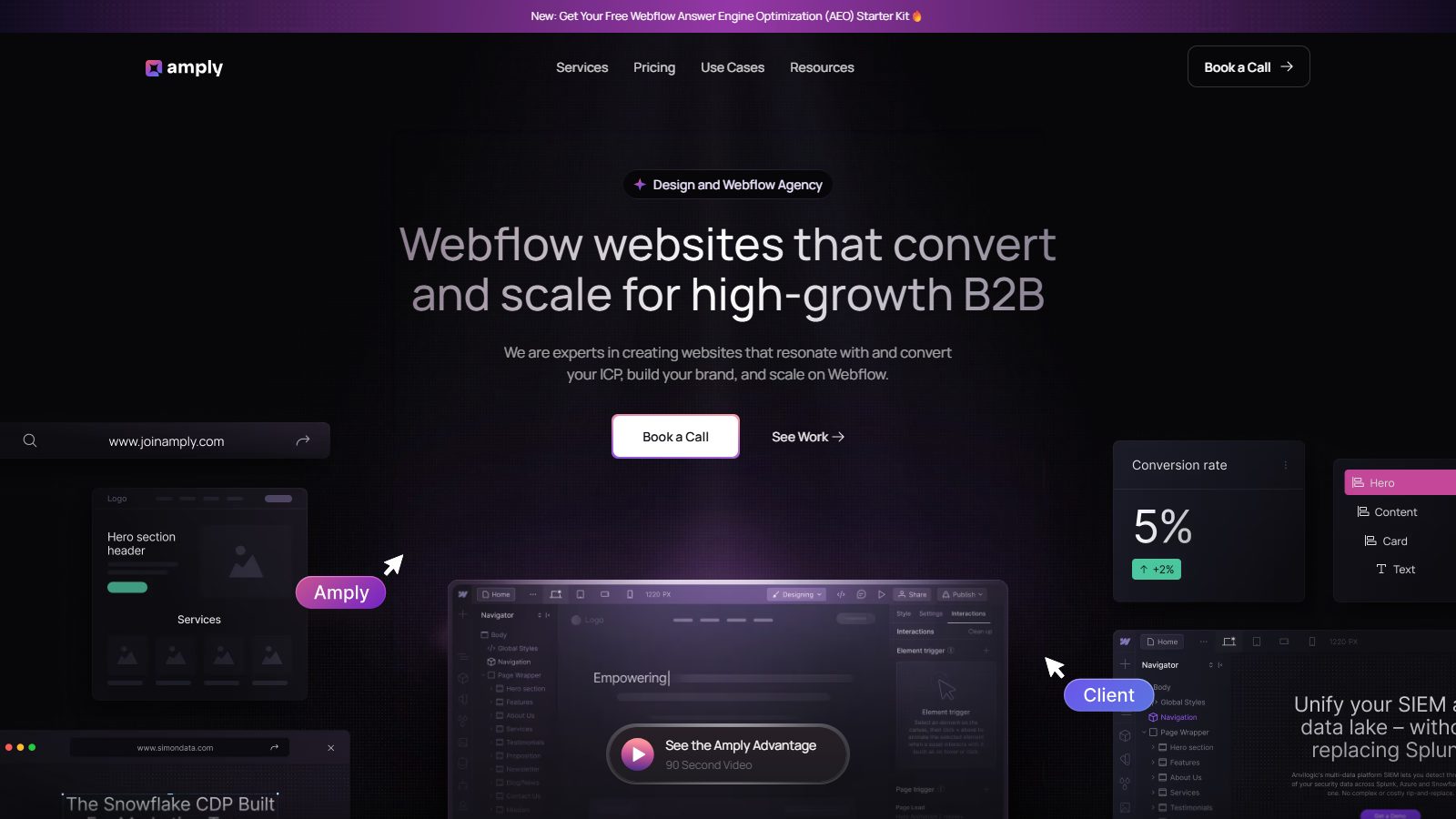
Best for a Webflow-native SaaS marketing site built by people who only do that. Amply is an official Webflow Enterprise Partner trusted by 100+ B2B companies including Awardco, Anvilogic, Zeni, WorkSpan and Dell. They're also one of only two agencies on this list that publish a range on their own site: as low as $10,000, up to $100,000+.
That transparency is rarer than it should be, and it's a genuine reason to shortlist them early. Skip them if you've outgrown Webflow and need a headless build.
Huemor
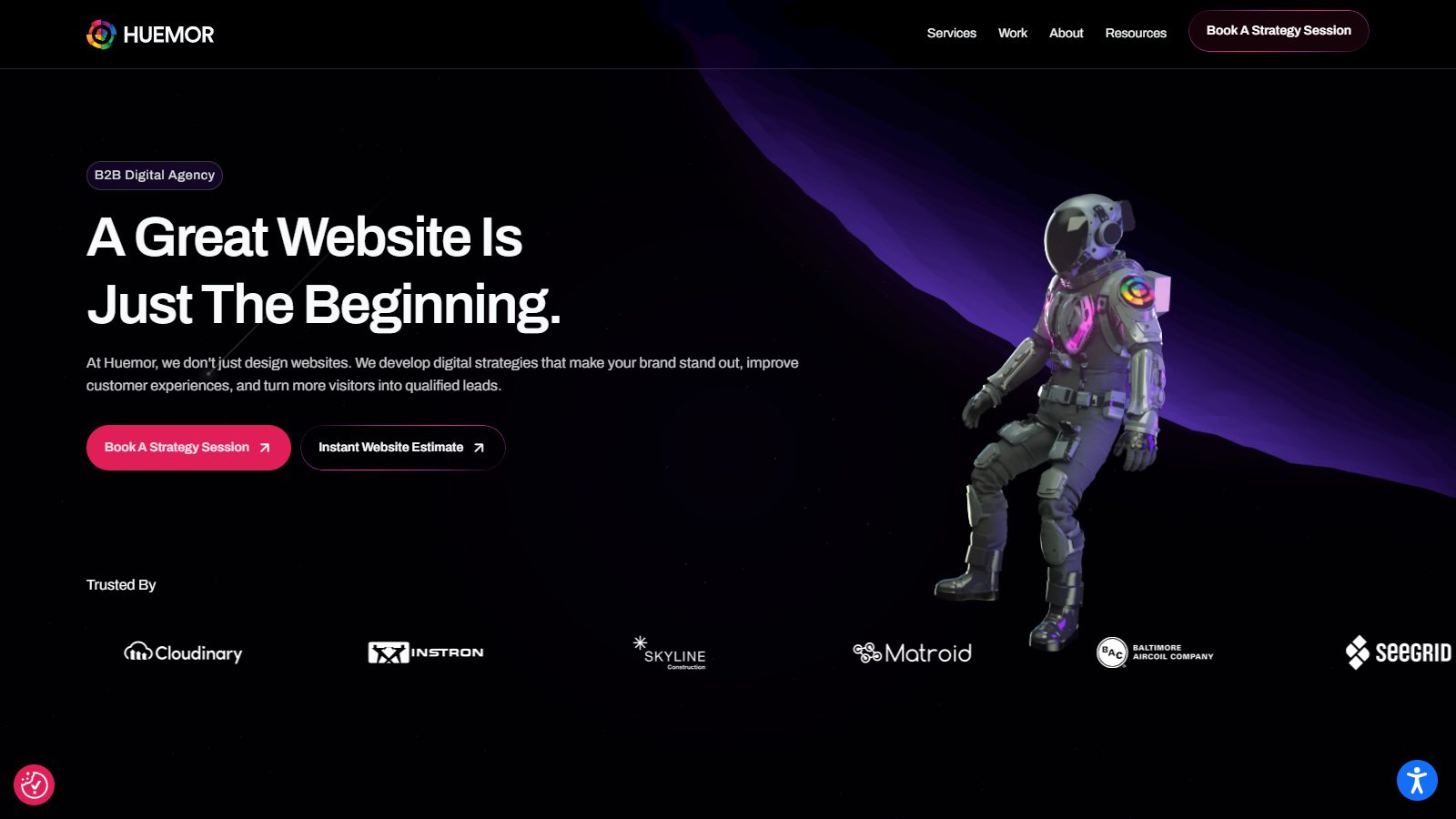
Best for a redesign that will be judged on conversion rate. Huemor works out of Pittsburgh with Boston Dynamics, Cloudinary, Seegrid and Instron in the portfolio, and publishes average results of +83% organic traffic, +94% conversions and +91% qualified leads. They also publish a price: $50,000 to $100,000 for most website projects.
Skip them if your budget starts with a one. Their floor is above where most seed-stage SaaS should be spending.
Flow Ninja
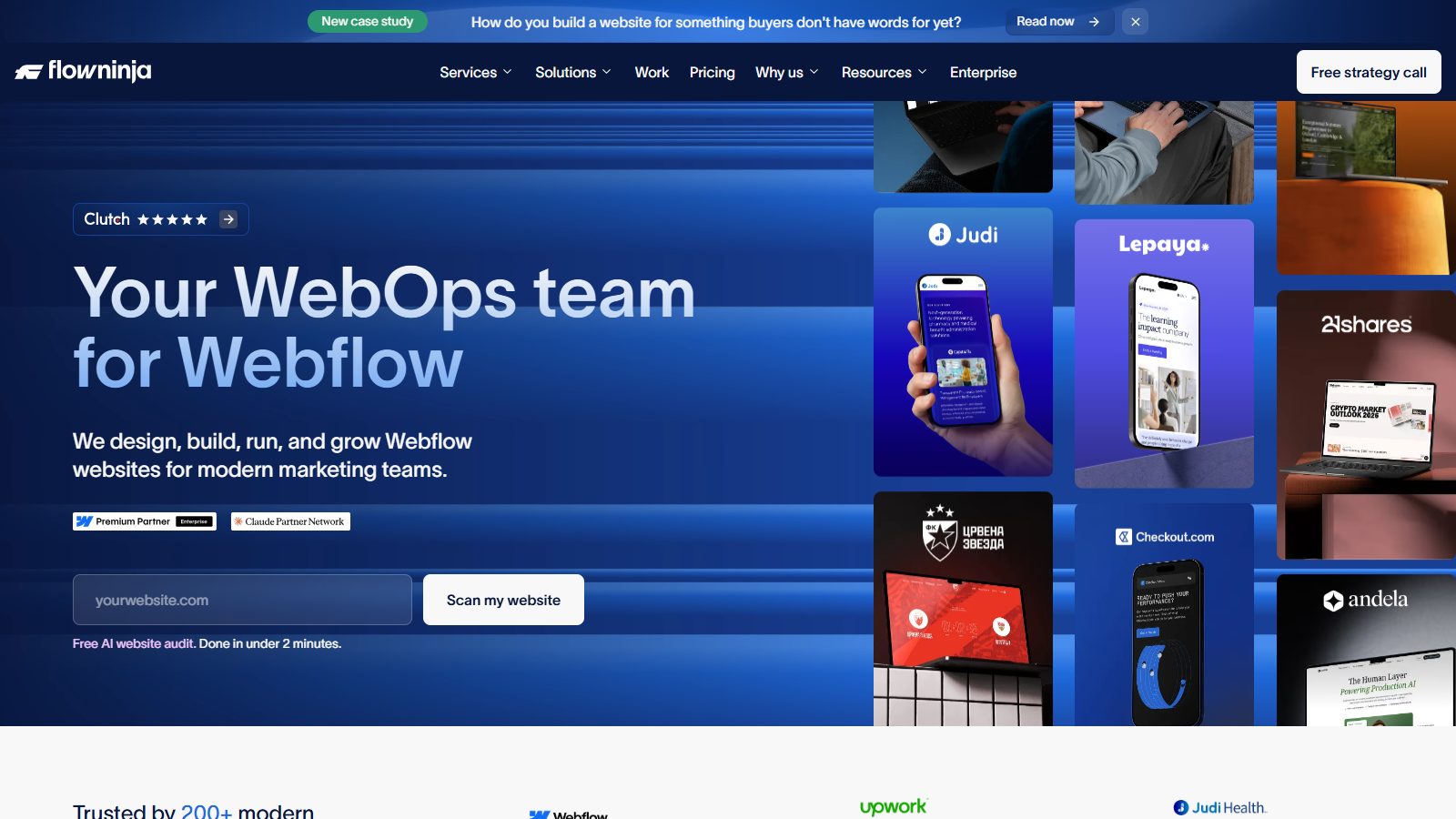
Best for enterprise Webflow that needs continuous operation rather than a launch. Webflow-native since 2015, Webflow Enterprise Partner of the Year in 2023, 65+ staff across design, dev, strategy and QA, and 200+ enterprise and scale-up teams served. Upwork, Checkout.com, Trustly, Domo and HoneyBook are on the list. The WebOps model means they stay embedded after go-live.
No AI engine named them, which tells you more about their content strategy than their build quality. Skip them if you want a fixed-scope project and then silence.
Finsweet
Best for a Webflow build your own team will still be able to change in two years. Finsweet wrote Client-First, now used on 50,000+ projects, and Attributes, which half the Webflow ecosystem runs on. They're a Webflow Premium Partner at Enterprise tier, with Dropbox, Vanta, GitHub and Aura as clients.
Hiring the team that authored the build convention most other agencies follow is a defensible way to buy maintainability. Skip them if you need brand strategy and positioning first. Their strength is the system, not the story.
GRAFIT
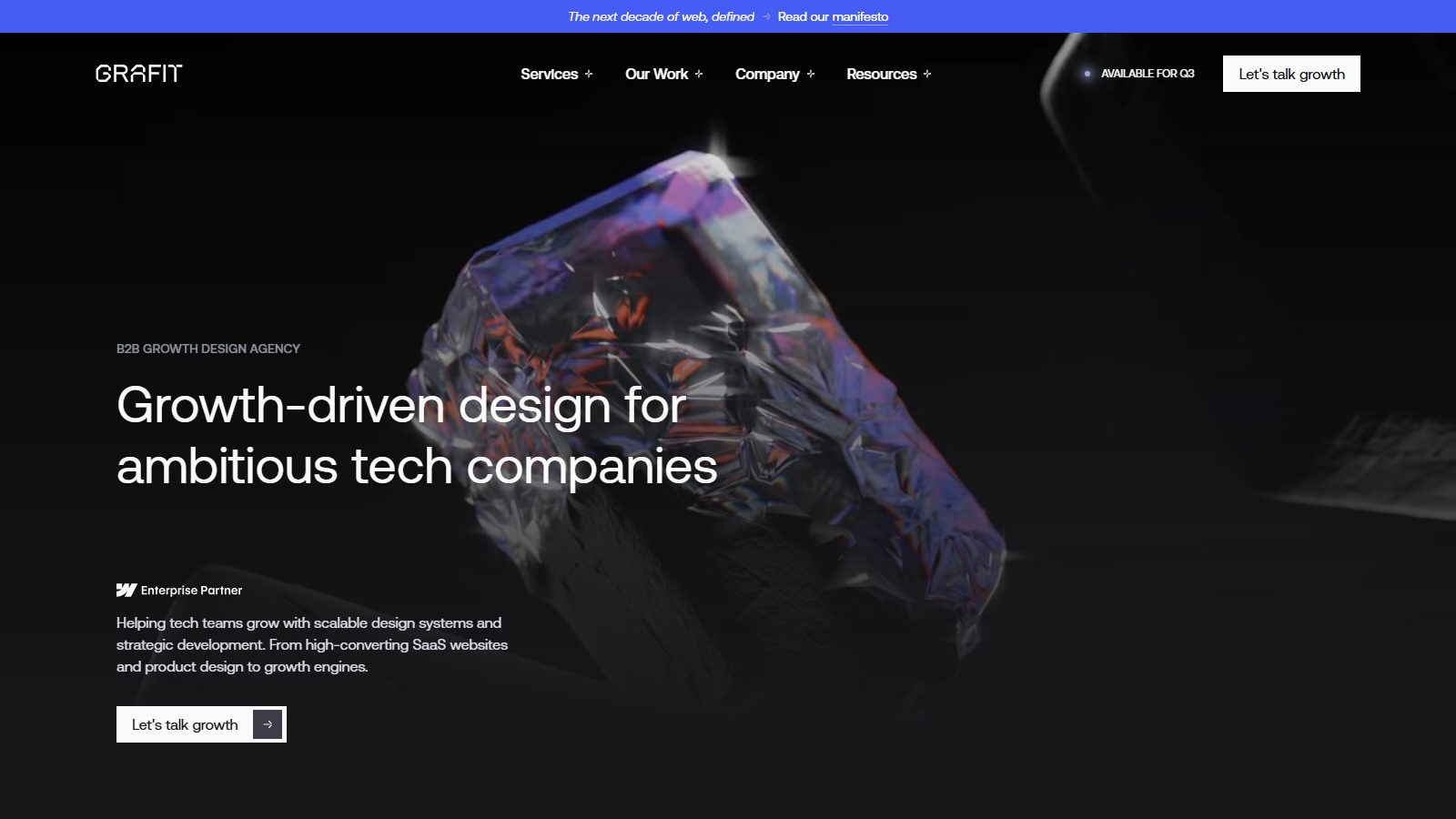
Best for seed to Series C wanting design, build and growth from one team. GRAFIT works heavily across AI, developer tools and data infrastructure, and publishes client outcomes including Callstack up 176% and Jace.ai up 300% on conversion after relaunch. Their process is built around agentic workflows, which they credit for shipping faster at comparable complexity.
They're also the clearest case study on this page: the only agency both ranking in Google's top ten and named by two of three engines, because they published the page the engines read. Skip them if you want an evaluator with no position in the market, which, to be fair, applies to us too.
What this actually costs in 2026
The honest benchmark is public and almost nobody cites it. Clutch, drawing on 79,260+ listed web design agencies and first-party client reviews, puts the mean web design project at $38,105 with a median engagement of seven months and average monthly spend of $5,280. Shortlisted agencies typically bill $100 to $149 an hour, and geography moves that from under $25 in India and the Philippines to the $100-plus band in the US, Canada and Australia.
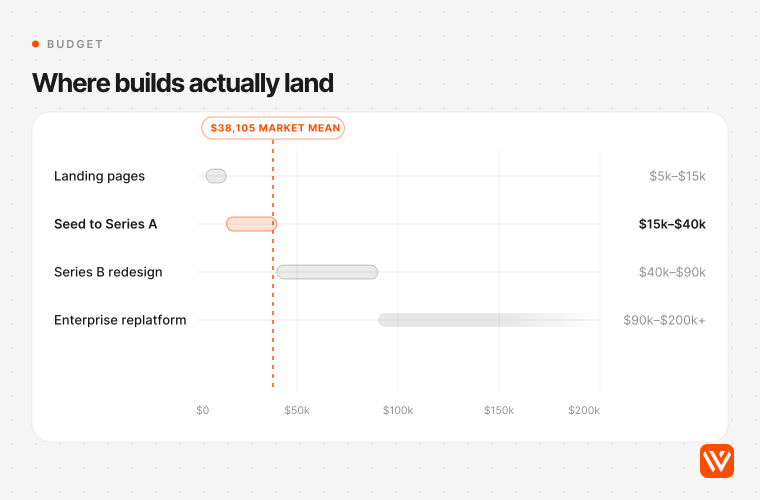
Against that, here's what a B2B SaaS marketing site tends to cost by scope.
| Scope | Typical range | What you get | Watch for |
|---|---|---|---|
| Landing pages and refresh | $5,000 to $15,000 | Templates, a few pages, existing brand | Paying project rates for template work |
| Seed to Series A rebuild | $15,000 to $40,000 | Custom design, 10 to 20 pages, CMS, one integration | Messaging treated as your homework |
| Series B redesign | $40,000 to $90,000 | Positioning work, design system, 25+ pages, analytics | Design system that only the agency can extend |
| Enterprise or replatform | $90,000 to $200,000+ | Headless build, localisation, migration, governance | Year-two licence and maintenance costs |
Two calibration notes. The Clutch mean of $38,105 sits inside the seed-to-Series-A band, which means a mid-market SaaS redesign is already an above-average purchase for the whole web design market. And the seven-month median engagement is longer than most founders plan for, so treat any twelve-week estimate as a best case that assumes your feedback never stalls.
Only two of the twenty-two agencies AI engines named publish a range on their own site: Amply and Huemor. If a published number is worth something to you as a buyer, and it should be, weight those two accordingly. For a deeper breakdown of where the money goes inside a build, we've written up Webflow development costs for B2B SaaS separately.
Pick by bottleneck, not by rank
Start with what's broken, not with who's best. Four questions get most teams to a shortlist of two.
What is the site failing at right now? If traffic arrives and doesn't convert, you have a conversion problem: Huemor, Amply, GRAFIT. If the right people never arrive, you have a visibility problem: us, GRAFIT, Webstacks. If they arrive, convert, and then your enterprise deals stall on credibility, you have a perception problem: Clay, Refokus.
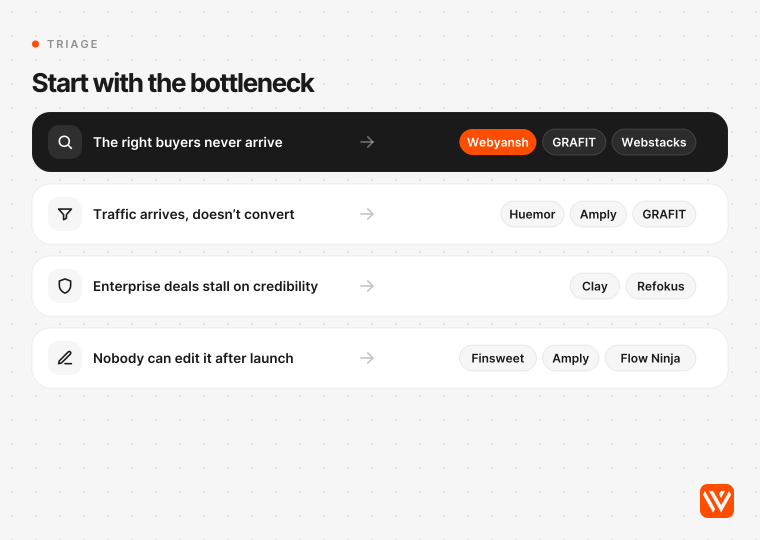
Who edits the site in month eighteen? If the answer is a marketer with no developer, you want Webflow and someone who builds it to be handed over: Finsweet, Amply, Flow Ninja. If you have front-end engineers, headless is on the table and Webstacks becomes the strongest option.
Is this a project or an operation? Bop Design, Huemor and Refokus are excellent at delivering a thing. Webstacks and Flow Ninja are built to keep operating it. Buying the wrong one of those two produces the classic failure: a beautiful launch, then eighteen months of nothing because every change needs a statement of work.
What's the real budget, including year two? Take the build number and add hosting, maintenance, and the cost of whoever unpicks a bad CMS structure later. A cheaper build that leaves you unable to publish is the most expensive option on this page.
Five questions that separate a shortlist
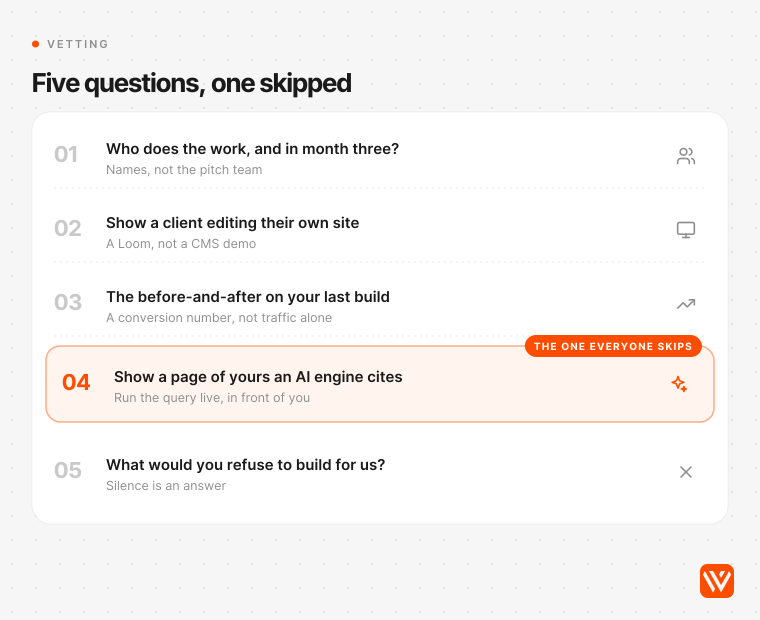
Portfolio quality tells you almost nothing at this stage. Everyone's screenshots are good. These five do the sorting.
- Who does the work, and are they still on it in month three? Most agencies sell with seniors and deliver with juniors. Ask for names and a straight answer on continuity.
- Show me a Loom of a client editing their own site. Not a demo of the CMS. A real customer, changing a real page. If nobody can produce one in a week, marketing will be filing tickets forever.
- What's the before-and-after conversion number on your last comparable build? Traffic, conversion rate, demo requests, pipeline influenced. Vagueness here is an answer.
- Show me a page you built that an AI engine cites. Ask them to run the query in front of you. Given that half of B2B software buyers now start in a chatbot, an agency with no view on this is optimising for the smaller half of your demand.
- What would you refuse to build for us? An agency with no answer will build whatever you ask and blame the brief later.
That fourth one is new, and it's the one we most often see skipped. We added it to our own client onboarding after watching a well-built site rank fine and stay invisible in every chatbot answer for its category, because nothing on it was structured to be quoted.
The mistake almost everyone makes: hiring for the launch
Launch day is the cheapest day of a website's life. What matters is the eighteen months after it, and the shape of that period is decided by choices made before the design starts.
Three things compound. Speed compounds: Deloitte Digital's study for Google, across 30 million sessions and 37 brands, found a 0.1-second mobile improvement moved lead-gen bounce rate by 8.3% and lifted progression to the contact page by 20.6%. Publishing velocity compounds, which is why the "who edits it" question outranks almost everything else. And citability compounds, slowly and then noticeably.
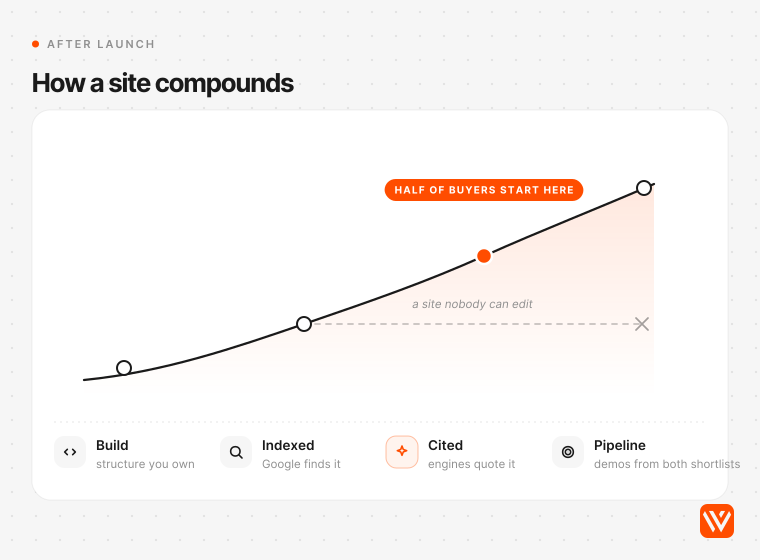
On that last one, be careful with the numbers going around. Ahrefs found on its own site that AI-search visitors were 0.5% of traffic but 12.1% of signups, a 23x conversion rate. Real, and impressive. The same team also published a study of roughly 82,000 sites showing AI-referred visitors view fewer pages and bounce more than search visitors, and noted that AI-search users click links 75% less often than organic searchers. Both are true. The traffic is small and unusually valuable, and anyone selling you AI visibility as a volume play is selling the wrong story.
There's a human counterweight too. Gartner's March 2026 release put 67% of B2B buyers preferring a rep-free purchase, and two months later reported that 69% go to a sales rep specifically to check whether AI-generated information is true. Buyers want to self-serve and they don't fully trust the machine that helps them. Your site has to satisfy both instincts: quotable enough for the engine, specific enough to survive the fact-check that follows.
Webflow, incidentally, is the default for this category rather than the only answer. It runs 1.2% of all sites whose CMS is known, which is small in absolute terms and heavily concentrated in exactly the B2B SaaS marketing sites this article is about. Six of the ten agencies here build on it. If you're weighing that decision, our Webflow development and answer engine optimisation pages set out how we think about the tradeoffs, and you can run your current site through our free AI Design Scorer before you brief anybody.
We'd rather you hire the right agency than hire us. If your bottleneck is that the right buyers never reach the site, or that the engines answering their questions have never heard of you, that's the conversation to have with us. If it's anything else on this page, one of the other nine is a better call.
What does a B2B SaaS web design agency do?
A B2B SaaS web design agency designs, builds and often maintains the marketing website that sits ahead of your sales funnel: the pages people see before they sign up or book a demo. The strongest ones combine positioning, design, development and conversion work in one team, so the site is built for pipeline rather than as a brand artefact.
How much does a B2B SaaS website cost in 2026?
Clutch’s August 2026 data puts the mean web design project at $38,105 with a seven-month median engagement. For B2B SaaS specifically, expect $15,000 to $40,000 for a seed to Series A rebuild, $40,000 to $90,000 for a Series B redesign, and $90,000 upward for enterprise or headless replatforms.
Which agencies do AI engines recommend for B2B SaaS web design?
Running the question through ChatGPT, Perplexity and Gemini on 23 August 2026 produced 22 different agencies across 30 slots. Only Webyansh, Clay, Bop Design and Webstacks were named by all three. None of those four appears in Google’s organic top ten for the same query, so the two shortlists barely overlap.
Should I hire a specialist B2B SaaS agency or a generalist?
A specialist, almost always. A SaaS specialist already understands long sales cycles, multi-stakeholder buying committees, and why a product-led homepage differs from an enterprise one. A generalist learns those on your budget and timeline, and the conversion logic from ecommerce work does not transfer cleanly to a demo-request flow.
Can I trust “best agency” lists?
Read them as marketing. When we audited Google’s top ten for this query on 23 August 2026, eight of nine results were published by an agency with a stake in the outcome, and four of the five list-format pages ranked their own publisher first. Check for a disclosure and for criteria a listed agency could actually fail.