Summarise this article using AI


The best AI website builders in 2026 are Webflow for marketing sites that need to rank, Framer for design-led launches, Wix for most small businesses and Hostinger on the tightest budget. If you need a working app rather than a site, Lovable and Base44 lead. Decide which of those two jobs you have first, because it rules out half the list.
We're a Webflow agency, so we have a stake in one of these ten. To check our bias we ran a test no ranking page has: we fetched 70 live sites built on 14 platforms the way ChatGPT's crawler reads them, without JavaScript. Prices were checked on each vendor's page on 14 October 2026. There are no affiliate links.
Key takeaways
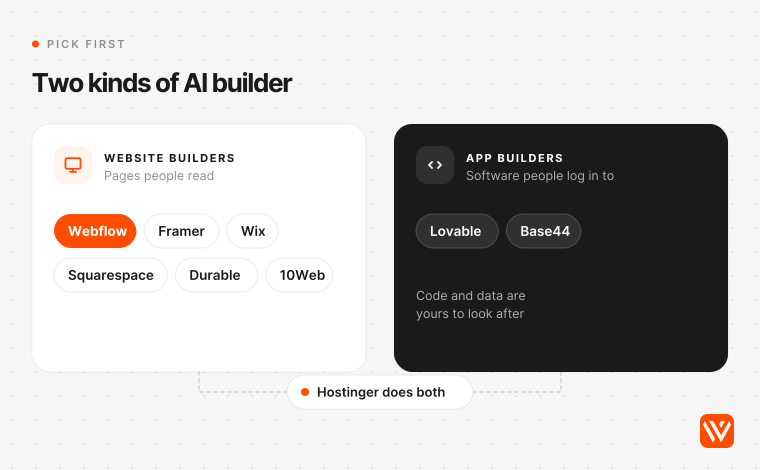
- Pick the category before the tool. Website builders make pages you edit and host in one place; app builders write code for software people log in to.
- Page builders pass the AI-crawler test and most app builders don't. Page-builder sites served a median 98.2% of their text to a crawler that doesn't run JavaScript; app-builder sites served 3.5%.
- The entry price is rarely the bill. Hostinger's $2.99 needs a 48-month prepay and renews at $10.99.
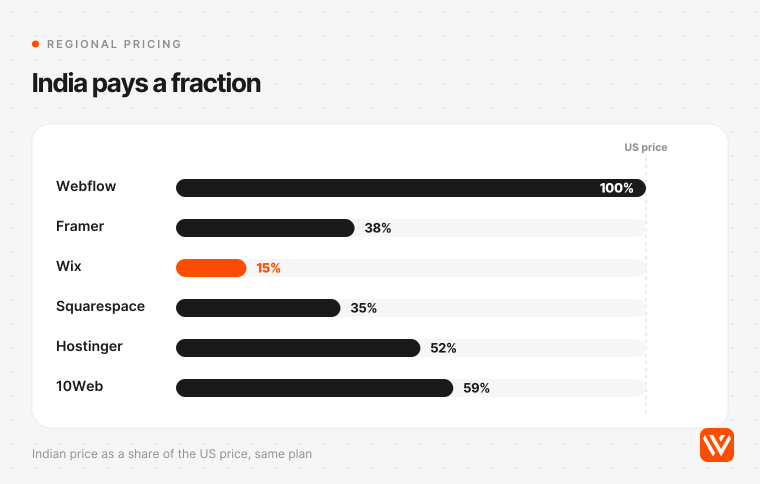
- India pays far less on most builders. Wix's Light plan is ₹250 a month, about 15% of its $17 US price, while Webflow charges India the US price.
The 10 best AI website builders compared
| Builder | Best for | Type | Lowest price with your own domain | AI crawler test |
|---|---|---|---|---|
| Webflow | Marketing sites that must rank and get cited | Site builder | $15 a month, billed yearly | 96.3% |
| Framer | Design-led startup sites | Site builder | $10 a month, billed yearly | 99.5% |
| Wix | Most small businesses | Site builder | $17 a month, billed yearly | 99.2% |
| Squarespace | Creatives and service brands | Site builder | $19 a month, billed yearly | 99.7% |
| Hostinger | Tight budgets | Site and app builder | $2.99 a month on a 48-month prepay | 100% |
| Durable | A service-business site in minutes | Site builder | $22 a month, billed yearly | 99.4%, but free subdomains block crawlers |
| 10Web | People who want WordPress | Site builder on WordPress | $10 a month on a 12-month term | 94.0% |
| Lovable | Web apps from a prompt | App builder | $21 a month, billed yearly | 0.4% |
| Base44 | Apps with a built-in backend | App builder | $16 a month, billed yearly | 11.4% |
| Relume | Planning a site before you build it | Planner with hosting | $12 a month per site, billed yearly | Not tested |
"AI crawler test" is the median share of a page's visible text our no-JavaScript fetch received, five sites per platform; the method is below.
How we chose these ten
The ten lists ranking for "best AI website builder" in the US, UK and India name 37 tools, 23 of them only once. Of 16 answers we collected from ChatGPT, Gemini, Google's AI Overview and Bing Copilot, only Wix, Framer, Hostinger and Webflow were named by all four engines. A tool made our ten if its AI builds something you can publish on your own domain at a public price. The order runs by job, from the most control over the finished site to the least, with Relume, a planner, last.
Website builder or app builder? Decide this first
An AI website builder generates pages you then edit and host on the same platform, usually with a CMS for a blog. An AI app builder writes the code for software people sign in to, with a database behind it. That second kind is vibe coding, a term Andrej Karpathy coined on 2 February 2025 for coding where you "forget that the code even exists."
The line is blurring. Hostinger merged its site builder and its Horizons app builder on 18 August 2026 and said nearly one in five projects on the platform are now SaaS products, internal tools or learning platforms, up from fewer than 4% a year earlier. Wix sells both kinds: Harmony for sites, and Base44, which it bought in June 2025 for about $80 million plus earn-outs.
Our rule: if visitors mostly read, use a website builder. If they log in and do something, use an app builder. You can build a marketing site in an app builder, but you inherit responsibility for code and data that a hosted site builder would carry for you.
The 10 best AI website builders, one at a time
1. Webflow: best for marketing sites that have to rank and get cited
Webflow is the pick when the site is part of how you sell. Its AI site builder, multi-page since 5 February 2026, turns a prompt into up to five pages and uses no AI credits doing it.
What you get afterwards is why it's first: a full visual editor, a CMS, and direct control of meta tags, canonicals, redirects, schema, robots.txt and llms.txt, all listed on Webflow's pricing page. In our crawler test the five Webflow sites served a median 96.3% of their text, and all five carried a meta description, JSON-LD and an H1.
We've built on Webflow since 2022. Our First December Films build runs 184 pages with a 100/100 Lighthouse SEO score and a 1.05-second LCP. It also hit a CMS limit worth knowing: a collection list renders at most 100 items, so we built a catalogue search around it.
Price: Basic is $15 a month billed yearly ($25 monthly); Premium, with the CMS, is $25 ($39). Code export needs a paid Workspace from $19 a month. Our Webflow pricing guide has the full bill.
Skip it if you want a site live this afternoon and never want to learn an editor. In our experience it has the steepest learning curve of the ten.
2. Framer: best for design-led startup sites
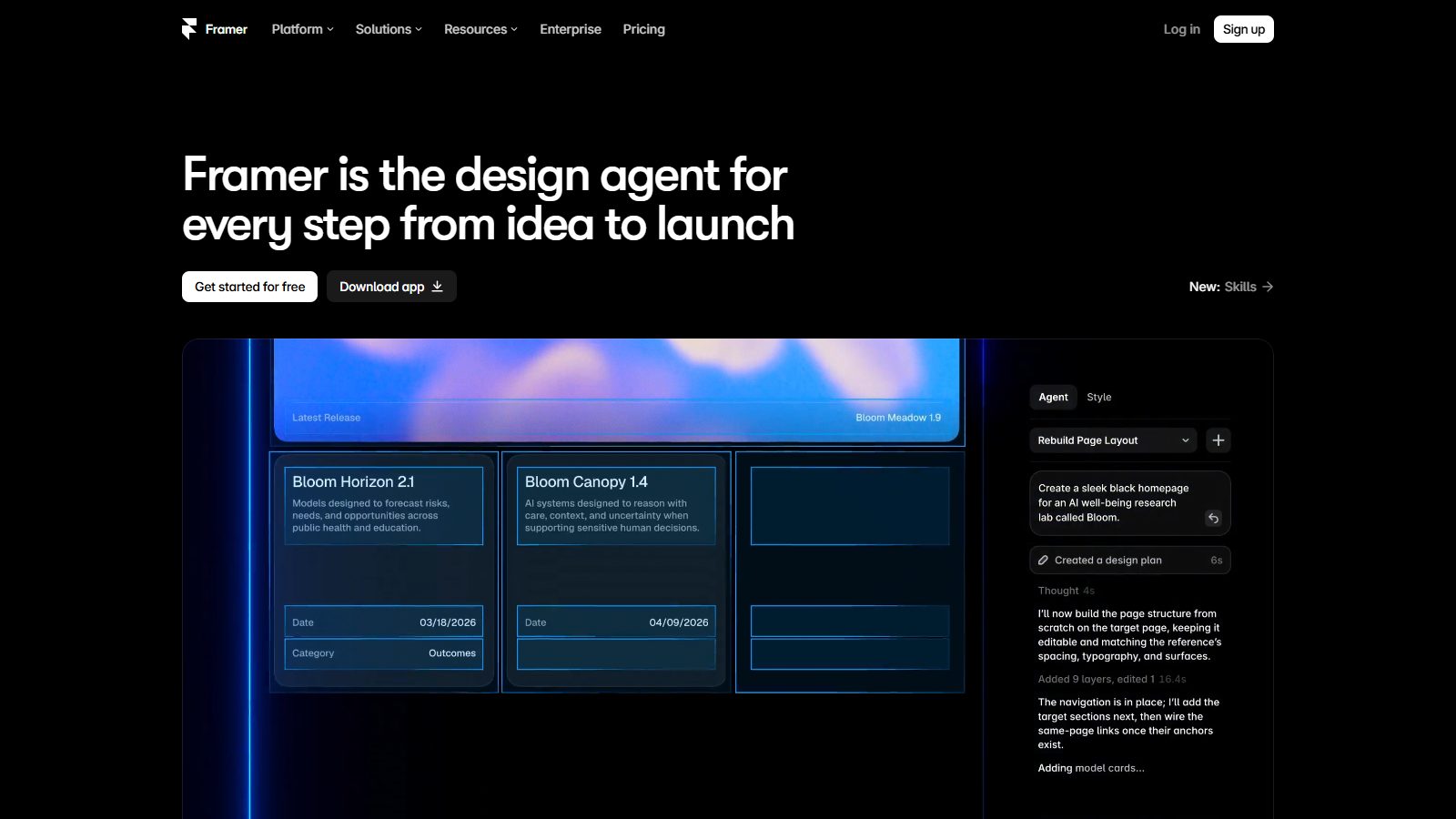
Framer is where designers go when the site itself has to impress. Wireframer drafts page structure from a prompt, and Framer's agents can build sites from scratch, restyle them and rewrite copy across pages. AI is metered: Basic includes 1,000 credits a month, and Framer's team admits that "generating a full page is where credits add up" (Framer, June 2026).
Framer sites served a median 99.5% of their text in our test, but none of the five had JSON-LD in the raw HTML, so add structured data yourself. We compare the two leaders in Webflow vs Framer.
Price: Basic is $10 a month billed yearly; in India it's ₹361 billed yearly or ₹540 monthly. The free plan is for non-commercial use on a Framer domain.
Skip it if you might want to self-host one day. Framer offers no HTML export.
3. Wix: best all-rounder for small businesses
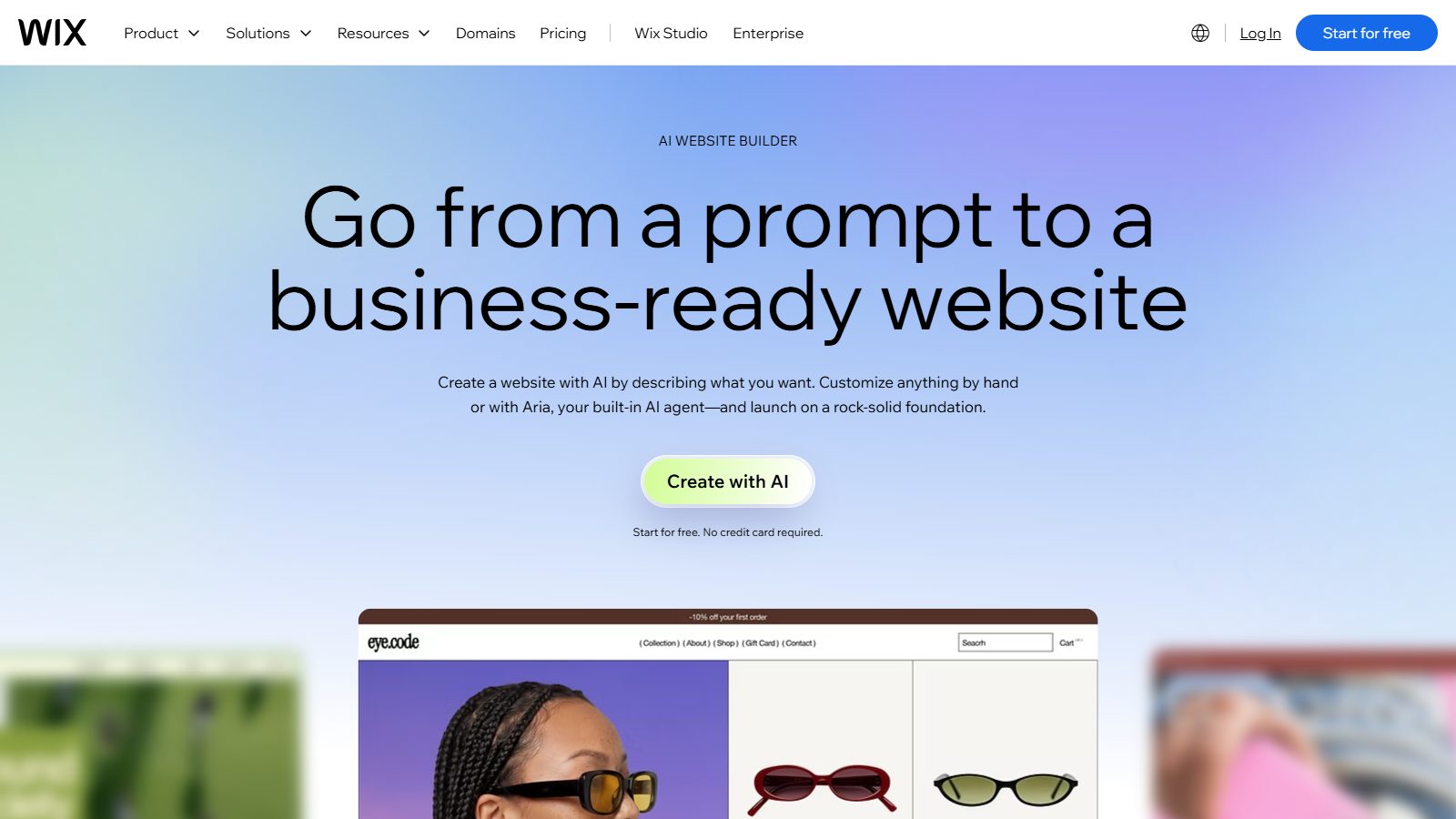
Wix was the first pick in 8 of the 16 AI-engine answers we collected, and for a typical small business it's the safe choice. You describe the site, Wix generates it, and you edit by hand or by asking Aria, its built-in agent; bookings, stores and a blog sit in the same plans. CEO Avishai Abrahami says the Harmony editor behind it blends "intuitive visual editing with the flexibility and power of Vibe coding" (Q4 2025 earnings call).
Wix retired its older ADI builder on 10 November 2024, so reviews still testing ADI are out of date. Wix sites served a median 99.2% of their text in our test, with a meta description, JSON-LD and an H1 on all five.
Price: Light is $17 a month billed yearly in the US, £9 in the UK and ₹250 in India, per Wix's plans page.
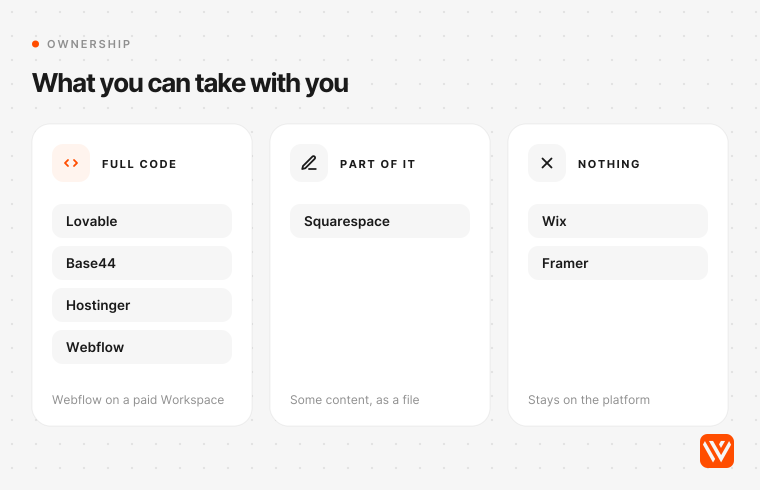
Skip it if you might move hosts later. A Wix site has to stay on Wix's servers, and Harmony doesn't allow custom code.
4. Squarespace: best for creatives and service brands
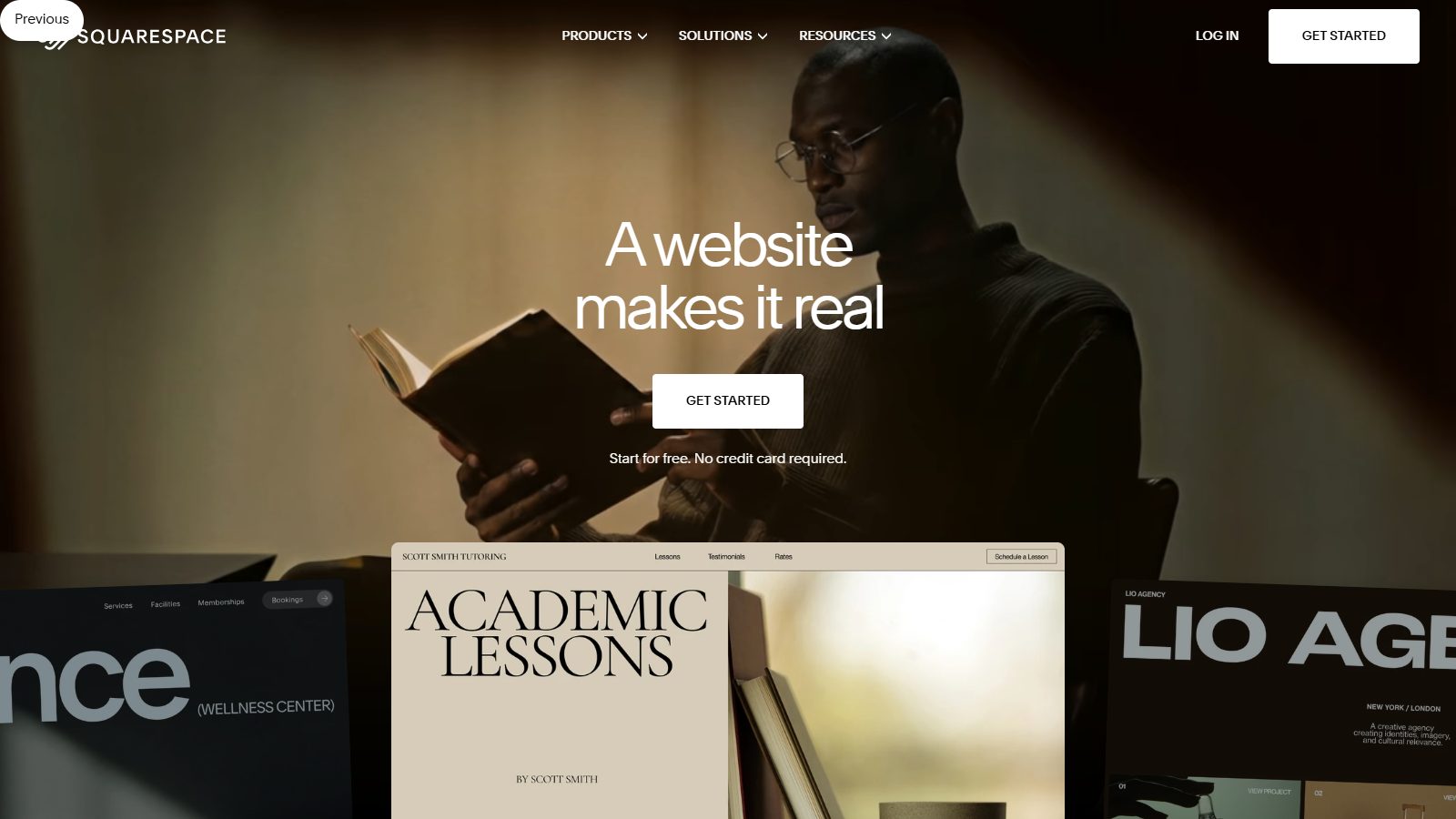
Squarespace's Blueprint AI asks for your business type and colour palette, then builds a starting point from "curated design and content recommendations" (Squarespace), so the result looks considered even when you change little. It suits portfolios, studios and service brands that sell on taste. Its sites served a median 99.7% of their text in our test, though two of five lacked a meta description.
The AI budget is small: Basic includes 10 credits once, Core 20 a month, per Squarespace's pricing page. There's no free plan, only a 14-day trial.
Price: Basic is $19 a month billed yearly ($25 monthly). India showed ₹630 a month billed yearly, with 30% off on the day we checked.
Skip it if you expect to leave. Squarespace exports only some content, as a WordPress-format file.
5. Hostinger AI Builder: best on a tight budget
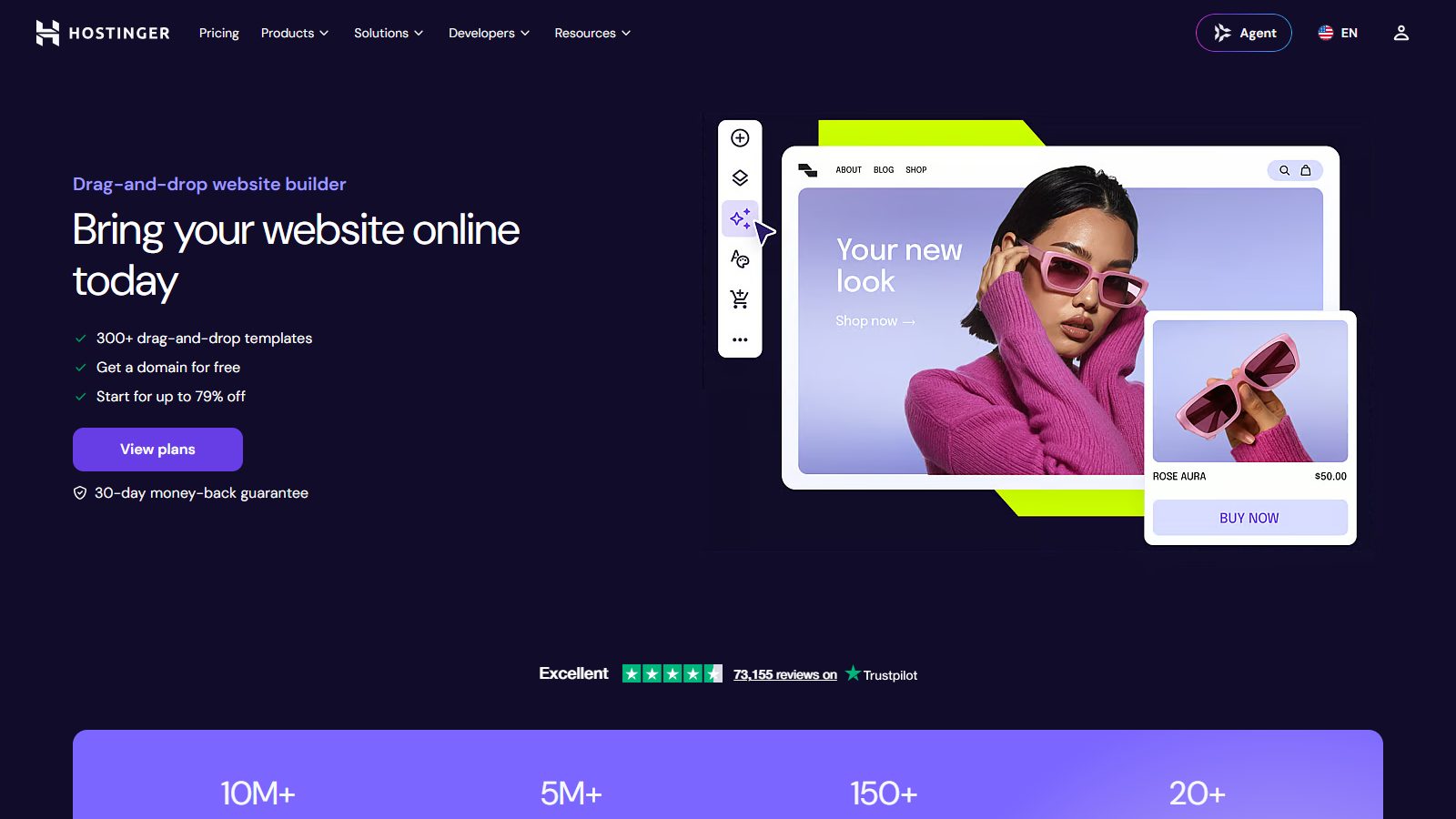
Hostinger is the cheapest way onto your own domain, and since August 2026 it's two builders in one: a manual mode that generates a site you then drag and drop, and an agentic mode that builds web apps. It's also one of the few site builders here with code export, so you can self-host later. All five Hostinger sites in our test were fully server-rendered.
Price: Premium is $2.99 a month on a 48-month prepay ($143.52 upfront), renewing at $10.99; it's £2.99 in the UK and ₹149 in India. The plan cards call its 5 AI credits a "one-time gift" while the FAQ mentions monthly credits, so check.
Skip it if you won't commit four years upfront for the headline price.
6. Durable: fastest route to a small-business site
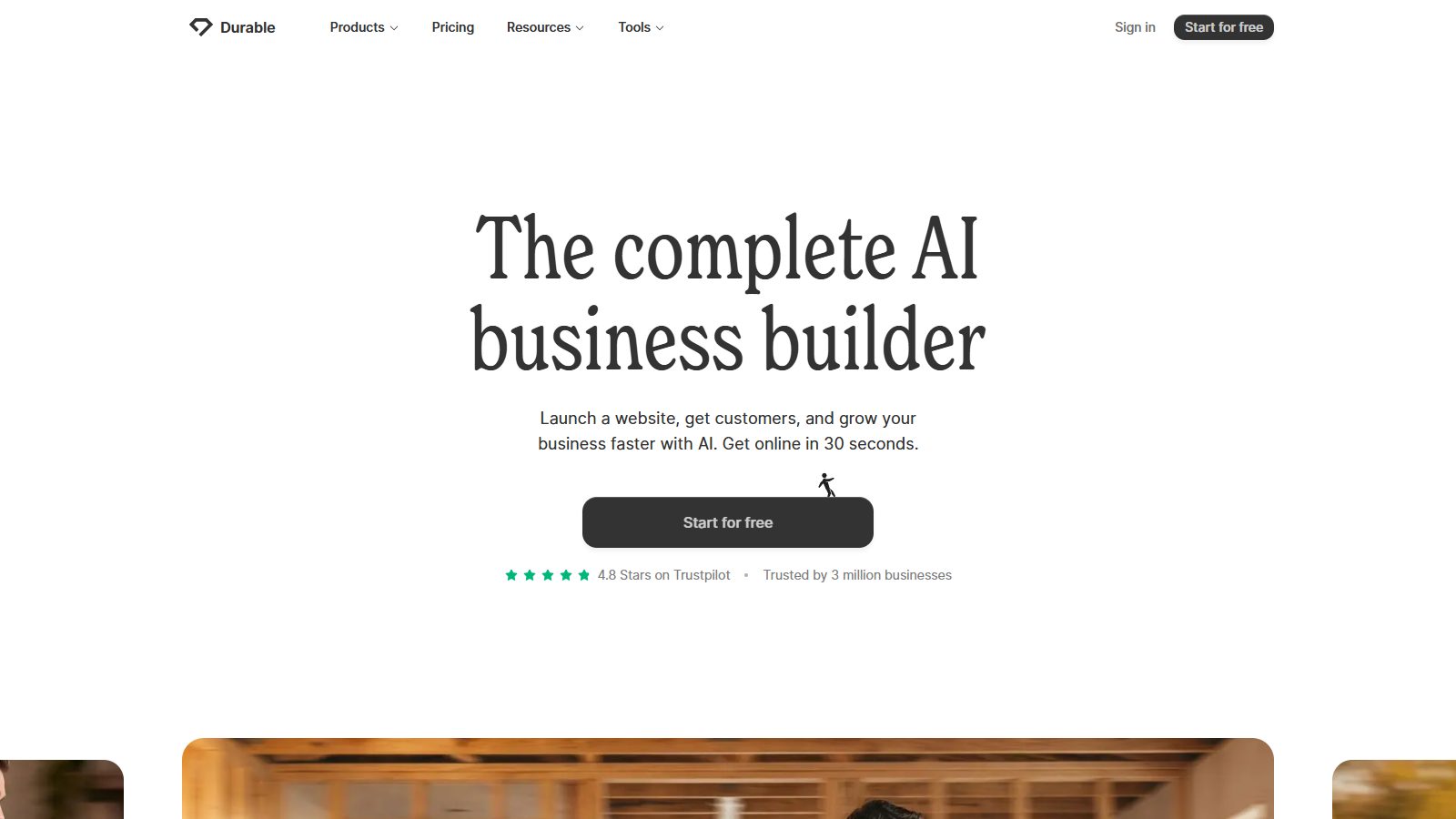
Durable asks three questions about your business, builds a site, then adds AI tools for blog posts, reviews and SEO, including structured data and llms.txt. Durable says more than 3,000,000 businesses have built on it, and a user in the r/vibecoding thread that ranks for this query said it "took like 10-15 minutes to get a site that actually looked human and professional."
Its pages were 99.4% readable in our test, but all five sites we found on durable.site subdomains had a robots.txt telling every crawler to stay out. That subdomain is where Durable's free private preview lives, so connect your own domain before you expect traffic.
Price: Launch is $22 a month billed yearly ($25 monthly), with 1,000 AI credits a month and a domain worth up to $20, per Durable's pricing page.
Skip it if you want design control. Durable calls itself a no-code tool without extensive HTML customisation, and lists no code export.
7. 10Web: best if you want WordPress
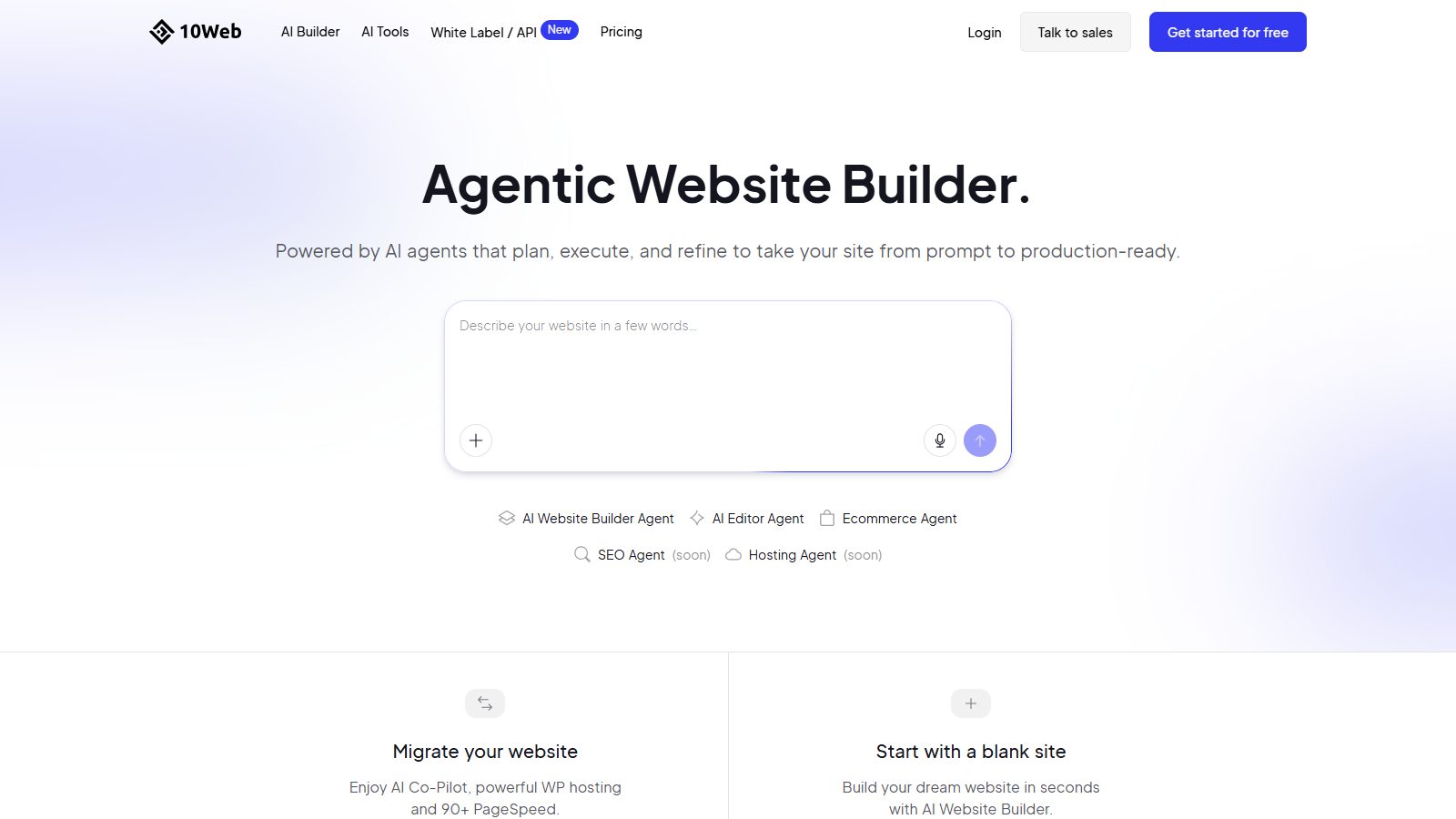
10Web generates a WordPress site from a prompt and hosts it, with agents that redesign pages, clone a page from a URL or convert a Figma file. The case for it is WordPress itself, which runs 40.0% of all websites (W3Techs, 14 October 2026), so your next developer already knows the CMS. Its example sites served a median 94.0% of their text in our test, but one rendered entirely in the browser and none had a meta description.
Price: AI Starter is $10 a month on a 12-month term ($120, against a regular $240), with 100 AI credits a month. India's price was ₹558.20 a month billed yearly, per 10Web's pricing page.
Skip it if you don't want to manage WordPress plugins and updates.
8. Lovable: best for turning a prompt into a web app
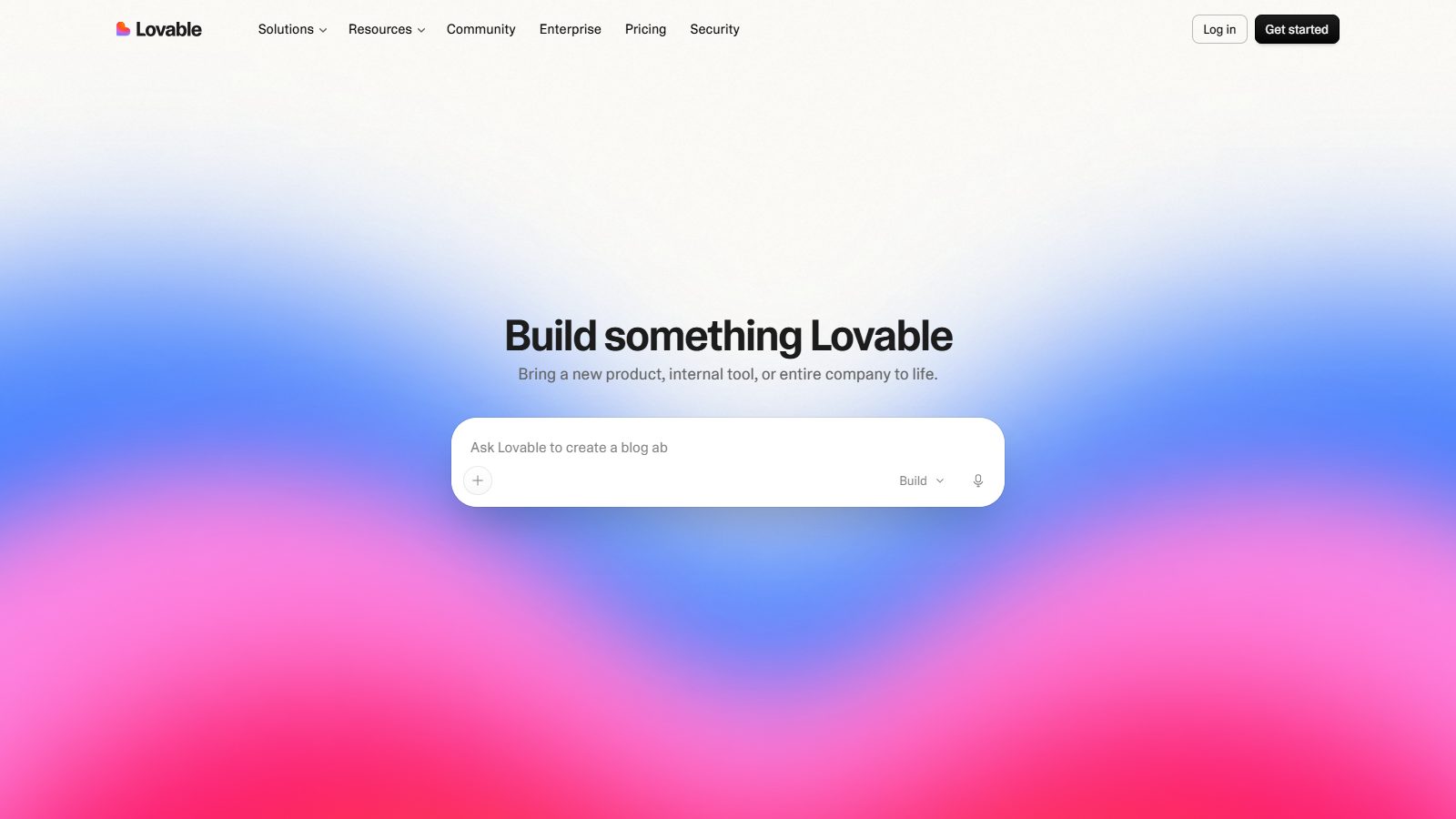
Lovable is the app builder most people mean by vibe coding. You describe an app, it writes the front and back end, and the code syncs two ways with GitHub. It says it has passed 60 million projects.
Its SEO story changed this year. In October 2025 CEO Anton Osika told a Reddit user it was "a long lived myth that Next.js is required, or even helps, for SEO." Since 13 May 2026, new projects render on the server by default, while older apps send "a mostly empty page" that Lovable pre-renders for verified crawlers. Three of the five Lovable sites in our test sent the crawler fetch an empty page; two served their copy.
Price: Pro is $21 a month billed yearly ($25 monthly) with 100 credits; Lovable prices a landing page with images at 1.70 credits.
Skip it if nobody on your team can review database rules. A 2025 flaw in Lovable apps' row-level security, CVE-2025-48757, was rated 9.3 critical; Lovable disputes it, saying each customer is responsible for their app's data. Matt Palmer, who found it while working at rival Replit, reported about 10.3% of 1,645 apps he scanned as exposed.
9. Base44: best for apps with a built-in backend
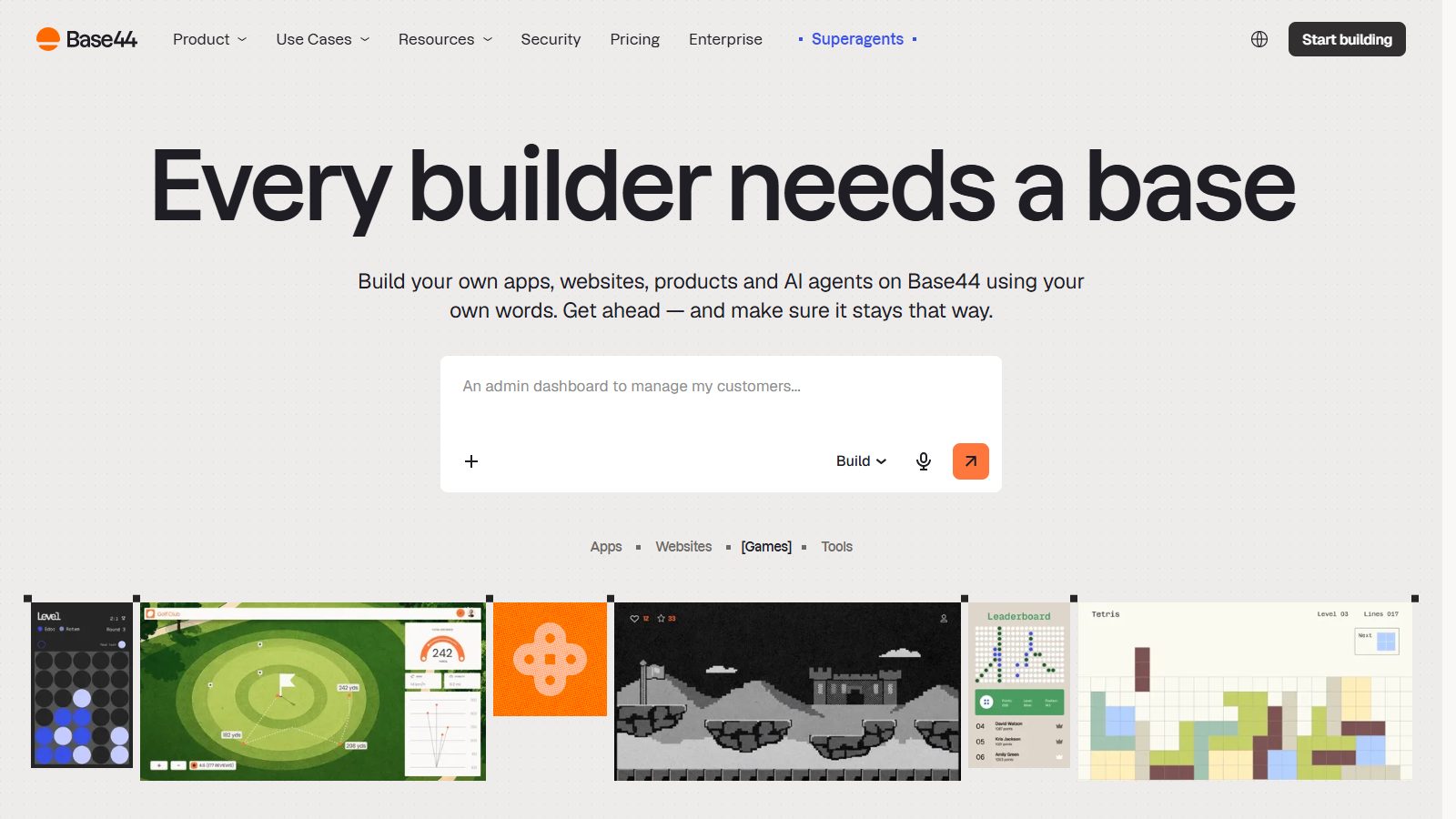
Base44 builds apps with the database, sign-in and integrations already wired in, which is why non-developers use it for internal tools. Wix reported about $150 million in annual recurring revenue for it by May 2026.
Base44's docs say it serves crawlers a rendered version of its browser-built apps, with SEO features aimed at custom domains. Our test didn't see it: all five sites, on base44.app subdomains, were client-only, with a median 11.4% of their text in the raw HTML. Use a custom domain.
Price: Starter, the first plan with your own domain, is $16 a month billed yearly ($20 monthly). GitHub sync starts on Builder at $40.
Skip it if your users' data is sensitive and you can't audit it. In July 2025 Wiz found an authentication bypass affecting private Base44 apps, which Wix fixed within 24 hours. Base44's Trustpilot score was 2.8 from 911 reviews on 14 October 2026.
10. Relume: best for planning a site before you build it
Relume turns a brief into a sitemap, wireframes and a style guide, then publishes on its own hosting or hands the work to Figma, Webflow or React. It's the tool we use when the hard part is deciding what the site should say. Relume gets about three times as many searches from India as from the US, by Ahrefs' October 2026 figures. We left it out of the crawler test as a planning tool, and walked through the Relume-to-Webflow route in building a site in under 10 minutes.
Price: Launch hosting is $12 a site a month billed yearly; export plans start at $18 a user, per Relume's pricing page.
Skip it if you want a finished, designed site with no design work afterwards.
Are AI website builders good for SEO and AI search?
Yes for the basics, if the builder serves real HTML and you supply what AI can't: a reason for the page to rank. Google says "appropriate use of AI or automation is not against our guidelines" (Search Central, 2023), but mass-produced pages "without adding value for users" breach its scaled content abuse policy.
AI search adds a requirement. Google renders JavaScript, but Google itself recommends server-side rendering because "not all bots can run JavaScript." ChatGPT's and Claude's crawlers can't: Vercel and MERJ found that "none of the major AI crawlers currently render JavaScript" across hundreds of millions of fetches a month (our JavaScript SEO guide explains why that matters). So we tested what those crawlers get.
Our test: what an AI crawler reads on sites built with each builder
On 14 October 2026 we fetched 70 live sites, five on each of 14 platforms, twice: with GPTBot's user agent and no JavaScript, then in Chrome as a visitor. The nine page builders served a median 98.2% of their visible text to the crawler fetch, with 33 of 45 sites fully server-rendered. The five app builders served 3.5%.
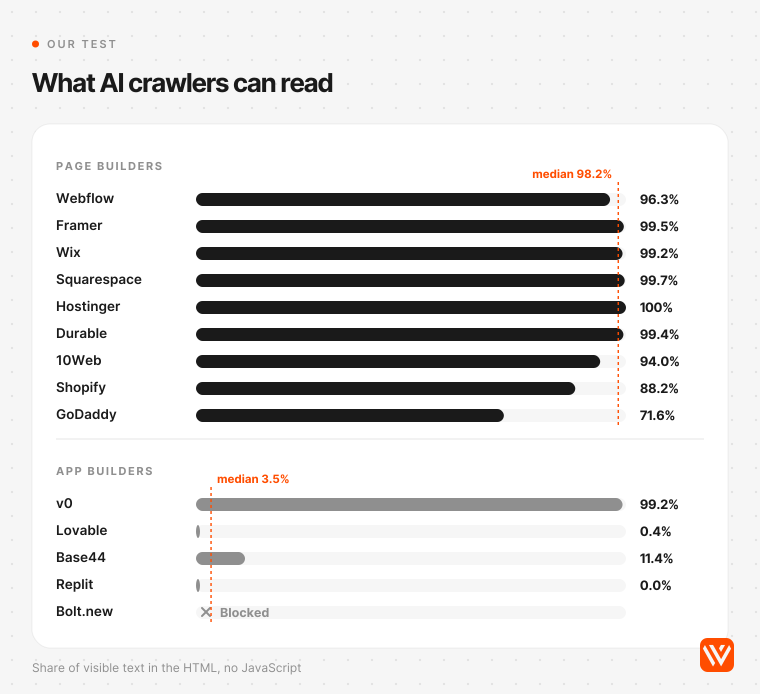
| Platform | Text visible to the crawler (median) | Fully server-rendered | JSON-LD in raw HTML |
|---|---|---|---|
| Webflow | 96.3% | 4 of 5 | 5 of 5 |
| Framer | 99.5% | 4 of 5 | 0 of 5 |
| Wix | 99.2% | 4 of 5 | 5 of 5 |
| Squarespace | 99.7% | 4 of 5 | 5 of 5 |
| Hostinger | 100% | 5 of 5 | 4 of 5 |
| Durable | 99.4% | 5 of 5 | 5 of 5 |
| 10Web | 94.0% | 3 of 5 | 0 of 5 |
| Shopify | 88.2% | 2 of 5 | 3 of 5 |
| GoDaddy | 71.6% | 2 of 5 | 0 of 5 |
| Lovable | 0.4% | 1 of 5 | 4 of 5 |
| Base44 | 11.4% | 0 of 5 | 2 of 5 |
| Replit | 0.0% | 1 of 5 | 2 of 5 |
| v0 | 99.2% | 5 of 5 | 0 of 5 |
| Bolt.new | Blocked | 0 of 5 | 0 of 5 |
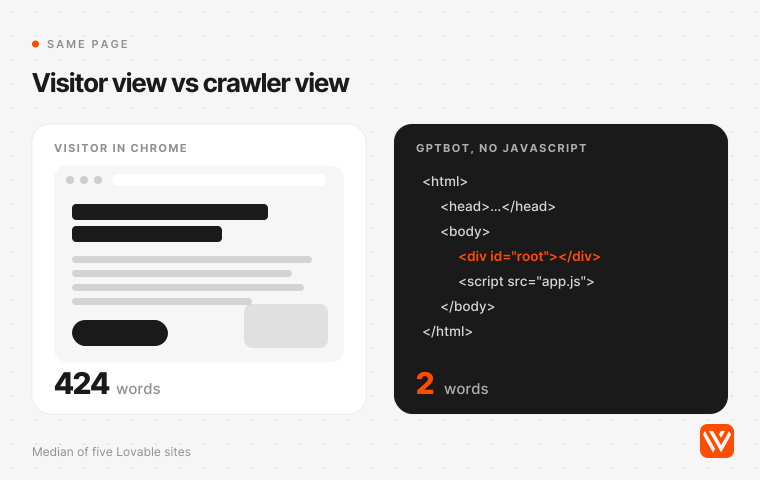
Most app-builder sites send crawlers an empty shell. Three of five Lovable sites returned an empty root element: across the five, visitors saw a median 424 words and the crawler fetch got a median 2. Every Base44 site returned only an app name, description and page list. v0 was the exception, with all five sites server-rendered.
Bolt's hosting turned GPTBot away. All nine bolt.host sites we tried answered GPTBot's user agent with a Cloudflare 403 block while serving Chrome normally, and ClaudeBot got the same on the five we sampled. Googlebot got through and robots.txt allowed everything, so a Bolt site owner has no visible sign of it.
Free subdomains can lock every crawler out. All five Durable sites on durable.site and three of five Replit sites had a robots.txt telling every crawler, Google included, to stay out.
Structured data is the common gap. JSON-LD was in the raw HTML of half the 70 sites. Webflow's five came from its customer stories (Lattice, Greenhouse and others), so their clean scores say as much about those teams as about the platform.
The limits: five sites per platform shows default rendering, not a precise share; the sites were built on each platform, not necessarily with its AI; and we used GPTBot's published user agent, not OpenAI's IP ranges, so platforms that verify crawlers by IP may show the real GPTBot more.
Check your own site in a minute: fetch it with `curl` or open it with JavaScript off, and look for your headline and first paragraph in the HTML. If they aren't there, ChatGPT's crawler can't read them either.
How much do AI website builders cost in 2026?
On these ten, a site on your own domain costs $2.99 to $22 a month billed yearly in the US. Watch three things beyond the headline: the term you prepay, the renewal price and the AI credits.
| Builder | US price a month | India price a month (≈ USD) | The catch |
|---|---|---|---|
| Webflow | $15 yearly, $25 monthly | Same USD price | CMS needs Premium, $25 |
| Framer | $10 yearly | ₹361 (≈ $3.79) | 1,000 AI credits a month |
| Wix | $17 yearly | ₹250 (≈ $2.62) | Can't move hosts |
| Squarespace | $19 yearly | ₹630 with 30% off (≈ $6.61) | 10 AI credits, once |
| Hostinger | $2.99, 48-month prepay | ₹149 (≈ $1.56) | Renews at $10.99 (₹449) |
| Durable | $22 yearly | Shown in USD | No code export listed |
| 10Web | $10, 12-month term | ₹558.20 (≈ $5.86) | Regular price $240 a year |
| Lovable | $21 yearly | Shown in USD | 100 credits a month |
| Base44 | $16 yearly | Shown in USD | Own domain from Starter |
| Relume | $12 per site, yearly | Shown in USD | Hosting only |
Rupee prices are what each vendor showed an Indian visitor on 14 October 2026, converted at the European Central Bank rate of 13 October 2026 (US$1 = ₹95.28). In the UK, Wix (£9) and Hostinger (£2.99) publish sterling prices.
The regional gap is the surprise: Wix's Indian Light plan is about 15% of its US price, Squarespace's 35%, Framer's 38%, Hostinger's 52% and 10Web's 59%, while Webflow charges India full US dollars.
Credits are the second trap. Full-page generation costs the most, and a stuck fix can drain a month's allowance: one Lovable user on Reddit watched "$20 of credits disappear in 10 minutes" while the AI looped on a CSS bug.
Which AI website builder should you choose?
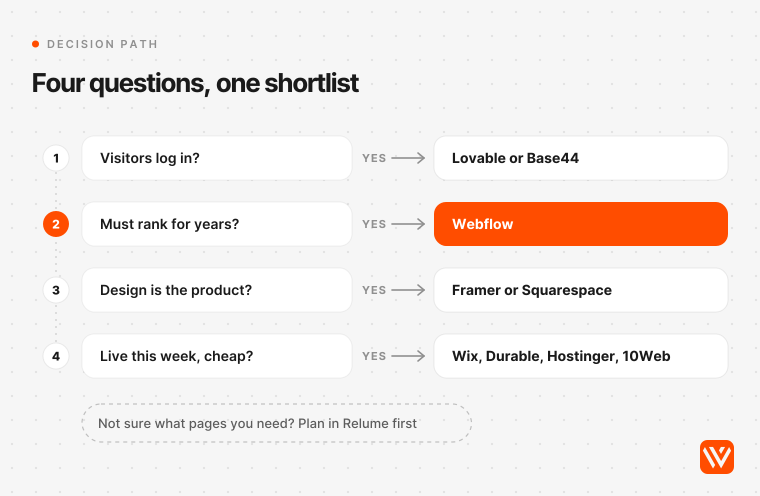
Answer four questions in order.
- Will visitors mostly read, or log in? If they log in, start with Lovable or Base44.
- Does the site need to rank and be cited for years, with a blog or resource library that keeps growing? Choose Webflow.
- Is the design the product, as for a portfolio, studio or launch page? Choose Framer, or Squarespace if you'd rather not touch a canvas.
- Do you need it live this week, cheaply, with bookings or a small shop? Choose Wix, Durable or Hostinger, or 10Web if you want WordPress.
Not sure what pages you need? Plan it in Relume first.
When an AI website builder is the wrong tool
Use the AI for a first draft at most in these cases.
- You already rank. A new platform means a redirect for every URL that earns traffic, and no prompt maps those for you.
- Your app holds sensitive data. Both incidents above touched many apps at once. As Wiz put it, one flaw in a platform's core "instantly jeopardizes every single application built upon it."
- You'll need to leave one day. Wix can't be hosted elsewhere, Framer has no HTML export and Squarespace exports only part of a site. Lovable, Base44, Hostinger and Webflow let you take the code.
- The site is your pipeline. Webflow CEO Linda Tong told TechRadar in June 2025: "We're starting to see a wave of quick builds that aren't designed to last."
If your site is how you win customers, get a second opinion before you commit: run it through our free AI Design Scorer, or see how we build Webflow sites for B2B SaaS.
Also considered
| Tool | Why it isn't in the ten |
|---|---|
| GoDaddy Airo | Free plan only previews; Starter is $9.99 a month billed yearly. CEO Aman Bhutani said Airo AI Builder reached "$10 million plus" in annualised bookings within weeks of beta (Q1 2026 call). |
| Shopify | A store builder: if you sell products, start here. Basic is $29 a month billed yearly. |
| Replit | A developer-grade app builder; free published apps go offline after 30 days. |
| Bolt.new | Its CEO, Eric Simons, told Sacra Bolt refocused on business teams after consumer churn. |
| v0 | Vercel's app builder, server-rendered in our test; paid plans start at $30 per user a month. |
| ChatGPT Sites | OpenAI's public beta for Plus, Pro and workspace accounts, built for dashboards and internal portals rather than marketing sites. |
Can ChatGPT actually create a website?
Yes, in public beta. ChatGPT Sites lets Plus, Pro and workspace accounts create, preview and publish websites and lightweight apps that OpenAI hosts, on your own domain if you already own one. OpenAI’s own examples are dashboards, trackers and internal portals, so for a public marketing site a dedicated builder still does more.
What is the best free AI website builder?
Wix is the best free option for a live site: its AI builds the whole site on a Wix subdomain, and you pay only to use your own domain and remove Wix branding. Webflow’s free plan generates two pages and Lovable’s gives five credits a day. None of the free plans we checked lets you use your own domain.
Which AI website builder is best for SEO?
Webflow, for a site you plan to grow, because it gives you direct control of meta tags, canonicals, redirects, schema, robots.txt and llms.txt. In our test of 70 live sites, Webflow, Wix, Framer, Squarespace and Hostinger each served a median of at least 96% of their text to a crawler that doesn’t run JavaScript.
Can I move my site off an AI website builder later?
It depends on the builder. Lovable, Base44 and Hostinger let you download or sync the code, and Webflow exports HTML and CSS on a paid Workspace. Wix sites can’t be hosted anywhere else, Framer offers no HTML export, and Squarespace exports only some content, as a WordPress file. Check this before you build, not after.
Are AI-built websites secure?
Hosted site builders such as Wix, Squarespace and Webflow handle hosting security for you. Prompt-built apps need checking: a 2025 flaw in Lovable apps’ database rules was rated critical (CVE-2025-48757, which Lovable disputes), and Wiz found an authentication bypass in Base44 that Wix fixed within 24 hours. Review database permissions before launch.