Summarise this article using AI


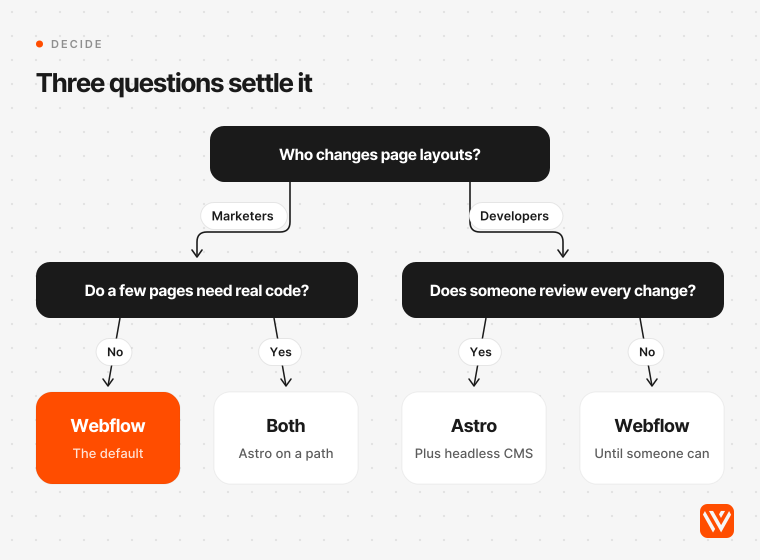
Choose Webflow if marketers change page layouts themselves. Choose Astro if developers or coding agents own the site and you want it in Git. For most marketing-led B2B SaaS companies, Webflow stays the better default for 2027, with Astro added on a path when a page needs real code.
We build on both, so we have a stake in this Astro vs Webflow question, and you should read everything below with that in mind. Webflow is most of our work and webyansh.com runs on it. That's why this comparison runs on public data rather than opinion: Chrome field data across seven markets, a fresh scan of 414 B2B SaaS homepages, a stack count of 2,400 Y Combinator B2B companies, Astro's release and security record, and price pages checked on 31 October 2026.
Key takeaways
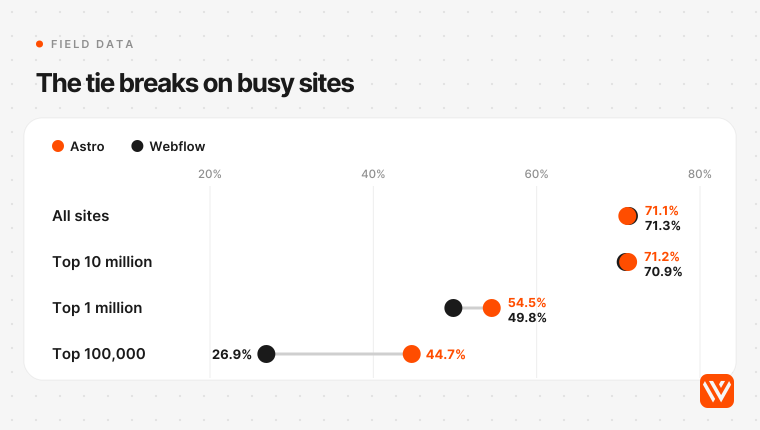
- The speed tie is misleading. 71.1% of Astro sites and 71.3% of Webflow sites pass Core Web Vitals on mobile (HTTP Archive, September 2026), yet among the 100,000 busiest sites Astro leads 44.7% to 26.9%.
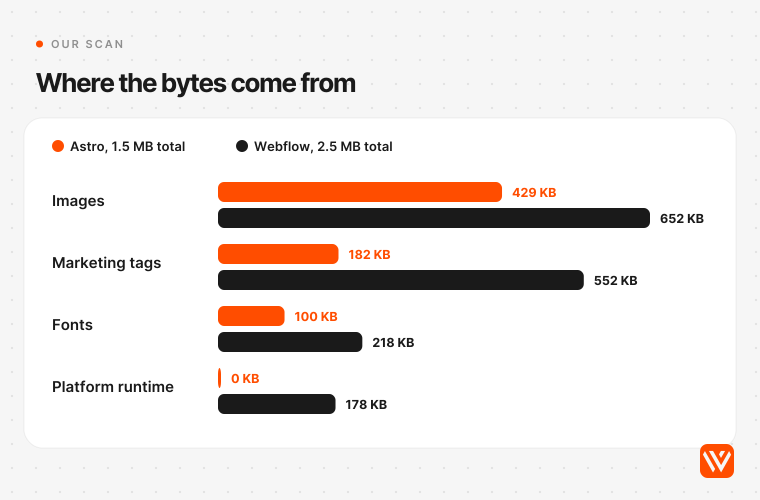
- On real SaaS homepages the median Astro page weighed 1.5 MB and the median Webflow page 2.5 MB in our 31 October 2026 scan. Astro's famous zero JavaScript didn't survive marketing: the median Astro homepage still shipped 385 KB of it.
- Webflow's own runtime is the small part of its problem. It came to about 178 KB at the median, against 552 KB of marketing tags on the same pages.
- Young, engineer-led companies have already moved. Webflow runs 24.3% of Y Combinator B2B homepages from the 2020 to 2022 batches and 2.0% from 2025 and 2026. Astro rose from 7.2% to 10.7%, and Next.js took most of the rest.
- Platform fees barely separate them: about $1,040 over three years in our model. Developer time decides it. Two layout changes a month on Astro cost more in a US team's wages than the whole Webflow bill.
- Source by Webflow, announced in September 2026, makes code the foundation of a new Webflow platform and connects to existing Astro codebases. None of the 12 top-ranking comparisons we read mention it.
What is the difference between Astro and Webflow?
Astro is an open-source web framework that turns components and content into finished HTML, adding JavaScript only where a page asks for it. Webflow is a hosted visual platform: design canvas, CMS, hosting and publishing in one subscription. Astro is code you own and run. Webflow is a product you log in to.
That distinction drives everything else. Comparing their prices or speed scores first is why so many of these articles reach a verdict that doesn't fit the buyer. The useful question is who holds the keys after launch.
| Astro | Webflow | |
|---|---|---|
| What you get | A framework, MIT licensed, with the team owned by Cloudflare since January 2026 | A hosted platform with Designer, CMS, hosting and forms |
| Who changes layouts | Developers or coding agents | Designers and marketers, on a visual canvas |
| Content | Git files or any headless CMS you connect | Built-in CMS, 20,000 items on Premium |
| Hosting | Any static host or Node host | Webflow's hosting |
| Version control | Git, branches and pull requests | Page branching on Team and Enterprise plans only |
| Leaving | You already hold the code | Export gives HTML and CSS, but CMS content needs the API |
| Who fixes it at 2 a.m. | You | Webflow |
Sources for the table: Webflow's pricing page and Cloudflare's press release, both read on 31 October 2026.
Which should a B2B SaaS marketing site use, Astro or Webflow?
Pick by who makes the changes, not by company stage or Lighthouse score. A Series B company with a three-person marketing team and no spare frontend engineer belongs on Webflow. A 10-person devtools startup whose founders live in Claude Code belongs on Astro. Stage predicts neither.
Run this test before any vendor call. Open your last 20 website changes and sort them into four piles: copy and CMS entries, layout changes, new page types, and custom logic. Then note who did each one, and how long the request waited.
- Five or more layout changes made by non-developers: stay on Webflow, or move to it. That's the workflow you'd be taking away.
- Almost all copy, with engineers shipping everything else: Astro with a headless CMS fits, and you'll get version control and previews you can't get on Premium.
- Mostly marketing work, plus one or two pages that need real logic: keep Webflow and run those pages as an Astro app on Webflow Cloud.
- Pages generated from an API or a dataset, beyond 20,000 items: Astro. A nightly build beats any amount of CMS importing.
Those thresholds are our judgment from scoping calls, not a law. The sorting exercise matters more than the numbers, because most teams guess wrong about who actually edits their site.
Is Astro faster than Webflow?
At the level of whole platforms the two tie, and that tie hides a real Astro lead among serious sites. In HTTP Archive's Technology Report for September 2026, 71.1% of 47,277 Astro origins passed Core Web Vitals on mobile against 71.3% of 59,483 Webflow origins. Core Web Vitals come from real Chrome users, so this is field data, not a lab score.
The tie doesn't hold once you cut it. Astro has a bigger share of its sites in slower markets (12.1% of its origins are in India against 9.2% for Webflow, while the US is 19.7% against 27.5%), and that drags its global number down. Weight the seven markets we pulled to Webflow's own mix and Astro moves ahead, 75.2% to 72.1%.
Rank tells the same story more sharply.
| Sites compared, mobile, September 2026 | Astro pass rate | Astro origins | Webflow pass rate | Webflow origins |
|---|---|---|---|---|
| All sites | 71.1% | 47,277 | 71.3% | 59,483 |
| Top 10 million | 71.2% | 32,563 | 70.9% | 45,726 |
| Top 1 million | 54.5% | 3,087 | 49.8% | 2,635 |
| Top 100,000 | 44.7% | 441 | 26.9% | 156 |
Busy sites carry more tags, more video and more stakeholders, so pass rates fall on every stack. Webflow falls further. A B2B SaaS site with real traffic sits nearer the bottom rows than the top one, so read those first. One caution: 156 origins is a thin sample, and it won't all be SaaS.
Most comparisons quote something else. The AI answer Brave shows for this query gives Astro 95 to 100 and Webflow 70 to 85 on Lighthouse, and 4 of the 12 ranking pages we read mention Lighthouse. None of the 12 cites field data. HTTP Archive's own median mobile Lighthouse performance score for September 2026 was 70 for Astro and 62.5 for Webflow, which is a far smaller gap and a far less flattering number for both.
What do real SaaS homepages actually weigh?
We scanned 414 B2B SaaS homepages on 31 October 2026 (198 on Astro, 216 on Webflow), all from active Y Combinator companies and earlier Webyansh samples, none from either vendor's showcase. Headless Chrome loaded each one at 1,440 pixels wide and scrolled it, and we split the bytes by who is responsible for them.
| Median homepage | Astro | Webflow |
|---|---|---|
| Total transfer | 1.5 MB | 2.5 MB |
| JavaScript | 385 KB | 1,072 KB |
| of which marketing tags | 182 KB | 552 KB |
| of which platform runtime | 0 KB | 178 KB |
| Images | 429 KB | 652 KB |
| Fonts | 100 KB | 218 KB |
| Requests | 60 | 104 |
| Pages over 5 MB | 5% | 14% |
Astro's lead is real: the median Webflow page was 1.7 times heavier. It's also not where people say it is.
Webflow's runtime and jQuery cost about 178 KB, which is the number every Astro pitch leans on. Images, fonts and tags account for far more of the gap. A Webflow team that compresses its hero video and audits Google Tag Manager will recover more than the runtime costs, without leaving the platform. And an Astro team that installs HubSpot, Segment and a chat widget gives back a good part of what the framework saved. On our sample, marketing tags were 56% of all JavaScript on Astro homepages.
Our view: speed alone shouldn't move a B2B SaaS company off a working Webflow site. If your pages fail Core Web Vitals, fix images and tags first. It's cheaper than a rebuild and you'd have to do it on Astro anyway.
Does Astro or Webflow rank better in Google and AI search?
Neither has a ranking advantage by default, because both serve finished HTML that crawlers can read. The difference in our scan was hygiene. Vercel and MERJ reported in December 2024 that the major AI crawlers fetch pages but don't run JavaScript, so what's in the raw HTML is what they get. At the median, Astro homepages had 100% of their visible text in the raw HTML and Webflow homepages 100%. Only 5% of Astro pages and 2% of Webflow pages fell below 80%, and several of those Astro pages held their copy in client-side islands, which is a build choice rather than a framework limit.
Where they split is the metadata teams have to set by hand.
| Homepage signal | Astro | Webflow |
|---|---|---|
| Canonical tag | 96% | 70% |
| Any JSON-LD | 77% | 63% |
| Organization schema | 74% | 57% |
| Exactly one H1 | 91% | 70% |
| An llms.txt file | 71% | 43% |
Read that carefully, because the table flatters Astro for a reason unrelated to Astro. Teams on Astro skew technical and young, and technical teams set canonicals. Webflow leaves the global canonical URL field for you to fill in, so a site can launch without one, and our audit of Webflow for SEO, GEO and AEO found the same gap. Nothing stops a Webflow team from fixing every row in an afternoon. HTTP Archive's median Lighthouse SEO score for September 2026 was 100 for Astro and 96 for Webflow, which puts the size of that gap in proportion.
What Astro does give you is control at the template level. Schema, sitemaps and llms.txt can be generated from your content model, so every new page inherits them. On Webflow you get the same result with custom code fields and CMS bindings, and it takes more care. If you publish thousands of pages, that difference compounds. If you publish 40, it doesn't.
Rankings and AI citations still come from content, links and entity signals, which is the work our answer engine optimization team spends its time on. A framework change alone won't move them.
Can marketers edit an Astro site without a developer?
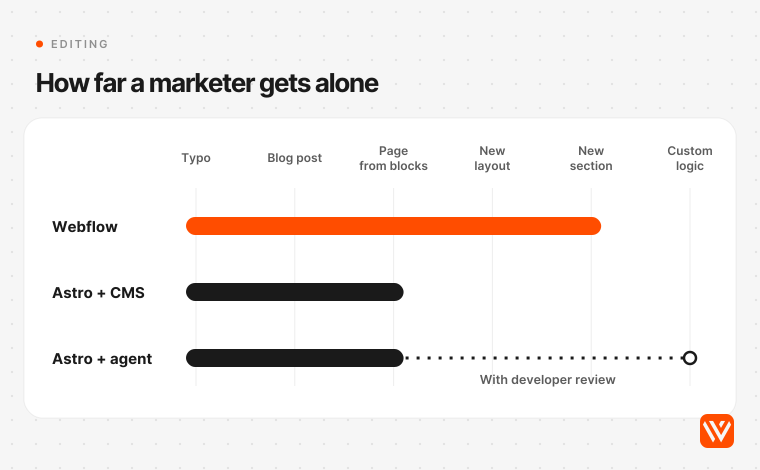
Yes for content, mostly no for layouts. A headless CMS such as Sanity, Storyblok or CloudCannon gives marketers forms, previews and scheduled publishing. The gap shows up when someone wants a page that doesn't match an existing block. On Webflow they build it. On Astro they file a ticket or brief an agent.
| Task | Webflow | Astro plus headless CMS | Astro plus coding agent |
|---|---|---|---|
| Fix a typo | Marketer | Marketer | Marketer, with review |
| Publish a blog post | Marketer | Marketer | Marketer, with review |
| New page from existing blocks | Marketer | Marketer | Marketer, with review |
| New page layout | Designer or trained marketer | Developer | Agent, then developer review |
| New section type | Designer | Developer | Agent, then developer review |
| Change global navigation | Designer | Developer | Agent, then developer review |
| A pricing calculator | Developer | Developer | Agent, then developer review |
The right-hand column is the new part, and practitioners disagree about it.
StackOne, an integrations company, rebuilt its marketing site on Astro in two weeks with two founders and a product marketing lead, and reports that a new page went from 24 to 72 hours on Webflow to 1 to 2 hours through Claude Code. A typo fix now means tagging an agent in Slack. That's a strong result. It also came from a team where most people already used Claude Code daily, which isn't true of most marketing teams.
Then there's the counter-example. A lead web developer at a mid-sized logistics firm wrote on r/webflow in July 2026 that the company moved to Astro and Sanity with Claude Code in about a day, then moved back. New pages drifted off-brand, and form sections stopped matching each other. Their summary: "the limitations of Webflow I've come to hate are actually blessings in disguise." The top replies blamed the setup, not the stack, and said agents need written design rules and a real component library. Both sides have a point, and it's the same point: agents need a design system someone has to own.
Alex Iglesias, CTO of Finsweet, one of the best-known Webflow agencies and now an active Astro explorer, put the buyer test plainly on the Webflow and Friends podcast on 12 October 2026. The best Astro client today, he said, is one "who's going to be relying on you to fully manage the website." On visual editing for clients, he sees "a big gap in the market right now."
Our scan hints at how most Astro sites run today. Only 12% of Astro homepages showed a detectable headless CMS, with Sanity the most common at 15 sites. Detection misses some setups, but the pattern fits developers editing in Git.
Tools are arriving to fill it. CloudCannon became Astro's official CMS partner in March 2026. Timothy Ricks' Stacki gives Astro a visual editor, though it's at version 0.1.94 and its hosted client editor needs a paid Cloudflare setup, so we'd treat it as promising rather than proven. Webflow's Designer has 14 years behind it. Nothing on the Astro side matches it yet.
How much does Astro cost compared with Webflow?
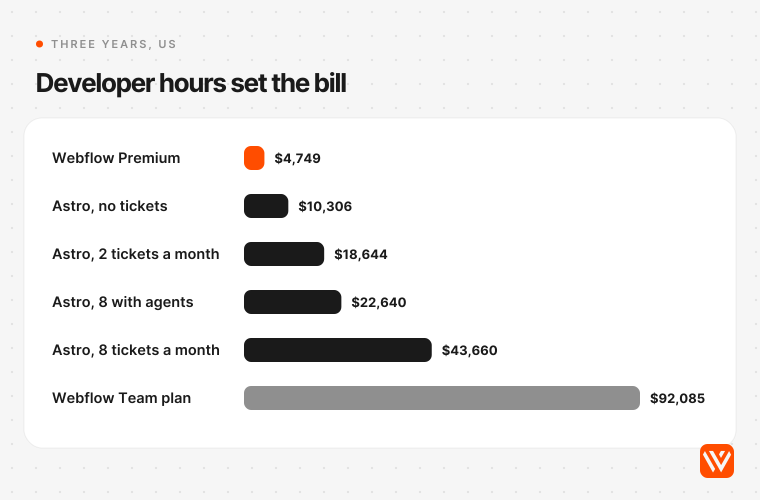
On platform fees alone they're close, and developer time decides the result. We modelled three years of running one 40-page marketing site with three editors, excluding the build.
Webflow Premium at $25 a month, a Core Workspace at $19 and two limited seats at $15 each come to $2,664 over three years (prices checked 31 October 2026). Astro on free static hosting with Sanity Growth at $15 a seat for three seats comes to $1,620. CloudCannon Standard at $49 a month would be $1,764, and Storyblok Growth at $90.75 would be $3,267. So the saving people quote as the reason to leave is about $1,040 across three years.
Now add people. Astro needs upkeep: two major upgrades in the last 12 months at 16 hours each, 10 security patch days at an hour each, and 8 hours of dependency and CMS care, about 50 hours a year. Webflow needs about 12. Then add the layout changes a Webflow marketer would have made alone, at two developer hours each.
| Three-year running cost, excluding the build | US | UK | India |
|---|---|---|---|
| Webflow Premium, Core and 2 limited seats | $4,749 | £3,458 | ₹2.71 lakh ($2,840) |
| Astro and Sanity, no layout tickets | $10,306 | £7,307 | ₹2.25 lakh ($2,360) |
| Astro and Sanity, 2 layout tickets a month | $18,644 | £13,157 | ₹2.92 lakh ($3,070) |
| Astro and Sanity, 8 layout tickets a month | $43,660 | £30,707 | ₹4.95 lakh ($5,190) |
| Same 8 tickets with agents halving developer hours | $22,640 | £15,961 | ₹3.25 lakh ($3,410) |
| Webflow Team plan | $92,085 | £68,886 | ₹85.9 lakh ($90,180) |
The model uses median developer pay with a 1.3 on-cost multiplier: $92,650 from the US Bureau of Labor Statistics for May 2025, and £65,000 and ₹7.5 lakh for the UK and India from the same proxies as our Webflow vs Next.js cost model. A lakh is 100,000 rupees. Exchange rates are from 30 October 2026. The hours are our assumptions, so swap in your own. On US wages, six extra developer hours a year wipe out Astro's platform saving.
Two results surprised us.
First, the Team plan flips everything. Page branching, publishing workflows and single-page publishing sit on Team at $2,500 a month on an annual contract. If those features are why your engineers are unhappy, Webflow costs $90,000 over three years and Astro gives you the same control through Git at no charge. None of the 12 ranking comparisons mentions this plan. A team that wants branching on Webflow should price Astro first.
Second, India changes the maths. At Indian developer rates, Astro needs about 71 extra developer hours a year before it costs more than Webflow, against 6 in the US. Webflow's dollar pricing doesn't come down with local wages.
Stale prices are a hazard in this comparison. Enacton's August 2026 article, which ranks for this query, still prices Webflow by the CMS and Business tiers that Premium replaced on 13 May 2026, and builds a five-year $63,000 figure on them. Check any Webflow number against the live pricing page.
What does an Astro site cost you after launch?
More attention than the free price suggests. Astro is healthy and fast-moving, which means you inherit its pace. The npm registry shows 113 stable Astro releases on 94 separate days in the 12 months to 31 October 2026, including two majors: Astro 6.0 on 10 March 2026 and Astro 7.0 on 22 June 2026.
Security is the part most comparisons skip. None of the 12 we read mentions it. GitHub's Advisory Database lists 15 advisories for the astro package so far in 2026, up from 11 in 2025 and 3 in 2024. One is rated critical: remote code execution through AVIF image optimisation, fixed in 7.2.8 on 8 September 2026. For scale, Next.js has 44 this year. Most of Astro's need on-demand rendering or attacker-controlled input, so a fully static site fed by a trusted CMS has far less exposure. Someone still has to read each one and decide. That AVIF bug is a good example: if your CMS accepts image uploads from outside your team, a static build isn't automatically safe.
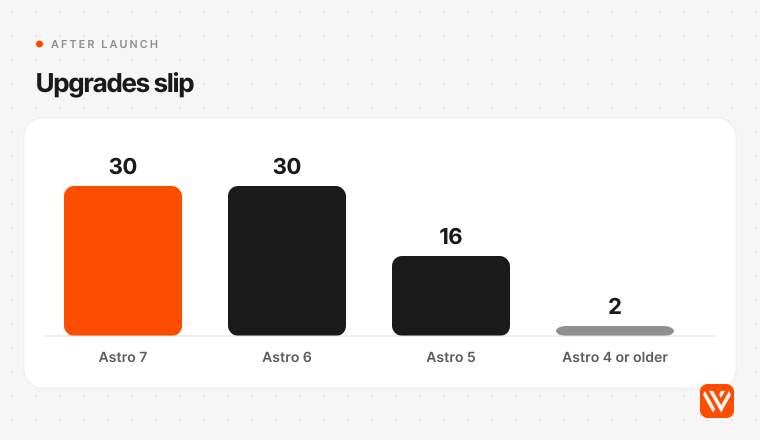
We wanted to know how teams keep up, and the generator tag gave us a rough answer. Of the 198 Astro homepages in our scan, 78 still expose their version. 30 run Astro 7, 30 run Astro 6, and 18 sit on 5 or older, at least two majors behind. It's a self-selected group, but the direction is clear: upgrades slip when a marketing site isn't anyone's main job. Even cloudflare.com, run by the company that bought Astro, reported Astro 6.3.7 on the day we looked.
Webflow has incidents too, and you can't fix those yourself. Its status feed shows 36 incidents between November 2025 and September 2026, seven of them rated major or critical. The trade is simple, and Alex Iglesias stated it well in that same interview: on a codebase, if things break they're on you, and on Webflow they're on a company with engineers and SLAs. A team without a named owner for the site should weigh that above any speed chart.
Why are SaaS teams moving from Webflow to Astro?
Control and AI workflows, far more than speed or price. The public migrations read alike. ZenML moved 2,224 pages across 20 CMS collections in about a week with Claude Code, citing no version control and no CI/CD, and says the saving of about $800 a year wouldn't have justified it alone. Very Good Ventures moved 309 pages in under two weeks because updates needed specialist knowledge. Omnia moved about 800 pages in 23 hours for about $1,200 in AI tokens.
Notice who those companies are. An ML tooling company, a software agency, an API company and an AI visibility startup. All of them have people who read code for a living.
Our stack count shows how far this has gone. We fingerprinted the homepages of 2,400 active Y Combinator companies tagged B2B or SaaS, grouped by batch year.
| YC batch | Homepages | Webflow | Astro | Next.js | Framer |
|---|---|---|---|---|---|
| 2019 and earlier | 329 | 25.8% | 6.7% | 23.7% | 3.0% |
| 2020 to 2022 | 653 | 24.3% | 7.2% | 31.9% | 6.6% |
| 2023 to 2024 | 588 | 15.0% | 7.3% | 42.7% | 14.8% |
| 2025 to 2026 | 830 | 2.0% | 10.7% | 51.7% | 6.3% |
Webflow's fall among the newest batches is steep: 17 of 830. Astro passed it, and so did Framer. Field data agrees on direction. HTTP Archive counted 8,933 Astro origins in September 2024 and 49,450 in September 2026, while Webflow went from 59,398 to 60,687 after peaking at 66,369 in February 2026. If the pace since April holds, Astro passes Webflow in that dataset around the turn of the year. That's our extrapolation, not a forecast from either company.
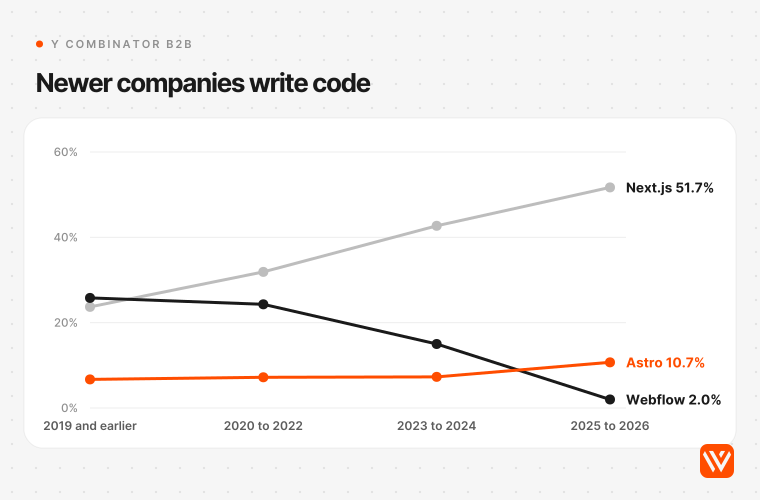
Before you act on that table, look at who's in it. A YC company from 2025 is a handful of engineers with no marketing team, and those founders write their own site with an agent. A $20 million ARR company with a head of marketing, a designer and a quarterly campaign calendar is a different buyer. Webflow's share among older batches, the ones most likely to have grown a marketing function, is still about one in four. Old sites stay on old stacks too, so part of that is inertia. It's a signal about founders, not a verdict on Webflow.
The lock-in argument is also weaker than it was, in both directions. If a single operator can move 800 pages in a day, leaving Webflow later is a much smaller risk than it was in 2024. That cuts against rushing.
Does Source by Webflow change the answer?
It might, but not yet. Webflow announced Source at Webflow Conf in September 2026, a new platform where code is the foundation and the visual canvas edits that code. CEO Linda Tong told CMSWire: "The source of truth of it is code, which is fundamentally different from how we started our business."
Webflow says Source connects to your existing codebase, CMS and hosting, including sites built in Webflow. Hal Zeitlin of Candid Leap, quoted on the Source page, says that for clients on Next.js and Astro "Source will be our new default." That's a vendor-selected quote from a partner, so weigh it accordingly, but the implication is big: the agents and governance Webflow is building may sit on top of an Astro repo. Webflow has been close to Astro for a while. It gave the project $150,000 in September 2025 and chose Astro to power its AI app generation.
Here's what's unknown as of 31 October 2026. Source is in a limited research preview, with partners and customers admitted in phases. No pricing is published. Webflow says the existing platform isn't going anywhere and promises a supported path if you choose to migrate. On that October podcast, Iglesias said Finsweet hadn't got access yet.
Our view: don't choose either stack based on a preview. But Source does lower the risk of both choices. A Webflow customer has a stated way forward to code, and an Astro team may yet get a visual layer for marketers. If you're undecided and nothing is broken, waiting two quarters costs you little.
Can you use Astro and Webflow together?
Yes, and for many B2B SaaS companies it's the best answer. Webflow Cloud deploys Astro apps on a path of your Webflow site, so marketers keep the Designer while developers ship real code under the same domain. It runs on Cloudflare Workers and deploys from GitHub.
We run this setup in production. On First December Films, a Mumbai production house, we built a 184-page Webflow site and an AI script analyser that runs as a separate Webflow Cloud app at /analyser, on Astro 7. The public page lives in the Designer, which owns its copy, FAQ and SEO, and a 1 KB embed loads the engine. The lesson came when the client rebuilt that page in the Designer to their own design, and the rebuild dropped the head code and an element ID. We restored both through the API within the hour, and it's now a checklist item. Hybrids need a written contract between the page and the app.
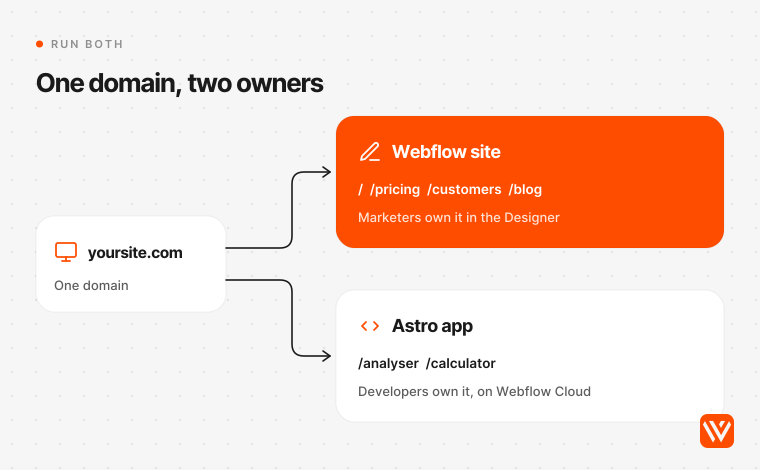
Read the limits before you commit. Webflow Cloud's limits page sets a 20-second request timeout and replaces your response Cache-Control header with private, no-cache, so you can't rely on your own CDN caching rules. That's fine for a calculator or a gated tool, and a poor home for your blog. If you want Astro for 5,000 programmatic pages beside a Webflow marketing site, you'll want separate hosting behind a reverse proxy, which brings the routing and analytics work that ChatGPT rightly warned about when we asked it this question. Vercel's comparison is worth reading too, though Vercel is a competitor here.
Is Astro a safe long-term bet after the Cloudflare acquisition?
Reasonably, for a content site. Cloudflare acquired the Astro team on 16 January 2026 and committed to keeping Astro open source. The MIT licence means your code runs on Vercel, Netlify or any static host regardless, and in our scan 25% of Astro homepages were on Vercel against 52% served through Cloudflare. The realistic risk is drift, where new features work best on Cloudflare, rather than abandonment.
Neither stack removes lock-in. It moves. Quarter, a Webflow agency, makes this point well: with Astro and Sanity your front end is yours, but your content sits in Sanity's store and its query language. On Webflow, code export leaves out CMS items, so content comes out through the API, and forms and interactions need rebuilding. Very Good Ventures says bulk export isn't easy. Both are solvable. Budget for it either way.
How does the answer change by market?
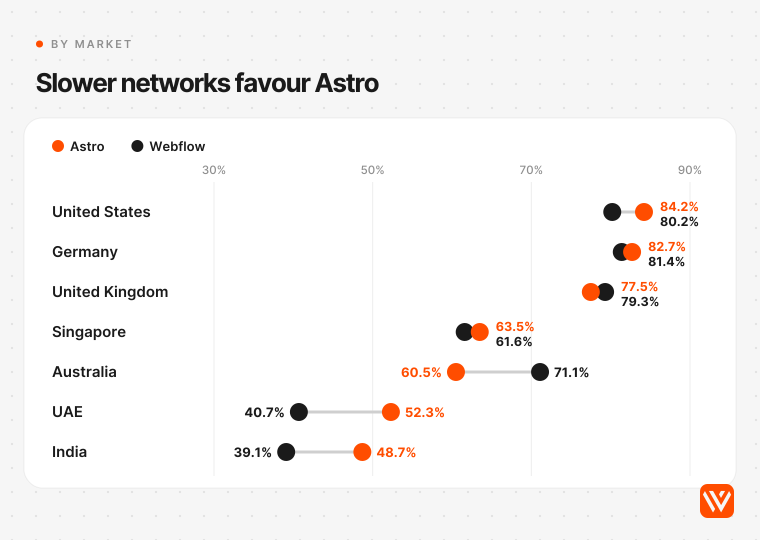
Core Web Vitals pass rates vary more by country than by stack, so check your buyers' market rather than the global number. Here's the September 2026 mobile data from HTTP Archive.
| Market | Astro pass rate | Astro origins | Webflow pass rate | Webflow origins |
|---|---|---|---|---|
| United States | 84.2% | 9,292 | 80.2% | 16,374 |
| Germany | 82.7% | 3,276 | 81.4% | 4,703 |
| United Kingdom | 77.5% | 2,651 | 79.3% | 4,049 |
| Singapore | 63.5% | 504 | 61.6% | 437 |
| Australia | 60.5% | 1,031 | 71.1% | 1,977 |
| United Arab Emirates | 52.3% | 520 | 40.7% | 551 |
| India | 48.7% | 5,728 | 39.1% | 5,454 |
Astro leads in five of the seven. The gaps widen where mobile connections are slower, which fits a lighter page: 9.6 points in India and 11.6 in the UAE, against 4 in the US. If your buyers are in the US or Europe, either stack passes comfortably. If you sell into India or the Gulf on mobile, page weight matters more, and Astro's advantage is real.
Hiring differs too. Webflow specialists are a defined freelance market, while Astro work draws on the much larger pool of JavaScript developers. A r/astrojs thread from a Webflow freelancer raises the worry that clients won't find Astro help later. The replies argue that a React developer can pick Astro up quickly. In India, where Webflow talent is thinner than general JavaScript talent, that argument is stronger still.
When does this advice not apply?
Skip Astro if nobody on your team can review a pull request. Agents write code quickly, and someone still has to notice when they've broken the pricing page.
Skip Webflow if the site is really an extension of your product: docs, a template gallery, thousands of generated integration pages, or shared components with your app. Past 20,000 CMS items on Premium, you're into Enterprise conversations or a different stack. And if your site needs logins and live data throughout, look at Next.js rather than Astro. Lucky Media, an official Astro partner agency, says the same about dashboards and authenticated apps.
Skip the whole debate if your site passes Core Web Vitals, your team ships weekly and nobody's complaining. Migrations cost attention you could spend on pages that sell.
What should you do next?
Do the 20-changes test this week, then decide with your head of marketing and an engineer in the same room. If you're on Webflow and your pages are slow, audit images and tags before anything else. Our free AI Design Scorer gives you a quick read on any page.
If the test points to Astro, or you want both on one domain, we build and migrate Astro sites from $4,000, usually in 6 to 8 weeks. We build on both, so if the honest answer is that Webflow already fits, that's what you'll hear.
Sources and method
The homepage pool was every active company tagged B2B or SaaS in the public yc-oss copy of the Y Combinator directory, plus earlier Webyansh B2B SaaS samples: 2,651 domains, fingerprinted from raw HTML on 31 October 2026, with 2,400 reachable YC homepages in the batch table. We rendered every Astro homepage and a seeded random sample of Webflow homepages in headless Chrome at 1,440 by 900, and kept 414 with at least 50 words of rendered text. Desktop transfer sizes aren't the same as HTTP Archive's mobile medians, so don't compare them directly. "Marketing tags" means scripts from known analytics, ad, chat, consent and tag-manager hosts. Field data comes from the HTTP Archive Technology Report API for September 2026. Astro's release counts come from the npm registry and its security counts from the GitHub Advisory Database, both read on 31 October 2026. The 12 ranking pages came from Brave Search in the US, UK and India, because Ahrefs returned no SERP for this query and Google blocked automated checks.
Is Astro better than Webflow?
Neither is better in general. Astro suits teams where developers or coding agents own the site and want it in Git. Webflow suits teams where marketers change layouts themselves. In September 2026 both passed Core Web Vitals on about 71% of sites, though Astro led among the busiest sites.
Is Astro faster than Webflow?
On real B2B SaaS homepages, yes. The median Astro homepage weighed 1.5 MB against 2.5 MB for Webflow in our October 2026 scan. Field pass rates tie overall at 71%, but Astro led 44.7% to 26.9% among the top 100,000 sites in HTTP Archive data.
Can you use Astro with Webflow?
Yes. Webflow Cloud runs Astro apps on a path of your Webflow site, so marketers keep the Designer and developers ship code under one domain. It suits calculators, gated tools and AI features. Its 20-second request timeout and fixed cache headers make it a poor home for a full blog.
Is Astro cheaper than Webflow?
On platform fees, slightly: about $1,040 less over three years in our model. Developer time usually reverses that. In the US, Astro with Sanity costs about $18,600 over three years with two layout tickets a month, against about $4,700 on Webflow. Webflow's Team plan changes the sums, at $90,000.
Can marketers edit an Astro site without a developer?
Yes for content. A headless CMS such as Sanity, Storyblok or CloudCannon lets marketers publish posts and edit copy with previews. New layouts and section types still need a developer or a supervised coding agent. That's the main trade-off against Webflow's visual canvas.