Summarise this article using AI


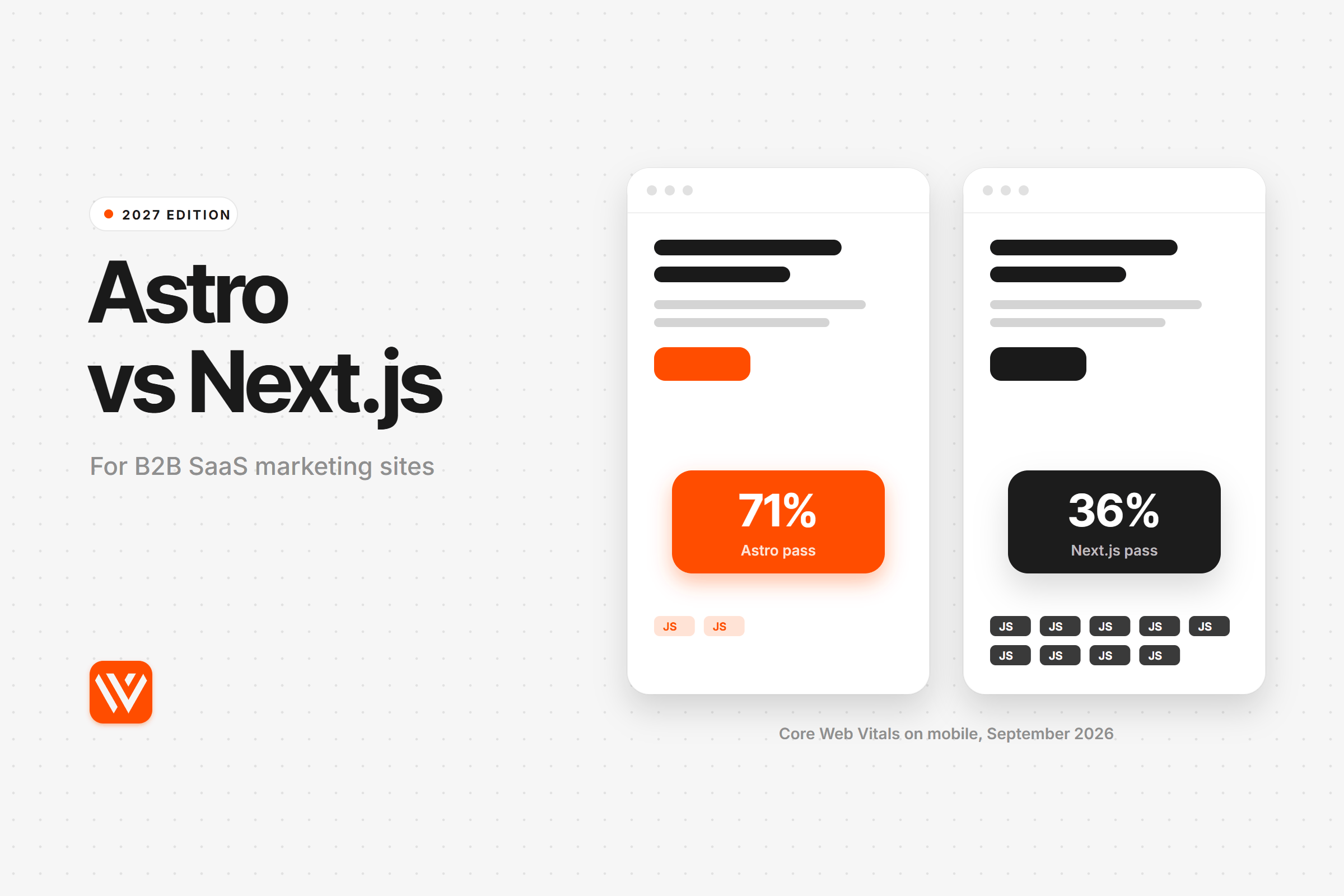
Use Astro for a B2B SaaS marketing site that is mostly pages, pricing, a blog and docs. Use Next.js when the marketing site behaves like the product, with logged-in states or per-user content, or when one team ships both from a single React codebase. In September 2026, 71.1% of Astro sites passed Core Web Vitals on mobile, against 35.7% of Next.js sites.
We build Astro sites and migrate Next.js marketing sites to Astro, so we have a stake in the Astro vs Next.js question. That's why this comparison runs on public data instead of opinion: Chrome field data across seven markets and five traffic tiers, a stack count of 2,650 Y Combinator B2B and SaaS homepages, a render of 277 of those homepages (174 Astro, 103 Next.js), every security advisory both frameworks published in 2026, and a three-year running-cost model in dollars, pounds and rupees.
Key takeaways
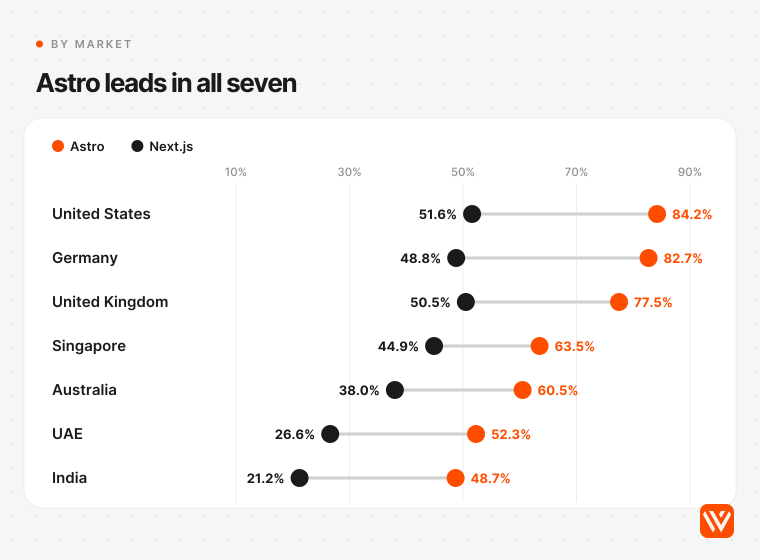
- Astro's speed lead is not a quirk of the sites that use it. It holds in all seven markets we pulled, from the US (84.2% vs 51.6%) to India (48.7% vs 21.2%), and in every traffic tier from the top 1,000 sites to the top 10 million (HTTP Archive, September 2026).
- On real B2B SaaS homepages the gap is smaller than the averages suggest. In our 3 November 2026 scan the median Astro homepage weighed 1.57 MB and the median Next.js homepage 1.86 MB. Next.js's own framework code came to 353 KB at the median; Astro's to 79 KB, with marketing tags making up most of its JavaScript.
- The security load follows the server, not the logo. Next.js published 44 advisories in 2026, and 41 of them, including all 5 critical ones, need a running Next.js server. A static marketing site doesn't have one.
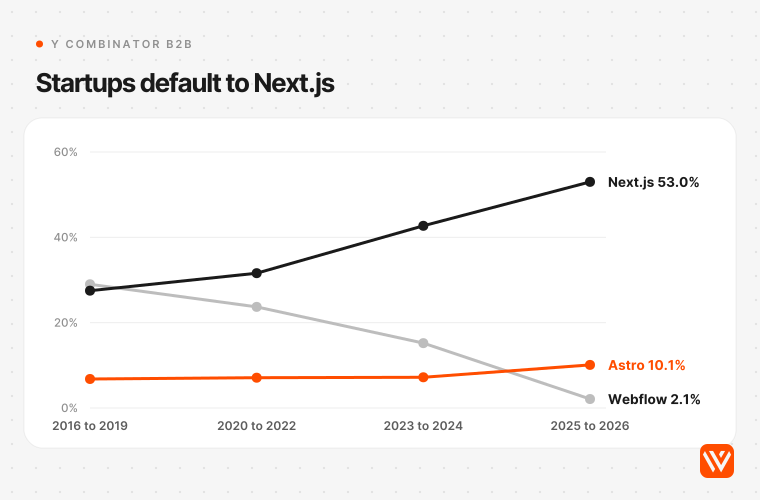
- Next.js is the default for new startups anyway: 53.0% of active Y Combinator B2B homepages from the 2025 and 2026 batches run it, against 10.1% on Astro.
- Running cost barely separates them. Our three-year model lands between about $3,300 and $6,000 in the US for every setup we tested. In India the picture flips, because Vercel's dollar seats outweigh local wages.
What is the difference between Astro and Next.js?
Astro is an open-source web framework that renders pages to HTML on the server or at build time and sends JavaScript to the browser only for the components you mark as interactive. Next.js is a full-stack React framework, maintained by Vercel, built to run applications: routing, data fetching, caching and server logic in one React codebase.
Both can produce fast, crawlable HTML. The difference is the default. Astro starts from a document and lets you add an app inside it. Next.js starts from an app and lets you make parts of it static.
| Astro | Next.js | |
|---|---|---|
| Built for | Content-led sites: marketing, docs, blogs | Applications and mixed app-plus-content estates |
| JavaScript in the browser | None unless a component opts in (client:load, client:visible) | The React runtime plus your client components on every page |
| UI components | React, Vue, Svelte, Solid or plain .astro, mixed in one project | React only |
| Rendering | Static by default; on-demand rendering and server islands per route | Static, server and streaming per route; Cache Components and "use cache" since Next.js 16 |
| Owner | The Astro team, part of Cloudflare since 16 January 2026; MIT licensed | Vercel; MIT licensed |
| Latest stable on 3 November 2026 | 7.4.5 | 16.4.4 |
| Best host | Any static host; adapters for Cloudflare, Netlify, Vercel and Node | Vercel; elsewhere through adapters such as OpenNext |
Sources for the table: Astro's server islands guide, the Next.js 16 release post, Cloudflare's press release and the npm registry for astro and next, read 3 November 2026.
Which should a B2B SaaS marketing site use, Astro or Next.js?
Pick by what the marketing site has to do, not by what the product is built on. If visitors read, compare and book a demo, Astro is the better fit. If visitors log in, see their own data or get pages assembled per account on every request, Next.js earns its weight.
Ask three questions, in this order.
- Does any marketing page need to know who the visitor is? Logged-in pricing, account-specific content, a dashboard preview fed by live data. If yes for many pages, lean Next.js. If yes for one or two widgets, Astro's server islands can render those pieces per request while the rest of the page stays static.
- Does one team own the product and the site, in one repo, with a shared component library? Then a second framework is a real cost, and staying on Next.js is reasonable. Astro can import those React components as islands, but someone has to own the seam.
- Who edits the site after launch? Neither framework has a visual editor. Both need a headless CMS (Sanity, Storyblok, Contentful, CloudCannon) for marketers to publish without a pull request. If marketers must change layouts on their own, the honest answer may be neither, and our Astro vs Webflow comparison covers that case.
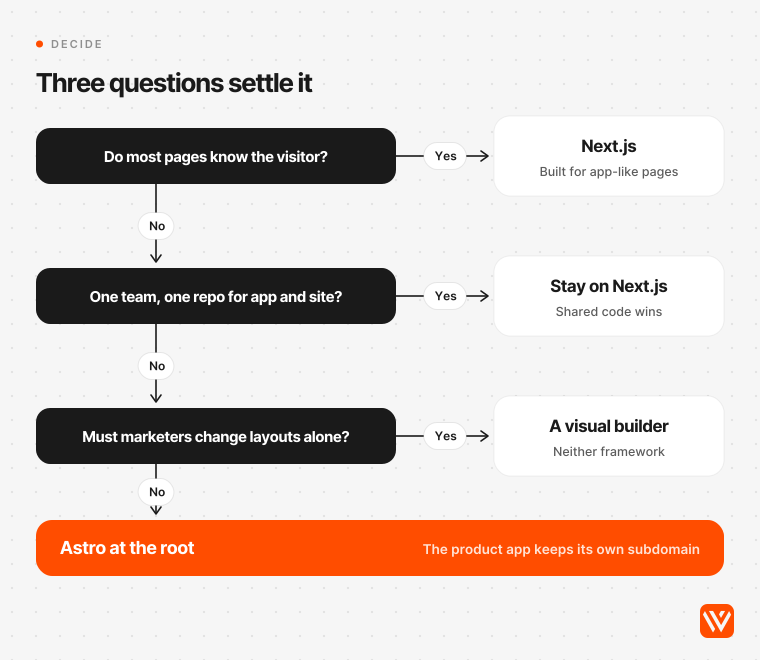
Our view: a separate marketing site at the root domain, built in Astro, with the product on app.yourdomain.com in whatever the product team prefers, is the right default for a marketing-led B2B SaaS company in 2027. Four AI engines we asked on 3 November 2026 (Google AI Mode, Perplexity, Gemini and Ask Brave) reached the same split, and two of them recommended the hybrid by name.
Is Astro faster than Next.js in real-world data?
Yes, by a wide margin. In September 2026, 71.1% of the 47,277 Astro origins in Chrome's field data passed all three Core Web Vitals on mobile. Only 35.7% of the 395,345 Next.js origins did. On desktop the split was 84.6% to 56.9% (HTTP Archive Technology Report, our pull on 3 November 2026).
Every individual metric points the same way:
| Mobile, September 2026 | Astro | Next.js |
|---|---|---|
| All three Core Web Vitals good | 71.1% | 35.7% |
| Largest Contentful Paint good | 81.1% | 53.5% |
| Interaction to Next Paint good | 85.0% | 59.7% |
| Cumulative Layout Shift good | 93.6% | 73.5% |
| Time to First Byte good | 63.1% | 45.6% |
| Median page weight | 1.29 MB | 2.07 MB |
| Median JavaScript | 399 KB | 802 KB |
| Median Lighthouse performance score | 70 | 53 |
Field data is what Google uses. Lighthouse runs a single lab test on one machine; the Chrome User Experience Report records what real visitors' phones experienced over 28 days. When a comparison leans on Lighthouse scores for Astro, as four of the 15 ranking pages we read do, it's quoting a lab number. The field gap above is the one that reaches rankings.
Is the gap just a different mix of sites?
No. This is the strongest argument for Next.js, and it doesn't survive the data. Vercel's own comparison, ranking first in India and the UK for this query, concedes that Astro sites pass Core Web Vitals "at higher aggregate rates in HTTP Archive data" and then argues the numbers "reflect the types of sites each framework is used for" (Vercel, 3 June 2026). The claim is fair to raise. Apps are heavier than brochures, and Next.js runs far more apps.
So we cut the data three ways that a pure mix effect would have to show up in.
By market. If Astro just had more sites in fast-network countries, the gap would shrink inside each country. It doesn't. Astro leads by 32.6 points in the US, 27.0 in the UK, 33.9 in Germany, 27.5 in India, 25.7 in the UAE, 22.5 in Australia and 18.6 in Singapore. Re-weighted to Next.js's own mix across those seven markets, Astro still passes 69.3% against 40.1%.
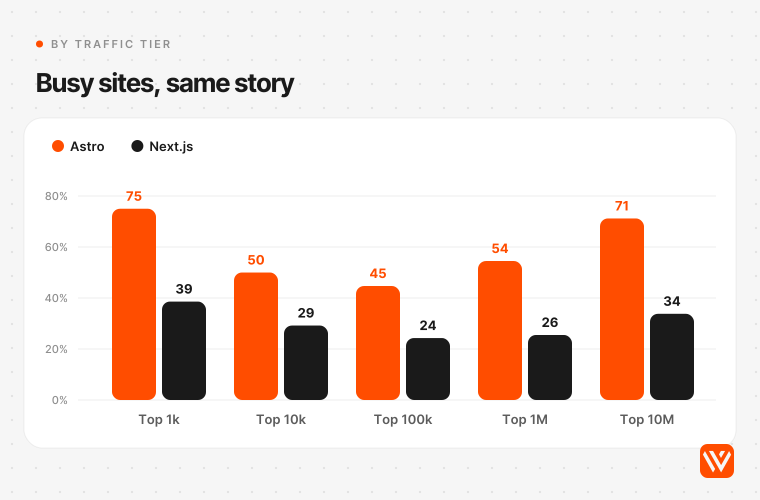
By traffic tier. Big, busy sites are where the most serious teams work. Astro leads in every tier HTTP Archive publishes:
| Rank band (mobile, Sep 2026) | Astro pass | Next.js pass | Astro origins | Next.js origins |
|---|---|---|---|---|
| Top 1,000 | 75.0% | 38.6% | 8 | 83 |
| Top 10,000 | 50.0% | 29.2% | 62 | 800 |
| Top 100,000 | 44.7% | 24.3% | 441 | 5,890 |
| Top 1 million | 54.5% | 25.5% | 3,087 | 39,764 |
| Top 10 million | 71.2% | 33.8% | 33,394 | 276,735 |
The top-1,000 row holds only 8 Astro sites, so read it as a hint. The 441 and 3,087 rows are solid.
Over time. In September 2024 the overall gap was 34.5 points (61.9% to 27.4%). Two years, two Next.js majors and a whole Server Components push later, it was 35.4 points (71.1% to 35.7%). Both improved. Neither caught up.
A well-built Next.js site can pass Core Web Vitals; many do. The data says that on average it takes more deliberate work, because every page starts with React's runtime and your client components on board.
What do real B2B SaaS homepages ship?
Heavier than Astro's reputation, lighter than Next.js. We rendered 174 Astro and 103 Next.js homepages of active Y Combinator B2B and SaaS companies in headless Chrome on 3 November 2026 and split every byte by who sent it. The median Astro homepage weighed 1.57 MB; the median Next.js homepage weighed 1.86 MB.
| Median homepage, 3 Nov 2026 scan | Astro | Next.js |
|---|---|---|
| Homepages rendered | 174 | 103 |
| Total transfer | 1.57 MB | 1.86 MB |
| All JavaScript | 414 KB | 644 KB |
| Framework JavaScript (/_astro/ or /_next/ files) | 79 KB | 353 KB |
| Marketing and analytics tags | 226 KB | 136 KB |
| Images | 494 KB | 377 KB |
| Homepages shipping over 500 KB of JavaScript | 42.5% | 64.1% |
| Under 80% of visible text in the raw HTML | 6.9% | 12.7% |
Three things in that table matter for a marketing team. First, the framework's own code is the clearest difference: about 79 KB for Astro against 353 KB for Next.js at the median, before a single tag loads. Second, Astro's "zero JavaScript" didn't survive marketing. The median Astro homepage still shipped 414 KB of JavaScript, and 226 KB of it was analytics, chat, consent and ad tags. 95 of the 174 Astro homepages had no hydrated island at all, so on those pages the script weight came from the site's own scripts and third-party tools rather than from interactive components.
Third, 91 of the 99 Next.js homepages whose router we could identify ran the App Router, and on those the inline React Server Components payload was 42% of the HTML at the median. That payload repeats the page as data for React, on top of the HTML, and every visitor downloads and parses it whether or not anything on the page is interactive.
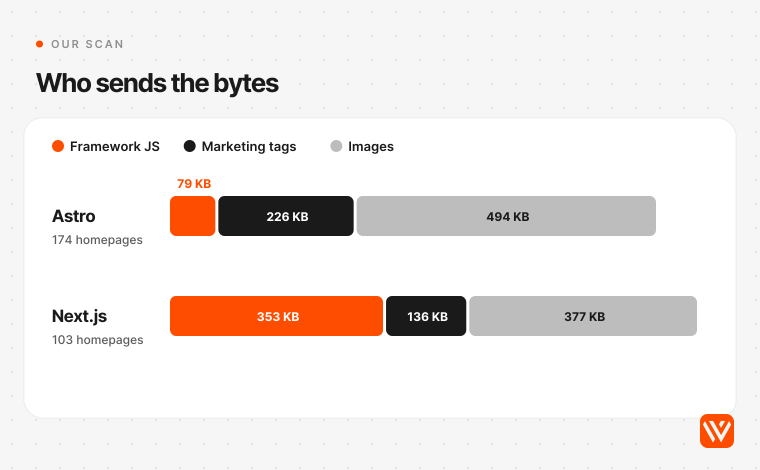
The practical lesson cuts both ways. Moving a Next.js marketing site to Astro removes roughly a quarter of a megabyte of framework code at the median. It does nothing for a tag manager carrying a dozen vendors, which is where many Astro sites in our sample spent their savings. Audit tags before you blame the framework.
Is Astro better than Next.js for SEO and AI search?
For classic Google SEO they're close: both render full HTML on the server or at build time, both handle metadata, sitemaps and structured data, and HTTP Archive's median Lighthouse SEO score is 100 for Astro and 96 for Next.js. Astro's real SEO edge is Core Web Vitals, which act as a tiebreaker between similar pages rather than a ranking engine.
AI search is where rendering matters more. Vercel's own crawler study found that none of the major AI crawlers, including those of OpenAI, Anthropic and Perplexity, run JavaScript; Gemini (through Googlebot) and Applebot are the exceptions (Vercel, December 2024). So any copy that appears only after hydration is invisible to ChatGPT and Claude when they fetch your page.
Both frameworks put text in the HTML by default. The risk with Next.js is drift: a pricing table or FAQ that someone moves into a client component with data fetched in the browser disappears from the raw HTML without anyone noticing. In our scan, 13 of 102 Next.js homepages (12.7%) had less than 80% of their visible text in the raw HTML, against 12 of 174 Astro homepages (6.9%). Astro sites were also likelier to publish an llms.txt file (71.8% against 53.4%) and JSON-LD structured data (79.3% against 63.1%), which says more about the teams that pick Astro than about the framework. Check your own pages with View Source, not DevTools; our JavaScript SEO guide walks through the test.
Which is safer to run, Astro or Next.js?
The one that runs less code on a server. In 2026 the GitHub Advisory Database published 44 advisories for the `next` package, 5 of them critical, on 10 separate dates. Astro had 15, 1 critical, on 7 dates. But the count matters less than where the bugs live.
We read all 59 summaries and sorted them by what a site must be running to be exposed:
| 2026 advisories | Next.js | Astro |
|---|---|---|
| Total | 44 | 15 |
| Critical | 5 | 1 |
| Need a live framework server (image endpoint, middleware, Server Actions, server components, caching, SSR routes) | 41 | 7 |
| Template escaping bugs, reachable on a static build only if untrusted input reaches the page | 1 | 8 |
| Development server only | 2 | 0 |
| Publish dates (days you'd patch a server deployment) | 10 | 7 |
All five critical Next.js advisories in 2026 were remote code execution through server features: the Image Optimization API with AVIF (8 September) and SVG files (22 October), `next/og` image responses (30 September), `use cache` functions (22 October) and Windows-hosted servers (8 September). Astro's one critical, published the same day as the AVIF one, was also remote code execution through AVIF image optimisation (GitHub Advisory Database, pulled 3 November 2026). The pattern before 2026 is the same: the March 2025 middleware authorisation bypass (Vercel's postmortem) and the December 2025 remote code execution in the React flight protocol (Next.js advisory) both needed a server.
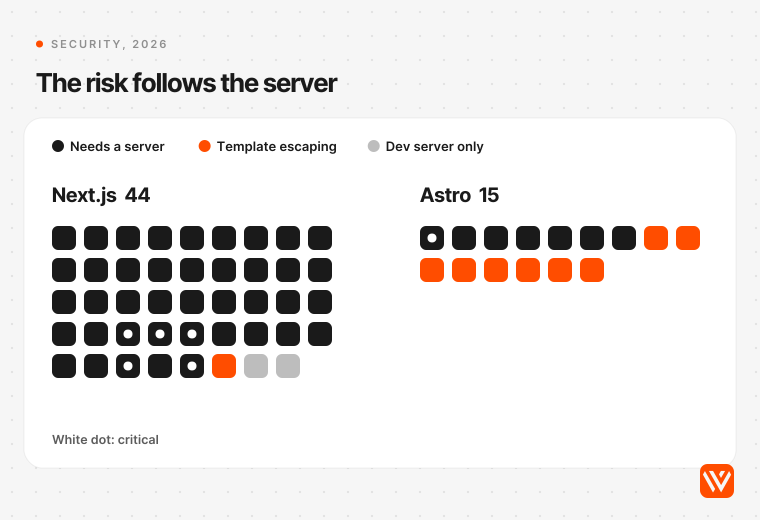
That gives a marketing team a cleaner choice than "which framework is safer". A fully static site has almost nothing to patch at 2 a.m. An Astro site built static and hosted as files sits there by default. A Next.js site can get there too with `output: 'export'`, but static export gives up rewrites, redirects, cookies, middleware, Incremental Static Regeneration, Server Actions and the default image optimisation (Next.js docs), which is much of why teams chose Next.js. Our position: if your marketing site doesn't need a server, don't run one, whichever framework you pick.
How much does Astro cost compared with Next.js?
Running costs are close. Over three years, a 40-page B2B SaaS marketing site costs about $3,300 to $6,000 in the US in our model, whichever framework you pick, once you leave out the build itself and the headless CMS, which costs the same either way.
| Three-year running cost, excluding the build and CMS | Hosting | Upkeep hours | US | UK | India |
|---|---|---|---|---|---|
| Astro, static on Cloudflare | $0 | 84 | $4,864 | £3,412 | ₹35,847 (about $378) |
| Astro, server-rendered on Cloudflare Workers | $180 | 93 | $5,565 | £3,912 | ₹56,775 (about $598) |
| Next.js, static export on Cloudflare | $0 | 57 | $3,301 | £2,316 | ₹24,325 (about $256) |
| Next.js on Vercel Pro, 2 developer seats | $1,440 | 78 | $5,957 | £4,243 | ₹1,69,984 (about $1,791) |
How we built it: Vercel Pro is $20 a month per developer seat with $20 of usage included (Vercel pricing); Cloudflare serves static assets free and without limit, and Workers Paid starts at $5 a month (Cloudflare pricing). Upkeep is our assumption of 16 hours per major upgrade (Astro shipped 6 majors from 2023 to 2026, Next.js one a year) plus an hour per patch day from the advisory table above. Wages are the BLS median for web developers ($92,650, May 2025), the UK median for Next.js permanent roles on ITJobsWatch (£65,000) and PayScale's Indian front-end developer average (₹6,82,802, about $7,190), each with a 1.3 on-cost. Currency at open.er-api.com rates on 3 November 2026: $1 = ₹94.93 = £0.746. Lakh is the Indian unit for 100,000, so ₹1,69,984 is about 1.7 lakh.
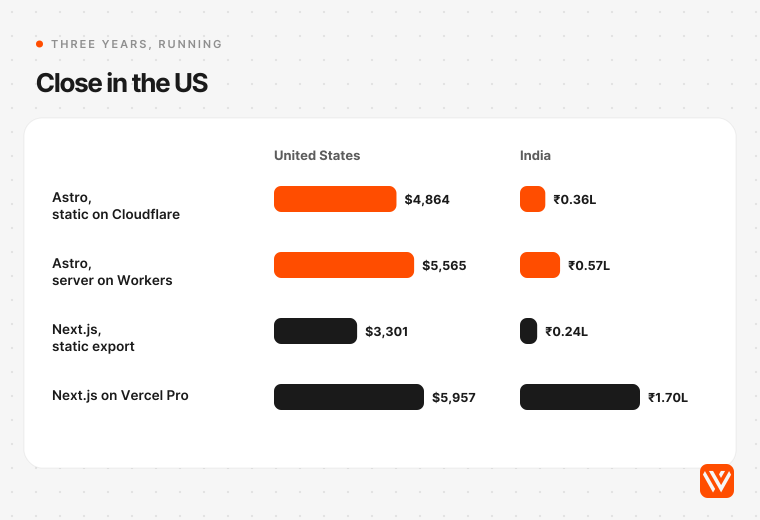
Two things stand out. First, Astro's faster major cadence costs it a few hours a year; the framework that ships less JavaScript isn't the one with less maintenance. Second, in India, Vercel's seats are 80% of the Next.js bill, because $1,440 of hosting is worth more than a year of patching at Indian rates. For an Indian SaaS team selling to the US, that's a real line item.
Neither number touches the expensive part, which is the build and the people who change the site every week. Our cost guide for B2B SaaS websites covers build budgets.
Why do so many new SaaS startups pick Next.js anyway?
Because it's the default React framework, and React is what their engineers already write. We fingerprinted 2,650 active Y Combinator B2B and SaaS homepages on 3 November 2026 from their raw HTML and headers. Next.js ran 1,002 of them and Astro 194. In the 2025 and 2026 batches, Next.js ran 53.0% of the 851 reachable homepages, up from 31.6% in the 2020 to 2022 batches. Astro grew too, from 7.1% to 10.1%, while Webflow fell from 23.7% to 2.1%.
| YC batches (active B2B or SaaS, reachable) | Homepages | Next.js | Astro | Webflow | Framer |
|---|---|---|---|---|---|
| 2016 to 2019 | 207 | 27.5% | 6.8% | 29.0% | 3.9% |
| 2020 to 2022 | 632 | 31.6% | 7.1% | 23.7% | 6.6% |
| 2023 to 2024 | 567 | 42.7% | 7.2% | 15.2% | 14.8% |
| 2025 to 2026 | 851 | 53.0% | 10.1% | 2.1% | 6.2% |
One caveat: for many young startups the homepage is the product's front door, sometimes the app itself, so Next.js there is often a product decision rather than a marketing-site decision.
Hiring follows the same line. Across the six "Ask HN: Who is hiring?" threads from June to November 2026, 85 of 1,453 job posts named Next.js and 5 named Astro (our count through the Hacker News search API). React appeared in 324. That gap is real for hiring a Next.js specialist, but it overstates the risk for a marketing site: Astro uses React components as islands, so a React developer keeps writing React inside an Astro codebase. What you need on staff is React, and React was in 22% of the posts.
Popularity and satisfaction have also split. The State of JavaScript 2025 survey found Next.js still gaining usage while losing satisfaction, with a 39% satisfaction gap behind Astro, the category leader (State of JS 2025). DatoCMS, a headless CMS company, moved its own site from Next.js to Astro in December 2024; its CEO, Stefano Verna, wrote that "it feels like React/Next is moving in a direction that isn't ours" (DatoCMS). The Hacker News thread on that post (167 points, 160 comments) split the way this decision usually splits: developers who only needed static pages praised Astro's stable upgrades, while others argued Next.js is "crazy good" at blending dynamic and static pages, with e-commerce as its best case (Hacker News).
Can you use Astro and Next.js together?
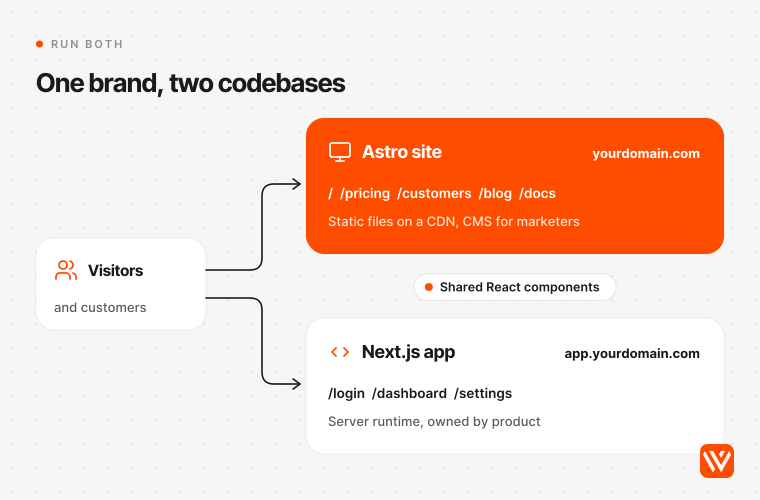
Yes, and for many B2B SaaS companies it's the best setup. Run the marketing site in Astro at the root domain and the product in Next.js on a subdomain such as app.yourdomain.com. Each deploys on its own schedule, and a marketing change can never break a login.
There are three common shapes:
- Separate subdomains. Astro on yourdomain.com, Next.js on app.yourdomain.com. Simplest, and the setup Gemini and Ask Brave both described when we asked.
- One domain, split by path. A proxy or rewrite sends /docs or /blog to Astro and everything else to Next.js. Next.js supports serving one domain from several apps through multi-zones; any CDN can do the same with path rules.
- Shared components. Keep your design system in React. Astro renders those components to HTML at build time and hydrates only the interactive ones, so the pricing toggle on the marketing site can be the same component the app uses.
We use the same pattern on a different stack for First December Films: the page at /script is owned in the Webflow Designer, while the script analyser behind it is a separate Astro 7 app on the Cloudflare Workers runtime at /analyser, loaded by a 1 KB embed (case study). Marketing keeps the page; the code that needs a server lives apart from it.
Who owns Astro and Next.js, and does it matter?
Both frameworks are open source and both are owned by hosting companies. Vercel maintains Next.js and sells the hosting it runs best on. Cloudflare bought the company behind Astro on 16 January 2026. Astro's CEO, Fred Schott, said Astro would stay the best way to build content sites "whether they host on Cloudflare or elsewhere" (Cloudflare press release).
That matters for how you read advice. The comparison ranking first in India and the UK is Vercel's. Google's AI Mode answer to our question cited only Vercel pages. Read every source on this topic, including this one, with its owner in mind.
It also matters for portability. Astro builds to plain files or runs through adapters for Cloudflare, Netlify, Vercel and Node. Next.js runs anywhere Node runs, but matching Vercel's caching and image handling elsewhere is enough work that an open-source project, OpenNext, exists to do it. On support, Next.js keeps each major in maintenance for two years after release (Next.js support policy); Astro ships majors faster (6.0 in March 2026, 7.0 in June 2026) and documents each upgrade path (Astro upgrade guide).
What changes next is less settled than either side's marketing suggests. Next.js shipped a new major every October from 2022 to 2025 (13.0 to 16.0); October 2026 passed without one, and the latest release on 2 November 2026 was 16.4.4. Astro 7 introduced route caching and CDN cache providers as experimental features, which Astro says will be enabled automatically "in a future release" (Astro 7 release post). Our forecast, and it is only ours: the gap in field data narrows a little as Next.js's caching work matures, but not enough to change the answer for a site that is mostly documents.
How does the answer change by market?
The verdict holds everywhere, but the size of the speed gap and the cost picture shift.
| Market | Astro mobile pass | Next.js mobile pass | What changes |
|---|---|---|---|
| United States | 84.2% | 51.6% | Largest absolute pass rates; Vercel seats are a rounding error next to wages |
| United Kingdom | 77.5% | 50.5% | 308 Next.js permanent roles in six months, median £65,000; no Astro category on ITJobsWatch yet |
| Germany | 82.7% | 48.8% | The widest gap of the seven, 33.9 points |
| India | 48.7% | 21.2% | Slower networks punish JavaScript most; dollar-priced hosting seats outweigh local upkeep |
| UAE | 52.3% | 26.6% | Fewer than 8,000 Next.js origins and about 500 Astro origins tracked |
| Singapore | 63.5% | 44.9% | The narrowest gap, 18.6 points |
| Australia | 60.5% | 38.0% | Gap of 22.5 points |
Source: HTTP Archive, mobile, September 2026. Pass rates fall for both frameworks where devices and networks are slower, and Next.js falls further: in India only about one in five Next.js sites passes. If a large share of your buyers browse on phones over mobile data, the JavaScript you don't ship is worth more than the US numbers suggest.
When does this advice not apply?
Skip Astro, or keep Next.js, if:
- Your marketing site and product are one experience: logged-in pricing, account-aware pages, a product tour fed by live data on most pages.
- One small team ships both from one Next.js repo and has no appetite for a second deploy pipeline. A second framework you can't maintain is worse than a heavier one you can.
- Your Next.js marketing site already passes Core Web Vitals in Search Console and your team ships changes quickly. Migrating a healthy site for a benchmark is a cost with no customer on the other end.
- You run many personalised or experiment-driven landing pages rendered per request at the edge. Astro can do request-time rendering, but Next.js has more of that tooling in the box.
And skip both if marketers need to change layouts without a developer. That's a visual-builder question, covered in our Webflow vs Next.js comparison.
What should you do next?
Run two checks this week. Open Search Console's Core Web Vitals report for your marketing site, and list the last 20 changes to it with who made them and whether any needed live data. If the site fails on mobile and none of the changes needed a server, you're paying for an app framework to serve documents.
Our free AI Design Scorer gives a quick read on any page. If the checks point to Astro, we build Astro sites and migrate Next.js marketing sites to Astro, keeping your React components as islands. Builds start from $4,000 and most marketing sites take 6 to 8 weeks. If your Next.js site already passes and ships fast, that's what we'll tell you.
Sources and method
Field data: HTTP Archive Technology Report API (cdn.httparchive.org/v1), technologies Astro, Next.js, Webflow, WordPress and Gatsby, pulled 3 November 2026 for the September 2026 crawl, eight geographies and five rank bands; "pass" means good LCP, INP and CLS at the origin level on mobile. Stack fingerprint: every active company tagged B2B or SaaS in the public yc-oss copy of the Y Combinator directory, plus earlier Webyansh B2B SaaS samples, 2,650 domains, fetched once with a Chrome user agent and classified from raw HTML and headers on 3 November 2026. Homepage render: every Astro homepage in the pool and a seeded random sample of Next.js homepages, interleaved, in headless Chrome at 1440x900 with a scroll pass; 282 attempted, 277 rendered (174 Astro, 103 Next.js). We stopped the Next.js sample at about 100 because the test machine was under heavy load, and for the same reason we report bytes and HTML coverage, not lab timings. Tags are scripts from a list of known analytics, chat, consent and ad hosts. Advisories: GitHub Advisory Database REST API for the npm packages next and astro, withdrawn advisories removed, classified by reading each summary. Hiring: Hacker News Algolia API, top-level posts in six monthly "Who is hiring?" threads, June to November 2026. Prices and wages as linked in the cost section. The four AI engines were asked the same question in a signed-out browser on 3 November 2026; ChatGPT asked us to log in instead of answering. Data files are kept with the post's research notes.
Is Astro better than Next.js?
For a content-led marketing site, yes. Astro sends far less JavaScript, and in September 2026 71.1% of Astro sites passed Core Web Vitals on mobile against 35.7% of Next.js sites. For an application with logged-in users and live data, Next.js is the better tool. Many B2B SaaS teams use both.
Is Astro better than Next.js for SEO?
Both render crawlable HTML, so neither has a built-in ranking advantage. Astro’s edge is speed: its sites pass Core Web Vitals about twice as often, which helps as a tiebreaker. It also keeps text in the HTML by default, which matters because most AI crawlers don’t run JavaScript.
Can I use Next.js with Astro?
Yes. The common setup is Astro for the marketing site at the root domain and Next.js for the product on a subdomain such as app.yourdomain.com. You can also split one domain by path with rewrites or Next.js multi-zones, and reuse React components from the app as Astro islands.
Is Next.js still a good choice in 2026?
Yes, for applications. It ran 53% of 2025 and 2026 Y Combinator B2B homepages we checked, and React appeared in 22% of recent Hacker News job posts. Its trade-offs are weight and upkeep: 44 security advisories in 2026, nearly all in server features a static marketing site doesn’t need.
Should I migrate my marketing site from Next.js to Astro?
Only if it fails Core Web Vitals on mobile, or your team spends real time on caching, routing and patching for pages that are really documents. If it passes and ships fast, leave it. When you do move, keep your React components as islands so the design system carries over.