Summarise this article using AI


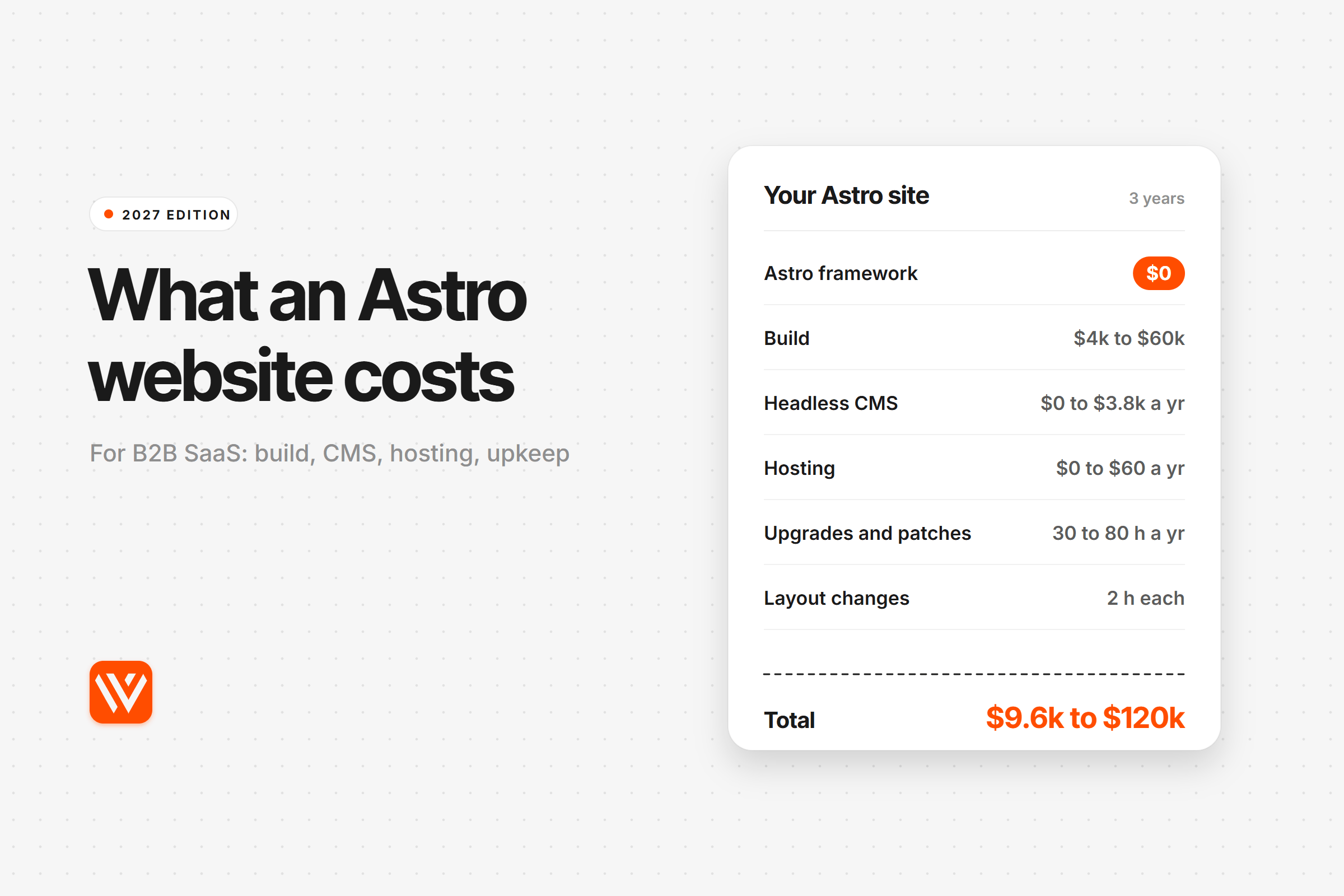
An Astro website for a B2B SaaS company costs $4,000 to $60,000 to build in 2026, depending on stage and who builds it, and $0 to about $4,300 a year in software to run. Astro itself is free. The bill that decides the total is people: the build, then the developer hours every change and upgrade needs.
We build Astro sites and publish our price, so we have a stake in this answer. That's why the numbers here come from public records, not from our proposals: a census of 166 published Astro prices from agencies, studios and marketplaces in seven regions, 41 official price pages for hosting and headless CMS read on 3 November 2026, and a three-year cost model in dollars, pounds and rupees.
Key takeaways
- Published Astro build prices sit in two worlds about ten times apart. The 26 firms in our census that print a price start at a median of $2,000. Lucky Media, one of four agencies in Astro's own partner directory, starts at $25,000.
- For a B2B SaaS site with a CMS, plan on $4,000 to $19,000 at seed, $12,000 to $40,000 at Series A and $30,000 to $60,000 at Series B.
- Software is the small line. A seed-stage site can run on $0 a year: Cloudflare's free static hosting and Sanity's free plan for up to 20 editors.
- Upkeep is the line nobody quotes. Astro shipped two major versions and 114 releases in the 12 months to 3 November 2026, and GitHub lists 22 security advisories for the astro package in the same period.
- Over three years, Astro costs more to run than Webflow for a small US or UK team without a developer. It costs far less in India while the CMS stays on a free plan, and for any team that would otherwise need Webflow's $2,500-a-month Team plan.
How much does an Astro website cost for a B2B SaaS company?
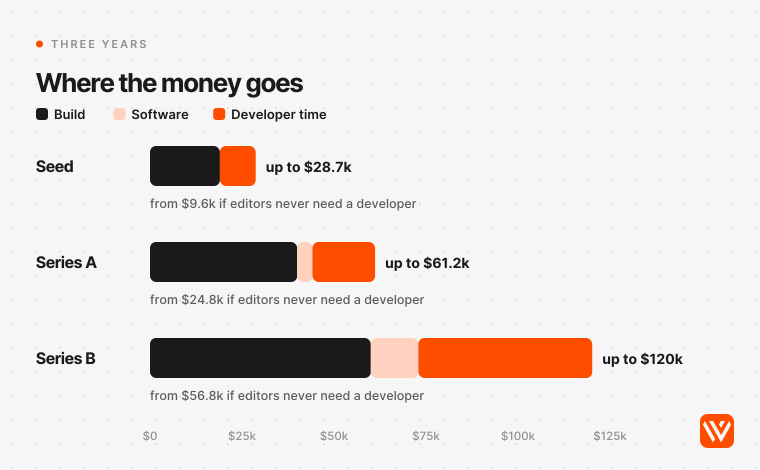
An Astro marketing site with a headless CMS costs $4,000 to $60,000 to build, and about $9,600 to $120,000 over three years once you add software and upkeep. Where you land depends mostly on your stage, because stage sets the number of page templates, editors and locales.
| Stage | Typical scope | Build (published prices) | Software a year | Three-year total, US |
|---|---|---|---|---|
| Seed | About 15 pages, 6 to 8 templates, blog CMS, 3 editors | $4,000 to $19,000 | $0 | $9,600 to $28,700 |
| Series A | About 60 pages, 15 to 25 templates, integrations, migration, 6 editors | $12,000 to $40,000 | About $1,400 | $24,800 to $61,200 |
| Series B | 150+ pages, 3 locales, 12 editors, search, monitoring | $30,000 to $60,000+ | About $4,300 | $56,800 to $120,200 |
How to read it: the build ranges come from prices agencies publish. The seed band runs from our own "from $4,000" to Digital Elevator's top fixed tier of $19,000 for seven templates. The Series A band starts at Hapy's integrations band and ends at Lucky Media's static range, and Series B uses Lucky Media's $30,000 to $60,000 for a site with a headless CMS. The three-year total adds the software and upkeep from our model further down, at US in-house developer rates. The low end assumes your editors never need a developer for a layout change; the high end assumes one to eight such requests a month.
For scale, AI engines asked the same question on 3 November 2026 gave answers from $1,000 (Google AI Mode, citing a non-Astro redesign guide) to $65,000 (also Google AI Mode). ChatGPT, Perplexity, Ask Brave and Gemini all landed between $5,000 and $60,000 for the build. None of them priced upkeep beyond a flat monthly range, and one told readers an Astro site needs no security patches. That's wrong, and it's the part of the bill that grows.
Is Astro free to use?
Yes. Astro is open-source software under the MIT licence, so there's no licence fee, no per-seat charge and no paid tier. You pay for everything around it: the people who build and change the site, a headless CMS if marketers edit content, and hosting if you outgrow the free plans.
Astro has tried selling hosted products before. Astro Studio, a hosted database, was wound down in 2024, and Astro DB was removed in Astro 7. Fred K. Schott, who led the Astro company, wrote on the day it joined Cloudflare that attempts at "paid, hosted primitives" in the ecosystem "fell flat", and that Astro "will remain free, open-source, and MIT-licensed" (Astro blog, 16 January 2026).
So the Cloudflare acquisition doesn't add a cost. Cloudflare's press release commits to keeping Astro open source and deployable elsewhere, and Astro still ships adapters for Netlify, Vercel and any Node server. What the deal changes is the default host. Expect Cloudflare to be the easiest and cheapest place to run Astro, which it already is.
What do agencies and freelancers charge for an Astro website?
Published Astro prices split into two worlds. Small studios and solo developers start at a median of $2,000 for a 5 to 15 page site. Specialist agencies that build for funded SaaS companies start at $25,000. Marketplaces sit far below both, at a median of $80 for a basic Fiverr package.
We collected every Astro price we could find on a firm's own site or listing on 3 November 2026: 166 price points in all, covering 26 firms with a build price, 15 firms that publish none, 39 Fiverr gigs, 24 Upwork listings, 4 Contra listings and 23 salary and day-rate anchors.
| Source | Sample | Median entry price (USD) | Range |
|---|---|---|---|
| Studios and agencies, all regions | 26 firms | $2,000 | $200 to $25,000 |
| Studios, United Kingdom | 4 | $2,273 | $664 to $3,352 |
| Studios, Western Europe | 6 | $4,366 | $560 to $6,717 |
| Contra Astro listings | 4 | $2,106 | $800 to $4,000 |
| Upwork catalog, "astro website" | 24 | $199 | $30 to $1,500 |
| Fiverr basic / top package | 39 gigs | $80 / $350 | $10 to $2,500 |
| Agency hourly rate for Astro work | 4 | $142 an hour | $85 to $175 |
| Care and hosting plans | 7 | $49 a month | $27 to $300 |
Some of the named prices behind those medians: in the UK, Crouch End Media starts at £495 for a 24-hour build, Astrofy charges £900 for up to five pages and £1,900 for up to 12, and WeBuildStores £2,490 for up to ten. In Western Europe, ClickForest in Belgium starts at €3,995 and Codeäffchen in Germany at €5,000. In the US, Digital Elevator sells fixed Astro builds from $6,000, stepping up with the number of page templates, and Lucky Media prices a static Astro site at $25,000 to $40,000, or $30,000 to $60,000 with a headless CMS.
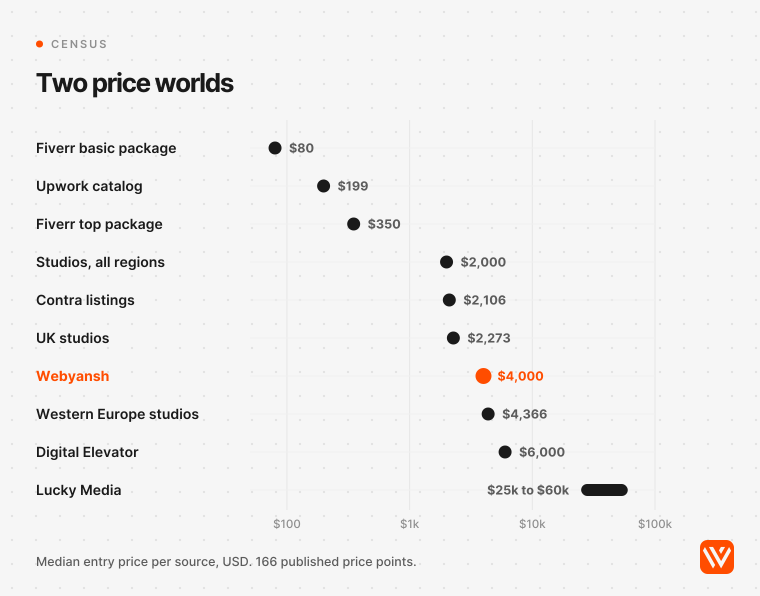
Three things in the census surprised us.
Astro's own partners rarely print a price. Astro's agency directory listed four partners on 3 November 2026. Only Lucky Media publishes a build price on its own site. Bejamas shows a $10,000 minimum on its Clutch profile, in a June 2025 copy.
Nobody prices Astro below their own Webflow or WordPress offer. Where one firm sells both, Astro costs the same or more. Zyner's subscription that adds Astro and Next.js work is $9,000 a month, against $6,000 for its Framer and Webflow plan.
India has no published Astro agency price at all. None of the India-based firms we found that build with Astro prints a number. Indian Fiverr sellers have the lowest basic packages of any region, at a median of $30. We're based in Bengaluru and publish ours: Astro builds start from $4,000 (about ₹3.8 lakh; a lakh is 100,000 rupees) on our Astro development page.
Why do Astro quotes vary by ten times?
Because the low quotes and the high quotes buy different things. A $500 quote is a developer turning a finished design or template into Astro pages. A $25,000 quote includes discovery, design, a content model, a CMS your marketers can use, migration with redirects, integrations and QA. The framework is the same in both.
Template count, not page count, is what moves the price. Lucky Media prices by the number of "unique design blocks", not pages. Digital Elevator's tiers step up with page templates, not pages. A B2B SaaS site usually needs more templates than founders expect: home, pricing, product pages, solutions by persona, an integrations directory, customer stories, a blog, comparison pages and legal. Our Webflow cost guide counts 16 to 23 unique templates for a typical SaaS site, and the count is the same whatever you build it in.
When you compare quotes, check that each one includes:
- The content model: which collections and fields the CMS holds, and who set them up.
- The editor experience: can a marketer add a page from existing blocks without a developer?
- Migration: every old URL mapped and redirected, with metadata carried over.
- Integrations: HubSpot or Salesforce forms, analytics, consent, search.
- Hosting and handover: whose accounts the code, hosting and CMS live in.
- What happens after launch: who applies upgrades and security patches, at what rate.
A quote that skips the last item isn't cheaper. It moves the cost to month four.
How much does a headless CMS add to an Astro site?
Between $0 and about $3,800 a year at list price, depending on how many people edit. Most B2B SaaS marketing teams of three to six editors can run free or close to it. The bill grows when you need roles, locales or 15 seats.
| CMS (list price, 3 Nov 2026) | Free plan | Paid entry | 3 editors a year | 6 editors | 15 editors |
|---|---|---|---|---|---|
| Sanity | Up to 20 seats, 2 roles | Growth, $15 per seat a month | $0 free, $540 Growth | $0 free, $1,080 Growth | $0 free, $2,700 Growth |
| Storyblok | 1 seat | Growth $90.75 a month annual, 5 seats, +$15 a seat | $1,089 | $1,269 | $3,839 (Growth Plus) |
| Contentful | 10 users, 2 locales | Lite $300 a month, 20 users | $0 | $0 | $3,600 |
| CloudCannon | None | Standard $49 a month annual, 3 users, +$10 a user | $588 | $948 | $2,028 (Standard plus 12 users) |
| TinaCMS | 2 users | Team $290 a year, 3 users, +$90 a seat | $290 | $560 | $2,990 (Business) |
| Decap, Keystatic, Payload self-hosted | Open source | Free; you host and maintain it | $0 | $0 | $0 |
| Webflow, for comparison: Premium, Core and limited seats (plans explained) | $888 | $1,428 | $3,048 |
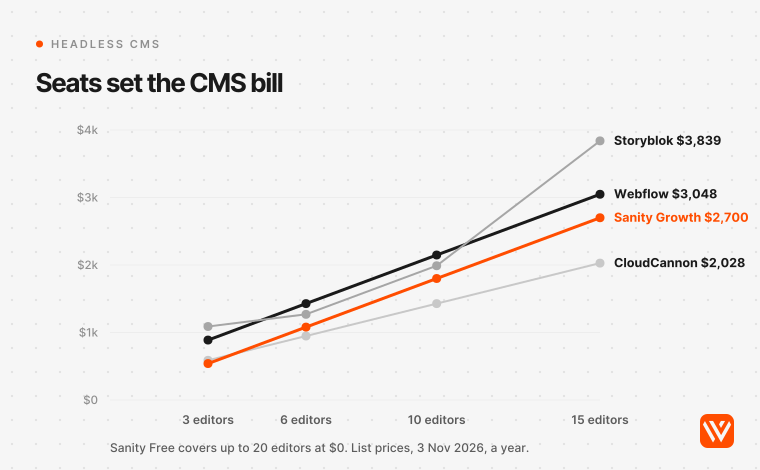
The surprise is how close Webflow and a paid headless CMS land. Finn Dollimore, a Webflow developer who moved his own site to Astro, put Sanity's seat price at "the same price" as a Webflow seat in a June 2026 video. Flow Ninja's October 2026 Astro pricing guide models six editors on Sanity Growth plus Cloudflare at $1,140 a year in software.
Two cautions. Free tiers carry limits that matter later, such as Sanity's two roles and 10,000 documents. And self-hosted options cost nothing in licences but put a database and an admin panel on your developer's list. Payload, the most capable of them, joined Figma, and new Payload Cloud deployments are paused.
What does Astro hosting cost?
For a static B2B SaaS marketing site, usually nothing. Cloudflare serves static files free and without a request limit, and its paid Workers plan starts at $5 a month if a page needs server rendering. The trap is Vercel's free Hobby plan, which forbids commercial use.
| Host | Free plan | Paid entry | Business use on free plan |
|---|---|---|---|
| Cloudflare Workers and Pages | Static assets free and unlimited; 100,000 dynamic requests a day | $5 a month, 10 million requests | Allowed |
| Netlify | 300 credits a month, hard cap | Pro $20 a month, unlimited members | Allowed |
| Vercel | Hobby, 100 GB transfer | Pro $20 per developer seat a month | Not allowed |
| AWS Amplify | 12-month free tier | Pay as you go, $0.15 per GB out | Allowed |
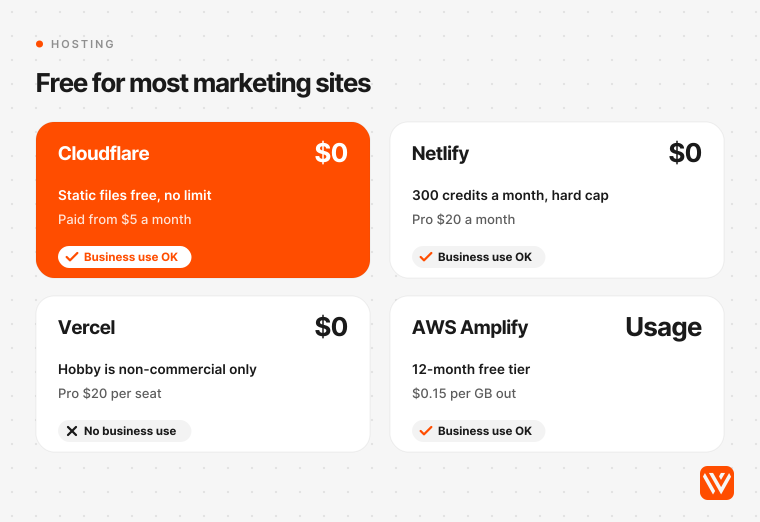
Growth Method's founder Stuart Brameld moved his marketing site from Framer to Astro and wrote that Cloudflare Pages' "generous free tier" cut hosting costs "significantly" (Growth Method, 29 January 2026). The real hosting risk sits on server-rendered sites. Developer Adam Fortuna's Vercel bill rose from $20 to $500 a month when his app moved data loading to the server (February 2025). That was a Next.js app, not an Astro site, but the lesson carries: keep marketing pages static, and server-render only the routes that need it.
What does an Astro website cost to maintain?
Plan on 30 to 80 developer hours a year, plus the time any layout change takes. In the US that's roughly $1,800 to $4,600 a year at in-house rates, or $4,500 to $11,400 at the median agency rate in our census. Astro moves fast, and a site nobody upgrades falls behind within months.
The record from the npm registry for the 12 months to 3 November 2026: 114 stable releases on 95 separate days, and two major versions, Astro 6.0 on 10 March 2026 and Astro 7.0 on 22 June 2026. The current release is 7.4.5. Each major can need code changes, and we budget 16 hours for one on a typical marketing site.
Security adds to it. GitHub's Advisory Database lists 22 advisories for the astro package in those 12 months, rising from 3 in 2024 and 11 in 2025 to 15 so far in 2026. One was critical: remote code execution through AVIF image optimisation, fixed in 7.2.8 on 8 September 2026. Most of Astro's advisories need server rendering or untrusted input, so a static site fed by your own team's CMS is less exposed. Someone still has to read each one and decide. For scale, Next.js had 44 advisories in 2026, most of them in server features, as our Astro vs Next.js comparison shows.
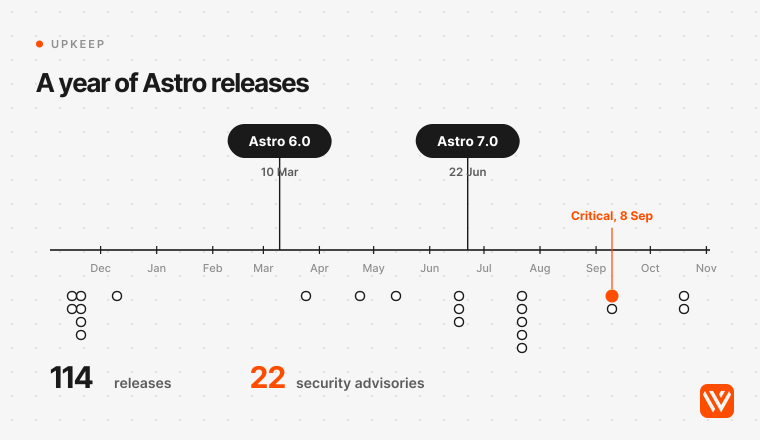
Then the hidden line: changes. On Webflow, a marketer can build a new page layout alone. On Astro, a new layout usually means a developer, unless the build gave your editors a block library in the CMS. StackOne's Guillaume Lebedel described the old pain from the other side: on their Webflow site, "a one-word change cost an hour of someone else's time" (StackOne, March 2026). Who can make a change, and how fast, decides whether Astro saves you money.
Alex Strick van Linschoten, who rebuilt ZenML's 2,224-page site on Astro, put the trade plainly: "you're taking on infrastructure" (ZenML, March 2026). DNS, caching, previews and rollbacks become yours.
Is Astro cheaper than Webflow over three years?
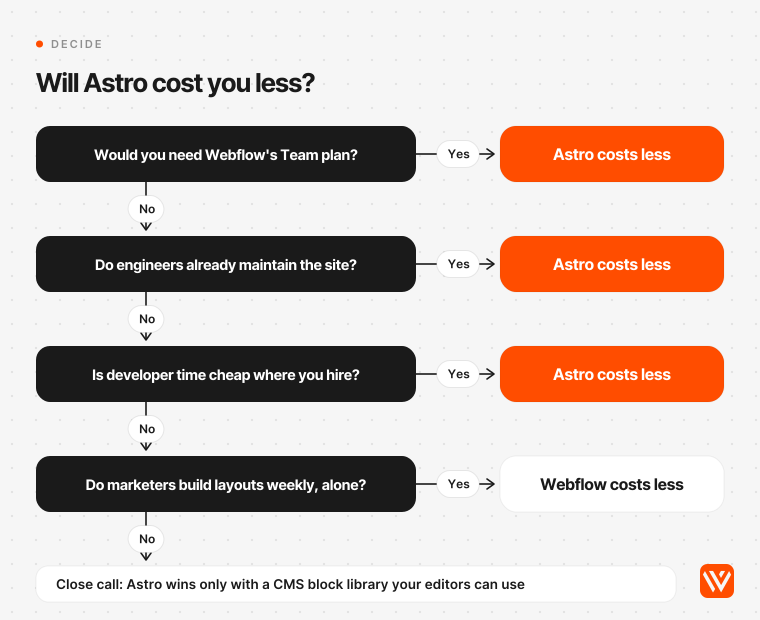
Only in some cases. For a small US or UK team without a developer, Webflow costs less to run. Astro wins in India, where developer time costs less than Webflow's dollar prices, as long as the CMS stays on a free plan. It also wins for teams that already have engineers, and for any team that would otherwise need Webflow's Team plan.
We modelled three years of running each stage's site, after the build. Astro's line is software plus upkeep hours plus layout changes at two developer hours each. Webflow's is its plans and seats plus 12 hours a year of developer help.
| Three-year running cost | Astro, no layout requests | Astro, with layout requests | Webflow |
|---|---|---|---|
| Seed, US | $5,600 | $9,700 (1 a month) | $4,700 |
| Series A, US | $12,800 | $21,200 (2 a month) | $6,400 |
| Series B, US | $26,800 | $60,200 (8 a month) | $11,300 self-serve, $92,100 on Team |
| Seed, UK | £3,900 | £6,800 | £3,400 |
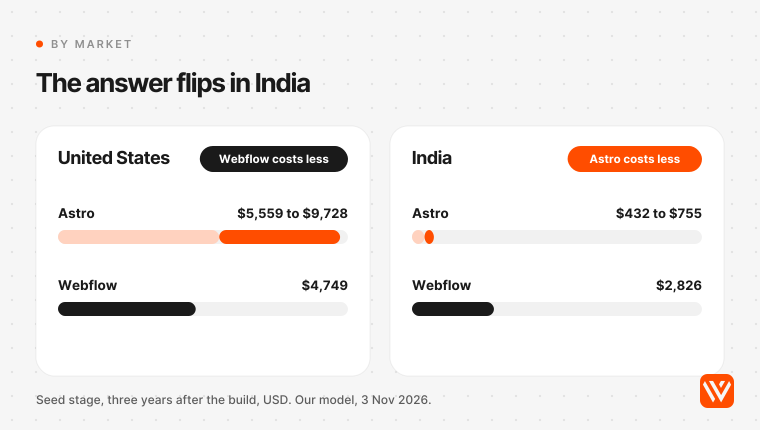
| Seed, India | ₹41,000 (about $430) | ₹71,700 (about $760) | ₹2.68 lakh (about $2,830) |
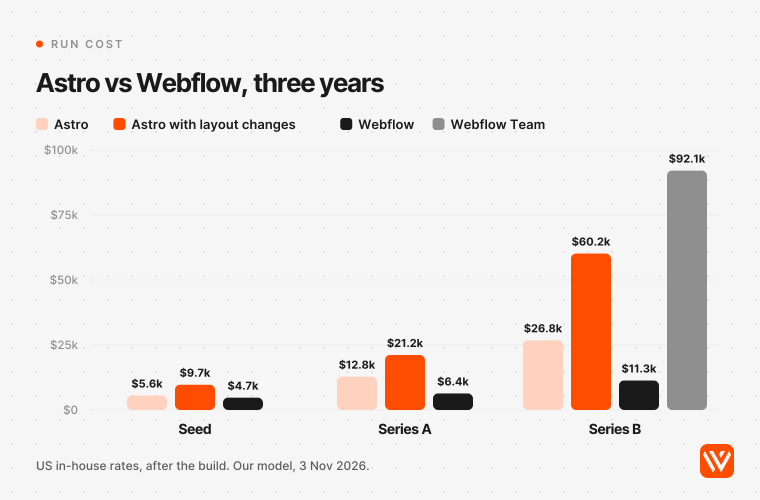
Three findings from the model.
First, Astro's software saving is real but small. At Series A, Sanity Growth for six editors costs $1,080 a year, against $1,428 for Webflow's Premium plan and seats. Put the same team on Sanity's free plan and the Astro line drops by $3,240 over three years. Either way, the difference is smaller than one month of a developer's time.
Second, layout requests decide the US answer. Every request a marketer could have handled alone in Webflow costs about $116 of developer time in Astro at US in-house rates, and roughly $280 at the census median agency rate. At eight a month, that's the biggest line in the model.
Third, Webflow's Team plan flips everything. Page branching, publishing workflows and single-page publishing sit on Team at $2,500 a month on an annual contract (Webflow pricing). A Series B team that needs those features pays about $90,000 over three years for the plan alone. Astro gives the same control through Git and a CMS for a fraction of it. We covered that comparison in depth in Astro vs Webflow.
Practitioners split along the same line. Flow Ninja's Mihajlo Ivanovic writes that "Webflow often costs less in total for marketing teams that have no developer on hand" (October 2026). Quarter Digital's view is the mirror image: "A composed stack is cheaper when engineers are going to maintain it anyway" (October 2026). Both are right. The question is which team you are.
How we built the model: wages are the US median for web developers ($92,650, BLS, May 2025), the UK front-end median (£65,000, ITJobsWatch) and India's front-end average (₹6,82,802, PayScale), each with a 1.3 on-cost over 2,080 hours: $57.91, £40.62 and ₹427 an hour. Upkeep is 32 hours a year at seed, 50 at Series A (the last 12 months' pace of two majors) and 80 at Series B. Exchange rates are from 3 November 2026: $1 = ₹94.93 = £0.746. The hours are our assumptions, so swap in your own.
How do AI coding agents change the cost of an Astro site?
They cut the build and migration bill sharply for teams with someone technical to steer them. Four B2B companies published Webflow-to-Astro rebuilds in 2026 that took days, not months. They don't remove upkeep, and one team that tried it moved back.
| Company | What moved | Time | Who | Published cost |
|---|---|---|---|---|
| Omnia | 800 pages, English and Spanish | 23 hours to DNS cutover | Founder and AI agents | About $1,200 in AI tokens |
| ZenML | 2,224 pages | About a week of evenings | One engineer with Claude Code | About $800 a year saved on Webflow |
| StackOne | Full marketing site | Two weeks | Both founders and a product marketing lead, no agency | New page time from 24 to 72 hours down to 1 to 2 |
| Very Good Ventures | 309 pages | Under two weeks to live | Internal team with AI agents | Not published |
Our forecast, labelled as one: in 2027 the build line for a standard Astro marketing site falls further, and the price gap between a $2,000 studio and a $25,000 agency is decided less by coding hours and more by strategy, content and the editor experience.
The counter-case matters. A lead developer at a mid-sized logistics company wrote on r/webflow in July 2026 that their team moved to Astro and Sanity with AI help, then "moved back to Webflow" because AI-built pages drifted off-brand (r/webflow). Replies blamed missing guardrails: no component system, no design tokens. An agent-built site is cheap to make and expensive to keep consistent unless someone designs the system first.
How does the cost change in the US, the UK and India?
The build price follows local rates; the software doesn't. CMS seats, hosting upgrades and Webflow's plans are priced in dollars everywhere. That makes Astro cheapest relative to Webflow in markets where developer time is cheap, which is why the answer flips in India.
- United States. Studio entry prices start around $1,500 and partner agencies at $25,000. In-house upkeep runs about $58 an hour, so a seed site's three-year running cost is about $5,600 to $9,700.
- United Kingdom. Studios are the cheapest located agencies in our census, with entry prices from £495 to £2,490. Front-end contractors charge a median £500 a day on ITJobsWatch. Running cost at seed is about £3,900 to £6,800 over three years, against £3,400 on Webflow.
- India. At ₹427 an hour in-house, a seed site's upkeep and changes cost about ₹41,000 to ₹72,000 over three years, under a third of Webflow's ₹2.68 lakh. For an Indian SaaS company selling to the US, Astro plus a free CMS tier is the lowest-cost stack in this post. Watch the CMS seats, though: at Series A, six paid Sanity seats cost about ₹3.1 lakh over three years and push Astro's running cost (₹4.6 to ₹5.2 lakh) above Webflow's (₹4.2 lakh). On Sanity's free plan it drops to ₹1.5 to ₹2.1 lakh.
- Western Europe. Agencies start higher than in the UK, at a median of about €3,900 ($4,366), and charge around €120 an hour for changes (Codeäffchen).
When is Astro the wrong budget choice?
Skip Astro, or wait, if:
- Your marketers build new page layouts every week and you have no developer. Each one becomes a ticket, and on US rates the tickets outgrow any software saving within a year. Bill Erickson, a WordPress developer who has moved client sites to Astro, puts it bluntly: "For active publishers, the lack of a full CMS is usually a non-starter" (June 2026).
- Your Webflow site passes Core Web Vitals and your team ships fast. ZenML saved about $800 a year on Webflow and wrote that "alone wouldn't have justified the migration". A rebuild for a smaller bill is rarely worth it.
- Nobody will own upgrades. Two majors a year and a steady flow of advisories need a named person or a care plan.
- You'd pick a $200 marketplace gig to save money. A B2B SaaS site with no content model or redirects costs more to fix later than it saved.
And Astro is the right budget choice if you'd otherwise pay for Webflow's Team plan, your team includes engineers who already work in Git, or you're in a market where developer hours cost less than dollar-priced software.
What should you do next?
Count two things before you ask for quotes, and run your current site through our free AI Design Scorer for a baseline: your unique page templates, and how many layout changes your team made in the last six months without a developer. The first sets your build price. The second tells you whether Astro's running cost will beat Webflow's for you.
Then ask every agency the six quote questions above, and get the upkeep rate in writing. We've built on Astro ourselves, including the First December Films script analyser, an Astro 7 app running on Webflow Cloud. If you want a fixed quote, our Astro development service starts from $4,000, most marketing sites take 6 to 8 weeks, and payment is 50% upfront and 50% at launch. If your numbers point to Webflow, we'll say so.
Sources and method
Build prices: a census of 166 price points published on firms' own sites and listings, read 3 November 2026: 26 firms with an Astro build price and 15 without, Astro's partner directory, 39 Fiverr gigs (each gig's own package list), the first 24 of 257 Upwork Project Catalog results for "astro website", 4 Contra listings, and 23 salary and day-rate anchors. Medians use one entry price per firm; no averages. 13 of the 26 priced firms state no country, so regional medians rest on small samples. Software prices: 41 official pricing pages and APIs, read 3 November 2026. Releases: the npm registry for astro. Security: the GitHub Advisory Database, withdrawn advisories removed. AI answers: ChatGPT, Perplexity, Ask Brave, Google AI Mode and Gemini, asked the same question signed out on 3 November 2026. Cost model: wages, hours and exchange rates as stated in the Webflow comparison section. Data files are kept with the post's research notes.
How much does an Astro website cost?
A B2B SaaS marketing site on Astro costs $4,000 to $60,000 to build in 2026, depending on templates, CMS, migration and who builds it. Small studios start around $2,000 and specialist agencies at $25,000. Running costs add $0 to about $4,300 a year in software, plus developer time for upgrades and changes.
Is Astro free to use?
Yes. Astro is open-source software under the MIT licence, with no licence fee or paid tier, and Cloudflare committed to keeping it open source when it acquired the Astro team in January 2026. You pay for the build, a headless CMS if marketers edit content, hosting beyond free plans, and developer upkeep.
What are the ongoing costs of an Astro website?
Expect $0 to about $4,300 a year in software and 30 to 80 developer hours a year for upgrades and security patches. Astro shipped two major versions and 22 security advisories for its core package in the 12 months to November 2026. Layout changes a marketer can't make alone add more developer time.
Is Astro cheaper than Webflow?
On software, slightly. Over three years, Astro costs more to run than Webflow for a small US or UK team without a developer, because changes need developer hours. It costs less in India on a free CMS plan, for teams with engineers, and for anyone who would otherwise need Webflow's $2,500-a-month Team plan.
How long does it take to build an Astro website?
Most B2B SaaS marketing sites take 6 to 8 weeks from signed scope to launch with an agency. Teams using AI coding agents have moved existing sites much faster: Omnia moved 800 pages in 23 hours and StackOne rebuilt its site in two weeks. Content, design approval and redirects usually set the pace.